Emily Milan, James A. Quirk, Kenjiro Hashi, John Cattermull, Andrew L. Goodwin, James A. Dawson, Mauro Pasta
{"title":"Filling the Gaps in the LiBr-LiOH Phase Diagram: A Study on the High-Temperature Li3(OH)2Br Phase","authors":"Emily Milan, James A. Quirk, Kenjiro Hashi, John Cattermull, Andrew L. Goodwin, James A. Dawson, Mauro Pasta","doi":"10.1021/acs.chemmater.5c00206","DOIUrl":null,"url":null,"abstract":"In this paper, we build on previous work to characterize a phase with stoichiometry Li<sub>3</sub>(OH)<sub>2</sub>Br existing between ∼225 and ∼275 °C in the LiBr-LiOH phase diagram. Diffraction studies indicate that the phase takes a hexagonal unit cell, and theoretical modeling is used to suggest a possible crystal structure. Nuclear magnetic resonance spectroscopy and electrochemical impedance spectroscopy measurements demonstrate excellent lithium-ion dynamics in this phase, with an ionic conductivity of 0.12 S cm<sup>–1</sup> at 250 °C. Initial attempts to stabilize this phase at room temperature through quenching were not successful. Instead, a metastable state demonstrating poor ionic conductivity is found to form. This is an important consideration for the synthesis of Li<sub>2</sub>OHBr solid-state electrolytes (also found in the LiBr-LiOH phase diagram) which are synthesized by cooling through phase fields containing Li<sub>3</sub>(OH)<sub>2</sub>Br, and are hence susceptible to these impurities.","PeriodicalId":33,"journal":{"name":"Chemistry of Materials","volume":"216 1","pages":""},"PeriodicalIF":7.0000,"publicationDate":"2025-04-03","publicationTypes":"Journal Article","fieldsOfStudy":null,"isOpenAccess":false,"openAccessPdf":"","citationCount":"0","resultStr":null,"platform":"Semanticscholar","paperid":null,"PeriodicalName":"Chemistry of Materials","FirstCategoryId":"88","ListUrlMain":"https://doi.org/10.1021/acs.chemmater.5c00206","RegionNum":2,"RegionCategory":"材料科学","ArticlePicture":[],"TitleCN":null,"AbstractTextCN":null,"PMCID":null,"EPubDate":"","PubModel":"","JCR":"Q2","JCRName":"CHEMISTRY, PHYSICAL","Score":null,"Total":0}
引用次数: 0
Abstract
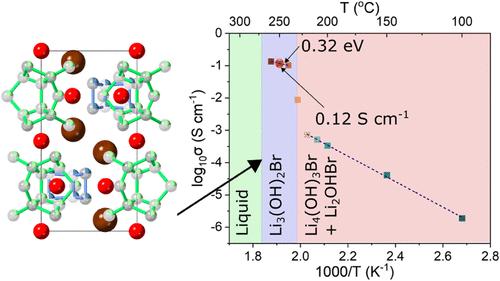
In this paper, we build on previous work to characterize a phase with stoichiometry Li3(OH)2Br existing between ∼225 and ∼275 °C in the LiBr-LiOH phase diagram. Diffraction studies indicate that the phase takes a hexagonal unit cell, and theoretical modeling is used to suggest a possible crystal structure. Nuclear magnetic resonance spectroscopy and electrochemical impedance spectroscopy measurements demonstrate excellent lithium-ion dynamics in this phase, with an ionic conductivity of 0.12 S cm–1 at 250 °C. Initial attempts to stabilize this phase at room temperature through quenching were not successful. Instead, a metastable state demonstrating poor ionic conductivity is found to form. This is an important consideration for the synthesis of Li2OHBr solid-state electrolytes (also found in the LiBr-LiOH phase diagram) which are synthesized by cooling through phase fields containing Li3(OH)2Br, and are hence susceptible to these impurities.
在本文中,我们在之前的工作的基础上,表征了Li3(OH)2Br在LiBr-LiOH相图中存在于~ 225和~ 275℃之间的化学计量Li3(OH)2Br相。衍射研究表明,相呈六角形,并用理论模型提出了可能的晶体结构。核磁共振谱和电化学阻抗谱测量表明,该相具有良好的锂离子动力学,在250°C时离子电导率为0.12 S cm-1。最初试图在室温下通过淬火来稳定这一相是不成功的。相反,亚稳态表明离子电导率差被发现形成。这是合成Li2OHBr固态电解质(也可以在LiBr-LiOH相图中找到)的一个重要考虑因素,这些电解质是通过含有Li3(OH)2Br的相场冷却合成的,因此容易受到这些杂质的影响。
期刊介绍:
The journal Chemistry of Materials focuses on publishing original research at the intersection of materials science and chemistry. The studies published in the journal involve chemistry as a prominent component and explore topics such as the design, synthesis, characterization, processing, understanding, and application of functional or potentially functional materials. The journal covers various areas of interest, including inorganic and organic solid-state chemistry, nanomaterials, biomaterials, thin films and polymers, and composite/hybrid materials. The journal particularly seeks papers that highlight the creation or development of innovative materials with novel optical, electrical, magnetic, catalytic, or mechanical properties. It is essential that manuscripts on these topics have a primary focus on the chemistry of materials and represent a significant advancement compared to prior research. Before external reviews are sought, submitted manuscripts undergo a review process by a minimum of two editors to ensure their appropriateness for the journal and the presence of sufficient evidence of a significant advance that will be of broad interest to the materials chemistry community.



 京公网安备 11010802042870号
京ICP备2023020795号-1
京公网安备 11010802042870号
京ICP备2023020795号-1

 分享
分享
 求助内容:
求助内容: 应助结果提醒方式:
 扫码关注我们
