Gernot T. L. Zug, Sylvia A. Zeiner, Jonas Reuter, Hartmut Schubert, Cäcilia Maichle-Mössmer and Reiner Anwander
{"title":"Half-sandwich scandium methylidenes†","authors":"Gernot T. L. Zug, Sylvia A. Zeiner, Jonas Reuter, Hartmut Schubert, Cäcilia Maichle-Mössmer and Reiner Anwander","doi":"10.1039/D5QI00152H","DOIUrl":null,"url":null,"abstract":"<p >AlMe<small><sub>3</sub></small> sticks, GaMe<small><sub>3</sub></small> quits. A series of Lewis acid stabilized scandium methylidenes with commercially available cyclopentadienyl ligands Cp<small><sup>R</sup></small> (Cp<small><sup>R</sup></small> = C<small><sub>5</sub></small>Me<small><sub>5</sub></small> (Cp*), C<small><sub>5</sub></small>Me<small><sub>4</sub></small>SiMe<small><sub>3</sub></small> (Cp′)) were synthesized. The-salt metathesis reaction of new half-sandwich dichloride precursors Cp<small><sup>R</sup></small>ScCl<small><sub>2</sub></small>(μ-Cl)Li(thf)<small><sub>3</sub></small> with LiAlMe<small><sub>4</sub></small> and AlMe<small><sub>3</sub></small> at ambient temperature yielded [Cp<small><sup>R</sup></small>Sc(AlMe<small><sub>4</sub></small>)Cl]<small><sub>2</sub></small>. [Cp′Sc(AlMe<small><sub>4</sub></small>)Cl]<small><sub>2</sub></small> was further methylated at ambient temperature to yield Cp′Sc(AlMe<small><sub>4</sub></small>)Me. At 70 °C, the reaction of Cp<small><sup>R</sup></small>ScCl<small><sub>2</sub></small>(μ-Cl)Li(thf)<small><sub>3</sub></small> with LiAlMe<small><sub>4</sub></small> and AlMe<small><sub>3</sub></small> led to the formation of Lewis acid stabilized Sc/Al<small><sub>2</sub></small> methylidenes Cp<small><sup>R</sup></small>Sc(CH<small><sub>2</sub></small>)(AlMe<small><sub>3</sub></small>)<small><sub>2</sub></small>. The new mixed Sc/Al/Ga methylidene Cp′Sc(CH<small><sub>2</sub></small>)(AlMe<small><sub>3</sub></small>)(GaMe<small><sub>3</sub></small>) was obtained from the reaction of Cp′Sc(AlMe<small><sub>4</sub></small>)Me with GaMe<small><sub>3</sub></small>. When heated, complex Cp′Sc(CH<small><sub>2</sub></small>)(AlMe<small><sub>3</sub></small>)(GaMe<small><sub>3</sub></small>) converted into the Sc/Al methylidene [Cp′Sc(CH<small><sub>2</sub></small>)<small><sub>2</sub></small>AlMe]<small><sub>3</sub></small><em>via</em> release of the comparatively weak Lewis acid GaMe<small><sub>3</sub></small> and methane. The core of trimeric [Cp′Sc(CH<small><sub>2</sub></small>)<small><sub>2</sub></small>AlMe]<small><sub>3</sub></small> can be described as a triscandacyclohexane {Sc(CH<small><sub>2</sub></small>)}<small><sub>3</sub></small> stabilized by a trialacyclohexane {Al(CH<small><sub>2</sub></small>)}<small><sub>3</sub></small><em>via</em> Pearson hard/hard matching. Complexes Cp<small><sup>R</sup></small>Sc(CH<small><sub>2</sub></small>)(AlMe<small><sub>3</sub></small>)<small><sub>2</sub></small> and [Cp′Sc(CH<small><sub>2</sub></small>)<small><sub>2</sub></small>AlMe]<small><sub>3</sub></small> differ in rigidity, thermal stability and reactivities toward ketones and Lewis bases. The isolated methylidenes were analyzed by <small><sup>1</sup></small>H, <small><sup>13</sup></small>C{<small><sup>1</sup></small>H}, <small><sup>45</sup></small>Sc, and variable temperature <small><sup>1</sup></small>H NMR spectroscopy, SC-XRD, IR spectroscopy, and elemental analysis. Complexes Cp<small><sup>R</sup></small>Sc(CH<small><sub>2</sub></small>)(AlMe<small><sub>3</sub></small>)<small><sub>2</sub></small> feature pronounced Sc⋯HC α-agostic interactions. The reaction of Cp<small><sup>R</sup></small>ScCl<small><sub>2</sub></small>(μ-Cl)Li(thf)<small><sub>3</sub></small> with LiAlMe<small><sub>4</sub></small> and AlMe<small><sub>3</sub></small> was investigated <em>via in situ</em><small><sup>1</sup></small>H and <small><sup>45</sup></small>Sc NMR spectroscopy.</p>","PeriodicalId":79,"journal":{"name":"Inorganic Chemistry Frontiers","volume":" 14","pages":" 4513-4523"},"PeriodicalIF":6.4000,"publicationDate":"2025-04-04","publicationTypes":"Journal Article","fieldsOfStudy":null,"isOpenAccess":false,"openAccessPdf":"https://pubs.rsc.org/en/content/articlepdf/2025/qi/d5qi00152h?page=search","citationCount":"0","resultStr":null,"platform":"Semanticscholar","paperid":null,"PeriodicalName":"Inorganic Chemistry Frontiers","FirstCategoryId":"92","ListUrlMain":"https://pubs.rsc.org/en/content/articlelanding/2025/qi/d5qi00152h","RegionNum":1,"RegionCategory":"化学","ArticlePicture":[],"TitleCN":null,"AbstractTextCN":null,"PMCID":null,"EPubDate":"","PubModel":"","JCR":"Q1","JCRName":"CHEMISTRY, INORGANIC & NUCLEAR","Score":null,"Total":0}
引用次数: 0
Abstract
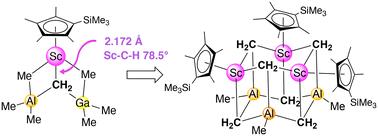
AlMe3 sticks, GaMe3 quits. A series of Lewis acid stabilized scandium methylidenes with commercially available cyclopentadienyl ligands CpR (CpR = C5Me5 (Cp*), C5Me4SiMe3 (Cp′)) were synthesized. The-salt metathesis reaction of new half-sandwich dichloride precursors CpRScCl2(μ-Cl)Li(thf)3 with LiAlMe4 and AlMe3 at ambient temperature yielded [CpRSc(AlMe4)Cl]2. [Cp′Sc(AlMe4)Cl]2 was further methylated at ambient temperature to yield Cp′Sc(AlMe4)Me. At 70 °C, the reaction of CpRScCl2(μ-Cl)Li(thf)3 with LiAlMe4 and AlMe3 led to the formation of Lewis acid stabilized Sc/Al2 methylidenes CpRSc(CH2)(AlMe3)2. The new mixed Sc/Al/Ga methylidene Cp′Sc(CH2)(AlMe3)(GaMe3) was obtained from the reaction of Cp′Sc(AlMe4)Me with GaMe3. When heated, complex Cp′Sc(CH2)(AlMe3)(GaMe3) converted into the Sc/Al methylidene [Cp′Sc(CH2)2AlMe]3via release of the comparatively weak Lewis acid GaMe3 and methane. The core of trimeric [Cp′Sc(CH2)2AlMe]3 can be described as a triscandacyclohexane {Sc(CH2)}3 stabilized by a trialacyclohexane {Al(CH2)}3via Pearson hard/hard matching. Complexes CpRSc(CH2)(AlMe3)2 and [Cp′Sc(CH2)2AlMe]3 differ in rigidity, thermal stability and reactivities toward ketones and Lewis bases. The isolated methylidenes were analyzed by 1H, 13C{1H}, 45Sc, and variable temperature 1H NMR spectroscopy, SC-XRD, IR spectroscopy, and elemental analysis. Complexes CpRSc(CH2)(AlMe3)2 feature pronounced Sc⋯HC α-agostic interactions. The reaction of CpRScCl2(μ-Cl)Li(thf)3 with LiAlMe4 and AlMe3 was investigated via in situ1H and 45Sc NMR spectroscopy.



 京公网安备 11010802042870号
京ICP备2023020795号-1
京公网安备 11010802042870号
京ICP备2023020795号-1

 分享
分享
 求助内容:
求助内容: 应助结果提醒方式:
 扫码关注我们
