Chen-Xi Yu, Le Ye, Hao Zhuo, Yun-Fan Yan and Wei-Xiong Zhang
{"title":"Barium(ii)-based molecular perovskite energetic compounds for next-generation pyrotechnic materials†","authors":"Chen-Xi Yu, Le Ye, Hao Zhuo, Yun-Fan Yan and Wei-Xiong Zhang","doi":"10.1039/D5QI00442J","DOIUrl":null,"url":null,"abstract":"<p >Traditional pyrotechnic compositions formed by mechanically mixing flammable and oxidative agents face the problems of complex formulations, inaccurate chemical stoichiometry, and inefficient colour-producing reactions. Emerging molecular perovskite energetic materials with embedded ternary ions have evolved into a new platform for developing explosives, propellants, ignition materials, and energetic biocides, taking advantage of their easy preparation and high adjustability. However, their potential in pyrotechnic applications has not yet been investigated. Herein, by assembling barium(<small>II</small>) perchlorate with imidazolium (Him<small><sup>+</sup></small>) and quinuclidinium (Hqe<small><sup>+</sup></small>) ions, we obtained two new energetic compounds, (Him)(Ba)(ClO<small><sub>4</sub></small>)<small><sub>3</sub></small> (IBP) with a cubic perovskite structure, and (Hqe)<small><sub>2</sub></small>(Ba)(ClO<small><sub>4</sub></small>)<small><sub>4</sub></small> (QBP) with a layered perovskite structure. Both IBP and QBP have decomposition peak temperatures exceeding 290 °C and much higher moisture stabilities than barium perchlorate. With a layered structure, QBP has significantly lower friction sensitivity (144 N) than IBP (5 N). Moreover, the tight stacking of barium(<small>II</small>), oxidative perchlorate ions, and carbon-rich fuel components at the molecular level allows QBP to exhibit high-efficiency and stable combustion, outputting a maximum combustion pressure of up to 550 kPa, a maximum pressure pulse rate of up to 10.48 MPa s<small><sup>−1</sup></small>, and a bright green flame. These findings demonstrate well that molecular perovskite energetic compounds integrating a luminescent component, oxidative anions, and organic cations are promising contenders for next-generation pyrotechnic materials.</p>","PeriodicalId":79,"journal":{"name":"Inorganic Chemistry Frontiers","volume":" 15","pages":" 4645-4652"},"PeriodicalIF":6.4000,"publicationDate":"2025-04-04","publicationTypes":"Journal Article","fieldsOfStudy":null,"isOpenAccess":false,"openAccessPdf":"","citationCount":"0","resultStr":null,"platform":"Semanticscholar","paperid":null,"PeriodicalName":"Inorganic Chemistry Frontiers","FirstCategoryId":"92","ListUrlMain":"https://pubs.rsc.org/en/content/articlelanding/2025/qi/d5qi00442j","RegionNum":1,"RegionCategory":"化学","ArticlePicture":[],"TitleCN":null,"AbstractTextCN":null,"PMCID":null,"EPubDate":"","PubModel":"","JCR":"Q1","JCRName":"CHEMISTRY, INORGANIC & NUCLEAR","Score":null,"Total":0}
引用次数: 0
Abstract
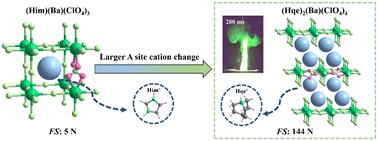
Traditional pyrotechnic compositions formed by mechanically mixing flammable and oxidative agents face the problems of complex formulations, inaccurate chemical stoichiometry, and inefficient colour-producing reactions. Emerging molecular perovskite energetic materials with embedded ternary ions have evolved into a new platform for developing explosives, propellants, ignition materials, and energetic biocides, taking advantage of their easy preparation and high adjustability. However, their potential in pyrotechnic applications has not yet been investigated. Herein, by assembling barium(II) perchlorate with imidazolium (Him+) and quinuclidinium (Hqe+) ions, we obtained two new energetic compounds, (Him)(Ba)(ClO4)3 (IBP) with a cubic perovskite structure, and (Hqe)2(Ba)(ClO4)4 (QBP) with a layered perovskite structure. Both IBP and QBP have decomposition peak temperatures exceeding 290 °C and much higher moisture stabilities than barium perchlorate. With a layered structure, QBP has significantly lower friction sensitivity (144 N) than IBP (5 N). Moreover, the tight stacking of barium(II), oxidative perchlorate ions, and carbon-rich fuel components at the molecular level allows QBP to exhibit high-efficiency and stable combustion, outputting a maximum combustion pressure of up to 550 kPa, a maximum pressure pulse rate of up to 10.48 MPa s−1, and a bright green flame. These findings demonstrate well that molecular perovskite energetic compounds integrating a luminescent component, oxidative anions, and organic cations are promising contenders for next-generation pyrotechnic materials.



 京公网安备 11010802042870号
京ICP备2023020795号-1
京公网安备 11010802042870号
京ICP备2023020795号-1

 分享
分享
 求助内容:
求助内容: 应助结果提醒方式:
 扫码关注我们
