{"title":"A Systematic Study on Trivalent Salt Cationic Specificity through Polyelectrolyte Brushes","authors":"Qing-Hai Hao, Han-Yang Qian, Ming-Lu Chao, Hong-Yan Zhang, Hong-Ge Tan, Bing Miao","doi":"10.1021/acs.macromol.4c02664","DOIUrl":null,"url":null,"abstract":"Ionic specificity is of fundamental importance in understanding both the equilibrium and dynamic properties of electrolyte systems. Herein, we report a systematic simulation study of the ionic specificity of trivalent salt ions in a planar polyelectrolyte (PE) brush system. By exploring a wide parameter space of salt ionic size and salt concentration, we find that ionic specificity significantly affects and regulates the surface structures and dynamics of the PE brush. Specifically, solely varying trivalent salt cationic size, which represents ionic specificity, induces a sequence of structural transitions, from a homogeneously collapsed brush layer, to a laterally heterogeneous pinned micelle, to a homogeneously reswelling layer, which is confirmed through analyzing the nonmonotonic brush height variation, and both the real-space morphologies and the reciprocal-space structure factor. Salt concentration, as another key controlling parameter for ionic solutions, also regulates brush morphologies quite differently depending on the salt cationic size. Beyond these equilibrium properties, the dynamics of the system are also studied by analyzing diffusion coefficients and the probability density function of components to clarify the ionic specificity effect. These findings are explained through a careful analysis of the combined and competing effects of the electrostatic screening of small ions, the multivalent ion-induced electrostatic bridging, and the excluded volume interaction of bulky ions. Our results provide both an important reference for a fundamental understanding of ionic specificity and a practical guide for designing smart stimuli-responsive materials based on the PE brush.","PeriodicalId":51,"journal":{"name":"Macromolecules","volume":"21 1","pages":""},"PeriodicalIF":5.2000,"publicationDate":"2025-04-03","publicationTypes":"Journal Article","fieldsOfStudy":null,"isOpenAccess":false,"openAccessPdf":"","citationCount":"0","resultStr":null,"platform":"Semanticscholar","paperid":null,"PeriodicalName":"Macromolecules","FirstCategoryId":"92","ListUrlMain":"https://doi.org/10.1021/acs.macromol.4c02664","RegionNum":1,"RegionCategory":"化学","ArticlePicture":[],"TitleCN":null,"AbstractTextCN":null,"PMCID":null,"EPubDate":"","PubModel":"","JCR":"Q1","JCRName":"POLYMER SCIENCE","Score":null,"Total":0}
引用次数: 0
Abstract
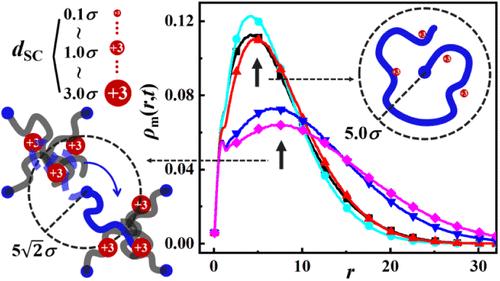
Ionic specificity is of fundamental importance in understanding both the equilibrium and dynamic properties of electrolyte systems. Herein, we report a systematic simulation study of the ionic specificity of trivalent salt ions in a planar polyelectrolyte (PE) brush system. By exploring a wide parameter space of salt ionic size and salt concentration, we find that ionic specificity significantly affects and regulates the surface structures and dynamics of the PE brush. Specifically, solely varying trivalent salt cationic size, which represents ionic specificity, induces a sequence of structural transitions, from a homogeneously collapsed brush layer, to a laterally heterogeneous pinned micelle, to a homogeneously reswelling layer, which is confirmed through analyzing the nonmonotonic brush height variation, and both the real-space morphologies and the reciprocal-space structure factor. Salt concentration, as another key controlling parameter for ionic solutions, also regulates brush morphologies quite differently depending on the salt cationic size. Beyond these equilibrium properties, the dynamics of the system are also studied by analyzing diffusion coefficients and the probability density function of components to clarify the ionic specificity effect. These findings are explained through a careful analysis of the combined and competing effects of the electrostatic screening of small ions, the multivalent ion-induced electrostatic bridging, and the excluded volume interaction of bulky ions. Our results provide both an important reference for a fundamental understanding of ionic specificity and a practical guide for designing smart stimuli-responsive materials based on the PE brush.
期刊介绍:
Macromolecules publishes original, fundamental, and impactful research on all aspects of polymer science. Topics of interest include synthesis (e.g., controlled polymerizations, polymerization catalysis, post polymerization modification, new monomer structures and polymer architectures, and polymerization mechanisms/kinetics analysis); phase behavior, thermodynamics, dynamic, and ordering/disordering phenomena (e.g., self-assembly, gelation, crystallization, solution/melt/solid-state characteristics); structure and properties (e.g., mechanical and rheological properties, surface/interfacial characteristics, electronic and transport properties); new state of the art characterization (e.g., spectroscopy, scattering, microscopy, rheology), simulation (e.g., Monte Carlo, molecular dynamics, multi-scale/coarse-grained modeling), and theoretical methods. Renewable/sustainable polymers, polymer networks, responsive polymers, electro-, magneto- and opto-active macromolecules, inorganic polymers, charge-transporting polymers (ion-containing, semiconducting, and conducting), nanostructured polymers, and polymer composites are also of interest. Typical papers published in Macromolecules showcase important and innovative concepts, experimental methods/observations, and theoretical/computational approaches that demonstrate a fundamental advance in the understanding of polymers.



 京公网安备 11010802042870号
京ICP备2023020795号-1
京公网安备 11010802042870号
京ICP备2023020795号-1

 分享
分享
 求助内容:
求助内容: 应助结果提醒方式:
 扫码关注我们
