{"title":"Synergism between cyclopentadienyl and amidinate ligands affording anionic scandium terminal imido complexes†","authors":"Tianyu Li, Dajiang Huang, Miaomiao Zhu, Junnian Wei and Wen-Xiong Zhang","doi":"10.1039/D5QI00390C","DOIUrl":null,"url":null,"abstract":"<p >Terminal rare-earth imido complexes containing metal–nitrogen double bonds have received more attention in recent years due to their importance in group transformation and catalytic reactions. However, due to the large difference in the orbital energy between rare-earth metals and nitrogen, their synthesis is difficult and the product is easy to polymerize. Here, we use the combination of Cp* and amidinate ligands to inhibit the tetramerization and provide exclusively the first anionic rare-earth(<small>III</small>) terminal imido complexes with both electron-donating and electron-withdrawing groups. Chemical bond analysis further confirms the double-bond character, and the strong polarity of the RE<img>N bond, which could be described as three orbital interactions, is primarily derived from the imido nitrogen, while the contribution from the rare-earth metal is limited. The mechanistic study using DFT calculations shows that the formation of the RE<img>N bond involves the activation of two N–H bonds. Furthermore, the anionic rare-earth(<small>III</small>) terminal imido complex shows some interesting and unique reactivity towards isocyanates, isonitriles, phenylsilanes, and W(CO)<small><sub>6</sub></small>. The work extends the multiple-bond chemistry between rare-earth metals and main group elements, and is expected to inspire the development of rare-earth organometallic chemistry and related fields.</p>","PeriodicalId":79,"journal":{"name":"Inorganic Chemistry Frontiers","volume":" 11","pages":" 3791-3799"},"PeriodicalIF":6.4000,"publicationDate":"2025-04-04","publicationTypes":"Journal Article","fieldsOfStudy":null,"isOpenAccess":false,"openAccessPdf":"","citationCount":"0","resultStr":null,"platform":"Semanticscholar","paperid":null,"PeriodicalName":"Inorganic Chemistry Frontiers","FirstCategoryId":"92","ListUrlMain":"https://pubs.rsc.org/en/content/articlelanding/2025/qi/d5qi00390c","RegionNum":1,"RegionCategory":"化学","ArticlePicture":[],"TitleCN":null,"AbstractTextCN":null,"PMCID":null,"EPubDate":"","PubModel":"","JCR":"Q1","JCRName":"CHEMISTRY, INORGANIC & NUCLEAR","Score":null,"Total":0}
引用次数: 0
Abstract
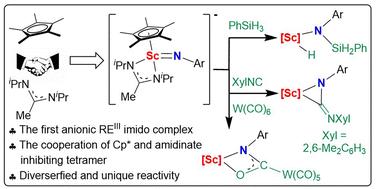
Terminal rare-earth imido complexes containing metal–nitrogen double bonds have received more attention in recent years due to their importance in group transformation and catalytic reactions. However, due to the large difference in the orbital energy between rare-earth metals and nitrogen, their synthesis is difficult and the product is easy to polymerize. Here, we use the combination of Cp* and amidinate ligands to inhibit the tetramerization and provide exclusively the first anionic rare-earth(III) terminal imido complexes with both electron-donating and electron-withdrawing groups. Chemical bond analysis further confirms the double-bond character, and the strong polarity of the REN bond, which could be described as three orbital interactions, is primarily derived from the imido nitrogen, while the contribution from the rare-earth metal is limited. The mechanistic study using DFT calculations shows that the formation of the REN bond involves the activation of two N–H bonds. Furthermore, the anionic rare-earth(III) terminal imido complex shows some interesting and unique reactivity towards isocyanates, isonitriles, phenylsilanes, and W(CO)6. The work extends the multiple-bond chemistry between rare-earth metals and main group elements, and is expected to inspire the development of rare-earth organometallic chemistry and related fields.




 京公网安备 11010802042870号
京ICP备2023020795号-1
京公网安备 11010802042870号
京ICP备2023020795号-1

 分享
分享
 求助内容:
求助内容: 应助结果提醒方式:
 扫码关注我们
