Debashis Sen, Nicholas Volya, Yusuf Muhammed, Robert A. Lazenby
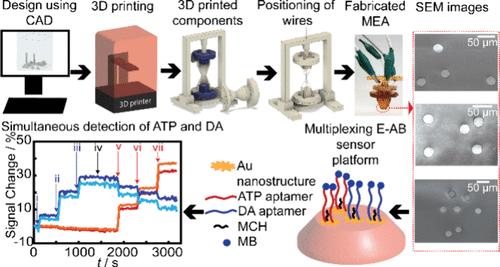
{"title":"Fabrication and Characterization of a Tunable Microelectrode Array Probe for Simultaneous Multiplexed Electrochemical Detection","authors":"Debashis Sen, Nicholas Volya, Yusuf Muhammed, Robert A. Lazenby","doi":"10.1021/acs.analchem.4c05175","DOIUrl":null,"url":null,"abstract":"Individually addressable microelectrode arrays (MEAs) enable the simultaneous and independent measurement of multiple analytes and benefit from a small size scale, which enables highly localized electrochemical detection. In this work, we describe a new methodology to fabricate low-cost and tunable MEA probes in which the number, spatial arrangement, and spacing of the electrodes and electrode material can be changed and controlled. This was achieved using a 3D printed support assembly to position wires of the electrode material into designated positions and a mold to seal the electrodes in place using epoxy resin. After curing of the epoxy, mechanical polishing exposed the surface of closely spaced disk microelectrodes embedded in the insulating material, which formed the MEA. The individual electrodes of the array were characterized using electrochemical methods and optical and electron microscopy to evaluate the surface quality and the integrity of the seal with the insulating epoxy. To validate the fabrication method and to demonstrate the controlled electrode spacing, we used a dual-disk electrode device, while four-, five-, and seven-electrode probes were used to demonstrate some of the different numbers and geometric arrangements of electrodes that are possible. While the developed probes have numerous potential applications, including as probes or substrates in scanning electrochemical microscopy, we fabricated electrochemical aptamer-based sensors on the individual electrodes, for the simultaneous detection of adenosine triphosphate and dopamine in phosphate-buffered saline solution, with and without 10% fetal bovine serum.","PeriodicalId":27,"journal":{"name":"Analytical Chemistry","volume":"37 1","pages":""},"PeriodicalIF":6.7000,"publicationDate":"2025-04-04","publicationTypes":"Journal Article","fieldsOfStudy":null,"isOpenAccess":false,"openAccessPdf":"","citationCount":"0","resultStr":null,"platform":"Semanticscholar","paperid":null,"PeriodicalName":"Analytical Chemistry","FirstCategoryId":"92","ListUrlMain":"https://doi.org/10.1021/acs.analchem.4c05175","RegionNum":1,"RegionCategory":"化学","ArticlePicture":[],"TitleCN":null,"AbstractTextCN":null,"PMCID":null,"EPubDate":"","PubModel":"","JCR":"Q1","JCRName":"CHEMISTRY, ANALYTICAL","Score":null,"Total":0}
引用次数: 0
Abstract
Individually addressable microelectrode arrays (MEAs) enable the simultaneous and independent measurement of multiple analytes and benefit from a small size scale, which enables highly localized electrochemical detection. In this work, we describe a new methodology to fabricate low-cost and tunable MEA probes in which the number, spatial arrangement, and spacing of the electrodes and electrode material can be changed and controlled. This was achieved using a 3D printed support assembly to position wires of the electrode material into designated positions and a mold to seal the electrodes in place using epoxy resin. After curing of the epoxy, mechanical polishing exposed the surface of closely spaced disk microelectrodes embedded in the insulating material, which formed the MEA. The individual electrodes of the array were characterized using electrochemical methods and optical and electron microscopy to evaluate the surface quality and the integrity of the seal with the insulating epoxy. To validate the fabrication method and to demonstrate the controlled electrode spacing, we used a dual-disk electrode device, while four-, five-, and seven-electrode probes were used to demonstrate some of the different numbers and geometric arrangements of electrodes that are possible. While the developed probes have numerous potential applications, including as probes or substrates in scanning electrochemical microscopy, we fabricated electrochemical aptamer-based sensors on the individual electrodes, for the simultaneous detection of adenosine triphosphate and dopamine in phosphate-buffered saline solution, with and without 10% fetal bovine serum.
可单独寻址的微电极阵列(MEAs)能够同时独立测量多种分析物,而且体积小,可实现高度局部电化学检测。在这项工作中,我们介绍了一种制造低成本、可调式 MEA 探针的新方法,其中电极的数量、空间排列和间距以及电极材料都可以改变和控制。这是利用三维打印的支撑组件将电极材料线定位到指定位置,并利用环氧树脂模具将电极密封到位。环氧树脂固化后,机械抛光暴露出嵌入绝缘材料中的紧密间隔的圆盘微电极表面,从而形成 MEA。使用电化学方法、光学和电子显微镜对阵列的各个电极进行了表征,以评估表面质量以及与绝缘环氧树脂密封的完整性。为了验证制作方法并演示可控的电极间距,我们使用了双盘电极装置,同时还使用了四电极、五电极和七电极探针来演示可能存在的一些不同数量和几何排列的电极。所开发的探针有许多潜在应用,包括用作扫描电化学显微镜的探针或基底,同时我们还在单个电极上制作了基于电化学适配体的传感器,用于同时检测磷酸盐缓冲盐溶液(含或不含 10%胎牛血清)中的三磷酸腺苷和多巴胺。
期刊介绍:
Analytical Chemistry, a peer-reviewed research journal, focuses on disseminating new and original knowledge across all branches of analytical chemistry. Fundamental articles may explore general principles of chemical measurement science and need not directly address existing or potential analytical methodology. They can be entirely theoretical or report experimental results. Contributions may cover various phases of analytical operations, including sampling, bioanalysis, electrochemistry, mass spectrometry, microscale and nanoscale systems, environmental analysis, separations, spectroscopy, chemical reactions and selectivity, instrumentation, imaging, surface analysis, and data processing. Papers discussing known analytical methods should present a significant, original application of the method, a notable improvement, or results on an important analyte.



 京公网安备 11010802042870号
京ICP备2023020795号-1
京公网安备 11010802042870号
京ICP备2023020795号-1

 分享
分享
 求助内容:
求助内容: 应助结果提醒方式:
 扫码关注我们
