Ilya V. Chepkasov , Viktor S. Baidyshev , Anastasiia V. Iosimovska , Ivan S. Zamulin , Alexander G. Kvashnin
{"title":"Adsorption properties of crystalline and amorphous PdIr nanoparticles. A systematic first-principles study","authors":"Ilya V. Chepkasov , Viktor S. Baidyshev , Anastasiia V. Iosimovska , Ivan S. Zamulin , Alexander G. Kvashnin","doi":"10.1016/j.jcat.2025.116102","DOIUrl":null,"url":null,"abstract":"<div><div>The great interest in metal nanoparticles is due to the fact that the transition from micro to nano size leads to huge changes in the physical and chemical properties of the material. The local atomic structure and composition can significantly influence the properties of nanoparticles. First-principles calculations are used to study the influence of the structure and chemnical ordering of IrPd nanoparticles on the electronic properties, charge distribution and adsorption energy of O, H, CO, NO, OH. Three different types of PdIr bimetallic nanoparticles with different chemical ordering are considered, namely Pd-core/Ir-shell (Pd@Ir), Ir-core/Pd-shell (Ir@Pd), and bimetallic alloy (Pd-Ir) particles consisting of 79 and 321 atoms with fcc and amorphous structures. The electronic and adsorption properties of the proposed nanoparticles are extensively studied in terms of their ability to adsorb O, H, CO, NO, OH, which opens up the possibility of fine-tuning their properties by modifying the atomic structure and composition. By adjusting the core–shell ratio, the adsorption energy on the nanoparticle surface can be fine-tuned, especially in fcc nanoparticles. This results in a narrower range of adsorption energies, which cannot be achieved with bimetallic alloys. In the case of amorphous nanoparticles, the adsorption energy is highly variable because to there are many non-equivalent adsorption sites on the surface.</div></div>","PeriodicalId":346,"journal":{"name":"Journal of Catalysis","volume":"447 ","pages":"Article 116102"},"PeriodicalIF":6.5000,"publicationDate":"2025-04-03","publicationTypes":"Journal Article","fieldsOfStudy":null,"isOpenAccess":false,"openAccessPdf":"","citationCount":"0","resultStr":null,"platform":"Semanticscholar","paperid":null,"PeriodicalName":"Journal of Catalysis","FirstCategoryId":"92","ListUrlMain":"https://www.sciencedirect.com/science/article/pii/S0021951725001678","RegionNum":1,"RegionCategory":"化学","ArticlePicture":[],"TitleCN":null,"AbstractTextCN":null,"PMCID":null,"EPubDate":"","PubModel":"","JCR":"Q2","JCRName":"CHEMISTRY, PHYSICAL","Score":null,"Total":0}
引用次数: 0
Abstract
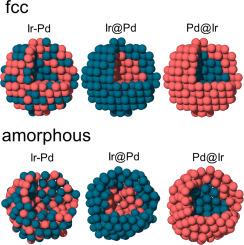
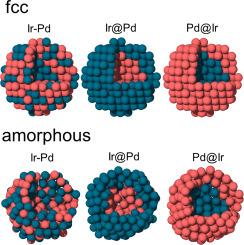
The great interest in metal nanoparticles is due to the fact that the transition from micro to nano size leads to huge changes in the physical and chemical properties of the material. The local atomic structure and composition can significantly influence the properties of nanoparticles. First-principles calculations are used to study the influence of the structure and chemnical ordering of IrPd nanoparticles on the electronic properties, charge distribution and adsorption energy of O, H, CO, NO, OH. Three different types of PdIr bimetallic nanoparticles with different chemical ordering are considered, namely Pd-core/Ir-shell (Pd@Ir), Ir-core/Pd-shell (Ir@Pd), and bimetallic alloy (Pd-Ir) particles consisting of 79 and 321 atoms with fcc and amorphous structures. The electronic and adsorption properties of the proposed nanoparticles are extensively studied in terms of their ability to adsorb O, H, CO, NO, OH, which opens up the possibility of fine-tuning their properties by modifying the atomic structure and composition. By adjusting the core–shell ratio, the adsorption energy on the nanoparticle surface can be fine-tuned, especially in fcc nanoparticles. This results in a narrower range of adsorption energies, which cannot be achieved with bimetallic alloys. In the case of amorphous nanoparticles, the adsorption energy is highly variable because to there are many non-equivalent adsorption sites on the surface.
期刊介绍:
The Journal of Catalysis publishes scholarly articles on both heterogeneous and homogeneous catalysis, covering a wide range of chemical transformations. These include various types of catalysis, such as those mediated by photons, plasmons, and electrons. The focus of the studies is to understand the relationship between catalytic function and the underlying chemical properties of surfaces and metal complexes.
The articles in the journal offer innovative concepts and explore the synthesis and kinetics of inorganic solids and homogeneous complexes. Furthermore, they discuss spectroscopic techniques for characterizing catalysts, investigate the interaction of probes and reacting species with catalysts, and employ theoretical methods.
The research presented in the journal should have direct relevance to the field of catalytic processes, addressing either fundamental aspects or applications of catalysis.



 京公网安备 11010802042870号
京ICP备2023020795号-1
京公网安备 11010802042870号
京ICP备2023020795号-1

 分享
分享
 求助内容:
求助内容: 应助结果提醒方式:
 扫码关注我们
