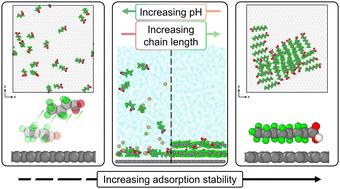
{"title":"PFAS self-assembly and adsorption dynamics on graphene: molecular insights into chemical and environmental influences†","authors":"Bradley G. Lamb and Boran Ma","doi":"10.1039/D4NR04995K","DOIUrl":null,"url":null,"abstract":"<p >Per- and polyfluoroalkyl substances (PFAS) are a class of chemicals known for their persistence in the environment due to their amphiphilic nature and the strength of carbon–fluorine bonds. While these properties lead to various industrial and commercial applications including firefighting foams and non-stick coatings, these same characteristics also result in significant environmental and health concerns. This study employs atomistic molecular dynamics (MD) simulations to achieve molecular level insights into PFAS self-assembly and adsorption dynamics, to inform PFAS water remediation. MD simulations of PFAS with different headgroup chemistries and chain lengths on a graphene sorbent surface under varied pH conditions were performed. These simulation results elucidated the impacts of headgroup, chain length, and pH on PFAS adsorption behavior. At neutral pH, PFAS headgroups are fully deprotonated, causing electrostatic repulsions that lead to micelle-like aggregate formation in solution, hindering adsorption. Conversely, at acidic pH, these repulsions are diminished due to protonated headgroups, resulting in higher adsorption percentage with large, stacked aggregates that fully adsorb onto the sorbent. Additionally, chain length notably influenced aggregation, with longer chains forming larger aggregates and achieving more stable adsorption compared to shorter chains. Furthermore, perfluoro-sulfonic acids (PFSAs) displayed stronger adsorption and greater aggregate order than perfluoro-carboxylic acids (PFCAs) in general. These findings underscore the complex interplay between PFAS structure and the dynamics of their adsorption behaviors, as well as the potential of pH as a tuning parameter to enhance PFAS adsorption stability and thereby improve PFAS removal efficiency.</p>","PeriodicalId":92,"journal":{"name":"Nanoscale","volume":" 17","pages":" 10632-10643"},"PeriodicalIF":5.1000,"publicationDate":"2025-04-04","publicationTypes":"Journal Article","fieldsOfStudy":null,"isOpenAccess":false,"openAccessPdf":"https://pubs.rsc.org/en/content/articlepdf/2025/nr/d4nr04995k?page=search","citationCount":"0","resultStr":null,"platform":"Semanticscholar","paperid":null,"PeriodicalName":"Nanoscale","FirstCategoryId":"88","ListUrlMain":"https://pubs.rsc.org/en/content/articlelanding/2025/nr/d4nr04995k","RegionNum":3,"RegionCategory":"材料科学","ArticlePicture":[],"TitleCN":null,"AbstractTextCN":null,"PMCID":null,"EPubDate":"","PubModel":"","JCR":"Q1","JCRName":"CHEMISTRY, MULTIDISCIPLINARY","Score":null,"Total":0}
引用次数: 0
Abstract
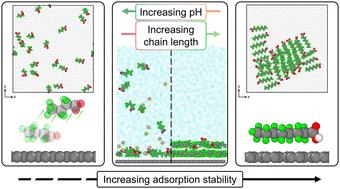
Per- and polyfluoroalkyl substances (PFAS) are a class of chemicals known for their persistence in the environment due to their amphiphilic nature and the strength of carbon–fluorine bonds. While these properties lead to various industrial and commercial applications including firefighting foams and non-stick coatings, these same characteristics also result in significant environmental and health concerns. This study employs atomistic molecular dynamics (MD) simulations to achieve molecular level insights into PFAS self-assembly and adsorption dynamics, to inform PFAS water remediation. MD simulations of PFAS with different headgroup chemistries and chain lengths on a graphene sorbent surface under varied pH conditions were performed. These simulation results elucidated the impacts of headgroup, chain length, and pH on PFAS adsorption behavior. At neutral pH, PFAS headgroups are fully deprotonated, causing electrostatic repulsions that lead to micelle-like aggregate formation in solution, hindering adsorption. Conversely, at acidic pH, these repulsions are diminished due to protonated headgroups, resulting in higher adsorption percentage with large, stacked aggregates that fully adsorb onto the sorbent. Additionally, chain length notably influenced aggregation, with longer chains forming larger aggregates and achieving more stable adsorption compared to shorter chains. Furthermore, perfluoro-sulfonic acids (PFSAs) displayed stronger adsorption and greater aggregate order than perfluoro-carboxylic acids (PFCAs) in general. These findings underscore the complex interplay between PFAS structure and the dynamics of their adsorption behaviors, as well as the potential of pH as a tuning parameter to enhance PFAS adsorption stability and thereby improve PFAS removal efficiency.
期刊介绍:
Nanoscale is a high-impact international journal, publishing high-quality research across nanoscience and nanotechnology. Nanoscale publishes a full mix of research articles on experimental and theoretical work, including reviews, communications, and full papers.Highly interdisciplinary, this journal appeals to scientists, researchers and professionals interested in nanoscience and nanotechnology, quantum materials and quantum technology, including the areas of physics, chemistry, biology, medicine, materials, energy/environment, information technology, detection science, healthcare and drug discovery, and electronics.



 京公网安备 11010802042870号
京ICP备2023020795号-1
京公网安备 11010802042870号
京ICP备2023020795号-1

 分享
分享
 求助内容:
求助内容: 应助结果提醒方式:
 扫码关注我们
