Anupam Jana, Arijit Maity, Ashadul Adalder, Sinthia Saha and Asamanjoy Bhunia
{"title":"A molecularly engineered MOF photocatalyst for CO production from visible light-driven CO2 reduction†","authors":"Anupam Jana, Arijit Maity, Ashadul Adalder, Sinthia Saha and Asamanjoy Bhunia","doi":"10.1039/D5NR00077G","DOIUrl":null,"url":null,"abstract":"<p >The search for new robust and efficient heterogeneous photocatalysts for the reduction of CO<small><sub>2</sub></small> has emerged as a key focus in the realm of CO<small><sub>2</sub></small> reduction research. However, there is a significant challenge in fabricating a photocatalyst with remarkable photoreduction activity. In this context, accommodation of a photocatalytic redox-active molecular metal complex into a stable MOF framework by replacing the existing linker through post-synthetic exchange (PSE), also termed solvent-assisted ligand exchange (SALE), is a powerful tool for developing photocatalysts for CO<small><sub>2</sub></small> reduction. Herein, we demonstrate for the first time the successful incorporation of a Ru(<small>II</small>) bis-terpyridine complex, [Ru(cptpy)<small><sub>2</sub></small>], into a stable Zr<small><sup>IV</sup></small>-based metal–organic framework (MOF) consisting of a naphthalene diimide (NDI) linker <em>via</em> SALE. The obtained MOF, Zr-NDI@Ru-tpy or Zr-NDI@Ru-tpy-m was used for photocatalytic CO<small><sub>2</sub></small> reduction under visible light. The Zr-NDI@Ru-tpy shows an impressive CO production rate of 2449 μmol g<small><sup>−1</sup></small> h<small><sup>−1</sup></small> with a low hydrogen production rate of 101 μmol g<small><sup>−1</sup></small> h<small><sup>−1</sup></small>, demonstrating a high selectivity of 97% for CO production. The turnover number (TON) for CO evolution by Zr-NDI@Ru-tpy is 123 in a photocatalytic run of 6 h. Furthermore, a plausible mechanism for CO<small><sub>2</sub></small> conversion into CO has been proposed using photophysical and electrochemical investigation, along with <em>in situ</em> diffuse reflectance infrared Fourier transform (DRIFT) spectroscopy. This study shows that the insertion of a redox-active molecular catalyst into a MOF is a promising method to produce efficient and stable photocatalysts that are also recyclable.</p>","PeriodicalId":92,"journal":{"name":"Nanoscale","volume":" 19","pages":" 12235-12244"},"PeriodicalIF":5.1000,"publicationDate":"2025-04-04","publicationTypes":"Journal Article","fieldsOfStudy":null,"isOpenAccess":false,"openAccessPdf":"","citationCount":"0","resultStr":null,"platform":"Semanticscholar","paperid":null,"PeriodicalName":"Nanoscale","FirstCategoryId":"88","ListUrlMain":"https://pubs.rsc.org/en/content/articlelanding/2025/nr/d5nr00077g","RegionNum":3,"RegionCategory":"材料科学","ArticlePicture":[],"TitleCN":null,"AbstractTextCN":null,"PMCID":null,"EPubDate":"","PubModel":"","JCR":"Q1","JCRName":"CHEMISTRY, MULTIDISCIPLINARY","Score":null,"Total":0}
引用次数: 0
Abstract
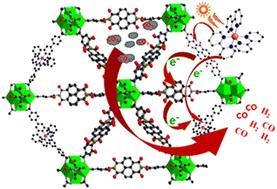
The search for new robust and efficient heterogeneous photocatalysts for the reduction of CO2 has emerged as a key focus in the realm of CO2 reduction research. However, there is a significant challenge in fabricating a photocatalyst with remarkable photoreduction activity. In this context, accommodation of a photocatalytic redox-active molecular metal complex into a stable MOF framework by replacing the existing linker through post-synthetic exchange (PSE), also termed solvent-assisted ligand exchange (SALE), is a powerful tool for developing photocatalysts for CO2 reduction. Herein, we demonstrate for the first time the successful incorporation of a Ru(II) bis-terpyridine complex, [Ru(cptpy)2], into a stable ZrIV-based metal–organic framework (MOF) consisting of a naphthalene diimide (NDI) linker via SALE. The obtained MOF, Zr-NDI@Ru-tpy or Zr-NDI@Ru-tpy-m was used for photocatalytic CO2 reduction under visible light. The Zr-NDI@Ru-tpy shows an impressive CO production rate of 2449 μmol g−1 h−1 with a low hydrogen production rate of 101 μmol g−1 h−1, demonstrating a high selectivity of 97% for CO production. The turnover number (TON) for CO evolution by Zr-NDI@Ru-tpy is 123 in a photocatalytic run of 6 h. Furthermore, a plausible mechanism for CO2 conversion into CO has been proposed using photophysical and electrochemical investigation, along with in situ diffuse reflectance infrared Fourier transform (DRIFT) spectroscopy. This study shows that the insertion of a redox-active molecular catalyst into a MOF is a promising method to produce efficient and stable photocatalysts that are also recyclable.
期刊介绍:
Nanoscale is a high-impact international journal, publishing high-quality research across nanoscience and nanotechnology. Nanoscale publishes a full mix of research articles on experimental and theoretical work, including reviews, communications, and full papers.Highly interdisciplinary, this journal appeals to scientists, researchers and professionals interested in nanoscience and nanotechnology, quantum materials and quantum technology, including the areas of physics, chemistry, biology, medicine, materials, energy/environment, information technology, detection science, healthcare and drug discovery, and electronics.



 京公网安备 11010802042870号
京ICP备2023020795号-1
京公网安备 11010802042870号
京ICP备2023020795号-1

 分享
分享
 求助内容:
求助内容: 应助结果提醒方式:
 扫码关注我们
