Kang Wang, Lu Peng, Peng Jiang, Le Xu, Lianghui Li, Hongxia Wang, Xin Jin, Wenyu Wang and Tong Lin
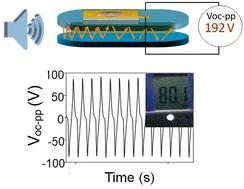
{"title":"Enhancing the acoustoelectric conversion of a nanofiber transducer in combination with a kazoo†","authors":"Kang Wang, Lu Peng, Peng Jiang, Le Xu, Lianghui Li, Hongxia Wang, Xin Jin, Wenyu Wang and Tong Lin","doi":"10.1039/D4NR05275G","DOIUrl":null,"url":null,"abstract":"<p >Acoustoelectric transducers are often combined with an acoustic resonator to improve their acoustoelectric performance. Previous studies have mostly been based on Helmholtz resonators, which are bulky in size and have limited improvement in acoustoelectric performance. In this study, for the first time, a kazoo, a flat miniature musical instrument, was used as an acoustic resonator to improve the acoustoelectric performance of a nanofiber acoustoelectric transducer. When a polyvinylidene fluoride (PVDF) nanofiber membrane was incorporated into the kazoo as a sound vibration diaphragm, it improved the acoustoelectric output in the low-frequency sound range and allowed sound to be collected from the side of the entire device. The electrospun PVDF nanofiber membrane worked with the polymethylmethacrylate kazoo to increase the sound intensity by at least 15 decibels in the nanofiber region. Under 100 Hz, 115 dB input sound conditions, the device generated 196.0 ± 8.6 V peak-to-peak voltage and 12.0 ± 1.1 μA current outputs. The generated power was sufficient to power applications. By rethinking resonator design and exploiting the versatility of nanofibers, this work establishes a paradigm shift in acoustic energy harvesting, offering a scalable, high-efficiency alternative to conventional resonator-dependent systems.</p>","PeriodicalId":92,"journal":{"name":"Nanoscale","volume":" 17","pages":" 10957-10968"},"PeriodicalIF":5.1000,"publicationDate":"2025-04-04","publicationTypes":"Journal Article","fieldsOfStudy":null,"isOpenAccess":false,"openAccessPdf":"","citationCount":"0","resultStr":null,"platform":"Semanticscholar","paperid":null,"PeriodicalName":"Nanoscale","FirstCategoryId":"88","ListUrlMain":"https://pubs.rsc.org/en/content/articlelanding/2025/nr/d4nr05275g","RegionNum":3,"RegionCategory":"材料科学","ArticlePicture":[],"TitleCN":null,"AbstractTextCN":null,"PMCID":null,"EPubDate":"","PubModel":"","JCR":"Q1","JCRName":"CHEMISTRY, MULTIDISCIPLINARY","Score":null,"Total":0}
引用次数: 0
Abstract
Acoustoelectric transducers are often combined with an acoustic resonator to improve their acoustoelectric performance. Previous studies have mostly been based on Helmholtz resonators, which are bulky in size and have limited improvement in acoustoelectric performance. In this study, for the first time, a kazoo, a flat miniature musical instrument, was used as an acoustic resonator to improve the acoustoelectric performance of a nanofiber acoustoelectric transducer. When a polyvinylidene fluoride (PVDF) nanofiber membrane was incorporated into the kazoo as a sound vibration diaphragm, it improved the acoustoelectric output in the low-frequency sound range and allowed sound to be collected from the side of the entire device. The electrospun PVDF nanofiber membrane worked with the polymethylmethacrylate kazoo to increase the sound intensity by at least 15 decibels in the nanofiber region. Under 100 Hz, 115 dB input sound conditions, the device generated 196.0 ± 8.6 V peak-to-peak voltage and 12.0 ± 1.1 μA current outputs. The generated power was sufficient to power applications. By rethinking resonator design and exploiting the versatility of nanofibers, this work establishes a paradigm shift in acoustic energy harvesting, offering a scalable, high-efficiency alternative to conventional resonator-dependent systems.
期刊介绍:
Nanoscale is a high-impact international journal, publishing high-quality research across nanoscience and nanotechnology. Nanoscale publishes a full mix of research articles on experimental and theoretical work, including reviews, communications, and full papers.Highly interdisciplinary, this journal appeals to scientists, researchers and professionals interested in nanoscience and nanotechnology, quantum materials and quantum technology, including the areas of physics, chemistry, biology, medicine, materials, energy/environment, information technology, detection science, healthcare and drug discovery, and electronics.



 京公网安备 11010802042870号
京ICP备2023020795号-1
京公网安备 11010802042870号
京ICP备2023020795号-1

 分享
分享
 求助内容:
求助内容: 应助结果提醒方式:
 扫码关注我们
