Electronic properties and photocatalytic characteristics with high solar-to-hydrogen efficiency in a promising S-scheme Hf2CO2/SiS2 heterojunction: First-principles calculations
Dahai Yu, Qingquan Xiao, Jianfeng Ye, Shengshang Lu, Songguo Yu, Fuqiang Ai
{"title":"Electronic properties and photocatalytic characteristics with high solar-to-hydrogen efficiency in a promising S-scheme Hf2CO2/SiS2 heterojunction: First-principles calculations","authors":"Dahai Yu, Qingquan Xiao, Jianfeng Ye, Shengshang Lu, Songguo Yu, Fuqiang Ai","doi":"10.1016/j.mcat.2025.115096","DOIUrl":null,"url":null,"abstract":"<div><div>The structural, electronic, and optical properties of the Hf<sub>2</sub>CO<sub>2</sub>/SiS<sub>2</sub> heterojunction were analyzed using first-principles calculations, and the effects of biaxial strains on its band structure and optical absorption were also investigated. The results show that the Hf<sub>2</sub>CO<sub>2</sub>/SiS<sub>2</sub> heterojunction exhibits an indirect bandgap of 1.05 eV and non-trivial band overlap, which facilitates efficient charge separation and transport. Differential charge density analysis reveals charge transfer at the interface, forming an intrinsic electric field that enhances the separation of photogenerated carriers and thereby improves photocatalytic performance. The Hf<sub>2</sub>CO<sub>2</sub>/SiS<sub>2</sub> heterojunction aligns with the S-scheme heterojunction model, enabling effective separation of photogenerated electron-hole pairs. Optical analysis shows significant light absorption in the UV and visible regions, with a redshift compared to monolayer materials. The predicted solar-to-hydrogen (STH) conversion efficiency of the Hf<sub>2</sub>CO<sub>2</sub>/SiS<sub>2</sub> heterojunction reaches 55.20 %, highlighting its potential for photocatalytic hydrogen production. Surface modification through elemental doping optimizes hydrogen evolution reaction (HER) activity of the Hf<sub>2</sub>CO<sub>2</sub>/SiS<sub>2</sub> heterojunction, ensuring exothermic reactions. Under alkaline conditions, the oxygen evolution reaction (OER) process of the Hf<sub>2</sub>CO<sub>2</sub>/SiS<sub>2</sub> heterojunction is spontaneous. Biaxial strain tuning further optimizes the bandgap and optical absorption properties of the Hf<sub>2</sub>CO<sub>2</sub>/SiS<sub>2</sub> heterojunction, thereby enhancing its photocatalytic performance. The research provides highly potential candidate materials for exploring efficient hydrogen evolution catalysts.</div></div>","PeriodicalId":393,"journal":{"name":"Molecular Catalysis","volume":"579 ","pages":"Article 115096"},"PeriodicalIF":4.9000,"publicationDate":"2025-05-15","publicationTypes":"Journal Article","fieldsOfStudy":null,"isOpenAccess":false,"openAccessPdf":"","citationCount":"0","resultStr":null,"platform":"Semanticscholar","paperid":null,"PeriodicalName":"Molecular Catalysis","FirstCategoryId":"92","ListUrlMain":"https://www.sciencedirect.com/science/article/pii/S2468823125002822","RegionNum":2,"RegionCategory":"化学","ArticlePicture":[],"TitleCN":null,"AbstractTextCN":null,"PMCID":null,"EPubDate":"2025/4/5 0:00:00","PubModel":"Epub","JCR":"Q2","JCRName":"CHEMISTRY, PHYSICAL","Score":null,"Total":0}
引用次数: 0
Abstract
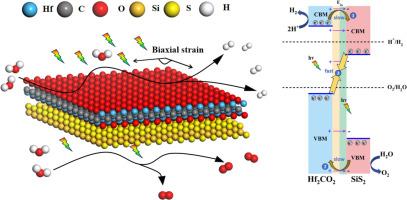
The structural, electronic, and optical properties of the Hf2CO2/SiS2 heterojunction were analyzed using first-principles calculations, and the effects of biaxial strains on its band structure and optical absorption were also investigated. The results show that the Hf2CO2/SiS2 heterojunction exhibits an indirect bandgap of 1.05 eV and non-trivial band overlap, which facilitates efficient charge separation and transport. Differential charge density analysis reveals charge transfer at the interface, forming an intrinsic electric field that enhances the separation of photogenerated carriers and thereby improves photocatalytic performance. The Hf2CO2/SiS2 heterojunction aligns with the S-scheme heterojunction model, enabling effective separation of photogenerated electron-hole pairs. Optical analysis shows significant light absorption in the UV and visible regions, with a redshift compared to monolayer materials. The predicted solar-to-hydrogen (STH) conversion efficiency of the Hf2CO2/SiS2 heterojunction reaches 55.20 %, highlighting its potential for photocatalytic hydrogen production. Surface modification through elemental doping optimizes hydrogen evolution reaction (HER) activity of the Hf2CO2/SiS2 heterojunction, ensuring exothermic reactions. Under alkaline conditions, the oxygen evolution reaction (OER) process of the Hf2CO2/SiS2 heterojunction is spontaneous. Biaxial strain tuning further optimizes the bandgap and optical absorption properties of the Hf2CO2/SiS2 heterojunction, thereby enhancing its photocatalytic performance. The research provides highly potential candidate materials for exploring efficient hydrogen evolution catalysts.
期刊介绍:
Molecular Catalysis publishes full papers that are original, rigorous, and scholarly contributions examining the molecular and atomic aspects of catalytic activation and reaction mechanisms. The fields covered are:
Heterogeneous catalysis including immobilized molecular catalysts
Homogeneous catalysis including organocatalysis, organometallic catalysis and biocatalysis
Photo- and electrochemistry
Theoretical aspects of catalysis analyzed by computational methods




 京公网安备 11010802042870号
京ICP备2023020795号-1
京公网安备 11010802042870号
京ICP备2023020795号-1

 分享
分享
 求助内容:
求助内容: 应助结果提醒方式:
 扫码关注我们
