Exchanged oxo-Cu2+ cations in mordenite zeolites: Evidencing the truly active in the stepwise conversion of methane to methanol from in situ DRS-UV–vis analyses performed during activation and reaction
Monize Picinini , Mateus Gonçalves dos Santos , José Maria C. Bueno , Ernesto A. Urquieta-Gonzalez
{"title":"Exchanged oxo-Cu2+ cations in mordenite zeolites: Evidencing the truly active in the stepwise conversion of methane to methanol from in situ DRS-UV–vis analyses performed during activation and reaction","authors":"Monize Picinini , Mateus Gonçalves dos Santos , José Maria C. Bueno , Ernesto A. Urquieta-Gonzalez","doi":"10.1016/j.mcat.2025.115093","DOIUrl":null,"url":null,"abstract":"<div><div>After activation, Cu<sup>2+</sup>-exchanged zeolites generate exchanged oxo-Cu<sup>2+</sup> cations that absorb UV–vis radiation in all of the d-d and LMCT transitions range. On the other hand, based on great experimental and/or theoretical data, bi- or trinuclear exchanged oxo-Cu<sup>2+</sup>-zeolites with attributed absorption UV–vis bands centered between 20,000 and 35,000 cm<sup>-1</sup>, are the mainly considered as the potential active species to directly convert methane to methanol (MTM) in a stepwise process, which obviously leads to low copper specific activities (TON). What about the others generated oxo-Cu<sup>2+</sup> cations? To elucidate this question, we developed a systematic study using catalytic evaluation data of oxo-Cu<sup>2+</sup> mordenites and <em>in situ</em> DRS-UV–vis analyses performed during air activation at 550 °C and MTM conversion at 200 °C. The obtained data allowed to confirm that the less-generated oxo-Cu<sup>2+</sup> cations related to absorption DRS-UV–vis bands centered at wavenumbers lower than 33,000 cm<sup>-1</sup>, are the effectively active species to directly oxidize the methane molecule to methanol, but also evidencing that the most generated oxo-Cu<sup>2+</sup> cations are poorly active, thus explaining the reported low copper TON values of activated Cu<sup>2+</sup>-exchanged zeolites. This finding must stimulate the involved scientific community to find more effective activation procedures that can promote the formation of such more active oxo-Cu<sup>2+</sup> cations.</div></div>","PeriodicalId":393,"journal":{"name":"Molecular Catalysis","volume":"579 ","pages":"Article 115093"},"PeriodicalIF":4.9000,"publicationDate":"2025-05-15","publicationTypes":"Journal Article","fieldsOfStudy":null,"isOpenAccess":false,"openAccessPdf":"","citationCount":"0","resultStr":null,"platform":"Semanticscholar","paperid":null,"PeriodicalName":"Molecular Catalysis","FirstCategoryId":"92","ListUrlMain":"https://www.sciencedirect.com/science/article/pii/S2468823125002792","RegionNum":2,"RegionCategory":"化学","ArticlePicture":[],"TitleCN":null,"AbstractTextCN":null,"PMCID":null,"EPubDate":"2025/4/5 0:00:00","PubModel":"Epub","JCR":"Q2","JCRName":"CHEMISTRY, PHYSICAL","Score":null,"Total":0}
引用次数: 0
Abstract
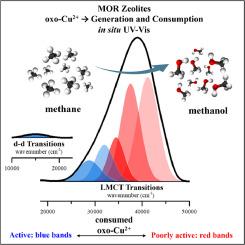
After activation, Cu2+-exchanged zeolites generate exchanged oxo-Cu2+ cations that absorb UV–vis radiation in all of the d-d and LMCT transitions range. On the other hand, based on great experimental and/or theoretical data, bi- or trinuclear exchanged oxo-Cu2+-zeolites with attributed absorption UV–vis bands centered between 20,000 and 35,000 cm-1, are the mainly considered as the potential active species to directly convert methane to methanol (MTM) in a stepwise process, which obviously leads to low copper specific activities (TON). What about the others generated oxo-Cu2+ cations? To elucidate this question, we developed a systematic study using catalytic evaluation data of oxo-Cu2+ mordenites and in situ DRS-UV–vis analyses performed during air activation at 550 °C and MTM conversion at 200 °C. The obtained data allowed to confirm that the less-generated oxo-Cu2+ cations related to absorption DRS-UV–vis bands centered at wavenumbers lower than 33,000 cm-1, are the effectively active species to directly oxidize the methane molecule to methanol, but also evidencing that the most generated oxo-Cu2+ cations are poorly active, thus explaining the reported low copper TON values of activated Cu2+-exchanged zeolites. This finding must stimulate the involved scientific community to find more effective activation procedures that can promote the formation of such more active oxo-Cu2+ cations.
期刊介绍:
Molecular Catalysis publishes full papers that are original, rigorous, and scholarly contributions examining the molecular and atomic aspects of catalytic activation and reaction mechanisms. The fields covered are:
Heterogeneous catalysis including immobilized molecular catalysts
Homogeneous catalysis including organocatalysis, organometallic catalysis and biocatalysis
Photo- and electrochemistry
Theoretical aspects of catalysis analyzed by computational methods




 京公网安备 11010802042870号
京ICP备2023020795号-1
京公网安备 11010802042870号
京ICP备2023020795号-1

 分享
分享
 求助内容:
求助内容: 应助结果提醒方式:
 扫码关注我们
