Polyphenols as enhancers of emulsifying and antioxidant properties of egg and yeast protein emulsions: Understanding the molecular interactions behind their technological and functional potential
Ana Catarina Ribeiro , Carlo Bravo , Rui Miguel Ramos , Ricardo Dias , Nuno Mateus , Victor de Freitas , Rosa Pérez-Gregorio , Susana Soares
{"title":"Polyphenols as enhancers of emulsifying and antioxidant properties of egg and yeast protein emulsions: Understanding the molecular interactions behind their technological and functional potential","authors":"Ana Catarina Ribeiro , Carlo Bravo , Rui Miguel Ramos , Ricardo Dias , Nuno Mateus , Victor de Freitas , Rosa Pérez-Gregorio , Susana Soares","doi":"10.1016/j.foodhyd.2025.111399","DOIUrl":null,"url":null,"abstract":"<div><div>The rising interest in alternative protein sources, such as yeast protein extracts (YPEs), has recently brought attention to their interactions with polyphenols, which can enhance their structural and technological properties while providing health-beneficial properties, such as antioxidant activity. In this study, a multi-technique approach was employed to investigate the effects of a green tea extract (GTE), rich in flavanols, and a blueberry extract (BE), rich in anthocyanins, on the conformational and functional properties of enolase (ENO), the most abundant protein in YPE, and ovalbumin (OVA), representing chicken egg proteins. Overall, results highlighted the formation of non-covalent complexes with higher affinity under acidic conditions (pH 3.5). UV–vis and fluorescence quenching analyses revealed that ENO formed stronger molecular interactions with the extracts than OVA. FTIR spectroscopy showed a decrease in α-helices and a concurrent increase in random coil structures of ENO, with BE inducing greater protein unfolding and structural disorganization than GTE. In addition, 3D fluorescence spectra also highlighted conformational changes in BE structure upon binding with ENO. Electrochemical analysis proved that both GTE and BE antioxidant moieties were partially embedded within the protein structure, preserving their antioxidant capacity. The ENO emulsification activity index remained consistent after the addition of polyphenols, while its emulsion stability improved in the presence of BE (+48 %). The findings in this study suggest that ENO-polyphenol complexes have the potential to be applied as novel functional food ingredients.</div></div>","PeriodicalId":320,"journal":{"name":"Food Hydrocolloids","volume":"167 ","pages":"Article 111399"},"PeriodicalIF":11.0000,"publicationDate":"2025-11-01","publicationTypes":"Journal Article","fieldsOfStudy":null,"isOpenAccess":false,"openAccessPdf":"","citationCount":"0","resultStr":null,"platform":"Semanticscholar","paperid":null,"PeriodicalName":"Food Hydrocolloids","FirstCategoryId":"97","ListUrlMain":"https://www.sciencedirect.com/science/article/pii/S0268005X25003595","RegionNum":1,"RegionCategory":"农林科学","ArticlePicture":[],"TitleCN":null,"AbstractTextCN":null,"PMCID":null,"EPubDate":"2025/4/1 0:00:00","PubModel":"Epub","JCR":"Q1","JCRName":"CHEMISTRY, APPLIED","Score":null,"Total":0}
引用次数: 0
Abstract
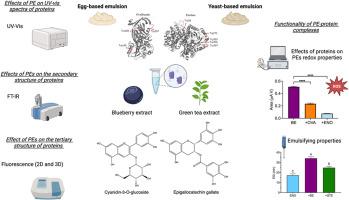
The rising interest in alternative protein sources, such as yeast protein extracts (YPEs), has recently brought attention to their interactions with polyphenols, which can enhance their structural and technological properties while providing health-beneficial properties, such as antioxidant activity. In this study, a multi-technique approach was employed to investigate the effects of a green tea extract (GTE), rich in flavanols, and a blueberry extract (BE), rich in anthocyanins, on the conformational and functional properties of enolase (ENO), the most abundant protein in YPE, and ovalbumin (OVA), representing chicken egg proteins. Overall, results highlighted the formation of non-covalent complexes with higher affinity under acidic conditions (pH 3.5). UV–vis and fluorescence quenching analyses revealed that ENO formed stronger molecular interactions with the extracts than OVA. FTIR spectroscopy showed a decrease in α-helices and a concurrent increase in random coil structures of ENO, with BE inducing greater protein unfolding and structural disorganization than GTE. In addition, 3D fluorescence spectra also highlighted conformational changes in BE structure upon binding with ENO. Electrochemical analysis proved that both GTE and BE antioxidant moieties were partially embedded within the protein structure, preserving their antioxidant capacity. The ENO emulsification activity index remained consistent after the addition of polyphenols, while its emulsion stability improved in the presence of BE (+48 %). The findings in this study suggest that ENO-polyphenol complexes have the potential to be applied as novel functional food ingredients.
最近,人们对酵母蛋白提取物(YPE)等替代蛋白质来源的兴趣日益浓厚,这使人们开始关注它们与多酚类物质的相互作用,因为多酚类物质可以增强蛋白质的结构和技术特性,同时提供有益健康的特性,如抗氧化活性。本研究采用多种技术方法研究了富含黄烷醇的绿茶提取物(GTE)和富含花青素的蓝莓提取物(BE)对烯醇化酶(ENO)(YPE 中含量最高的蛋白质)和卵清蛋白(OVA)(代表鸡卵蛋白)构象和功能特性的影响。总之,研究结果表明,在酸性条件下(pH 值为 3.5)形成的非共价复合物具有更高的亲和力。紫外可见光和荧光淬灭分析表明,ENO 与提取物形成的分子相互作用比 OVA 更强。傅立叶变换红外光谱显示,ENO 的 α 螺旋结构减少,同时无规线圈结构增加,与 GTE 相比,BE 诱导的蛋白质解折和结构紊乱程度更大。此外,三维荧光光谱也突显了 BE 与 ENO 结合后结构的构象变化。电化学分析证明,GTE 和 BE 的抗氧化分子都部分嵌入了蛋白质结构中,从而保持了其抗氧化能力。添加多酚后,ENO 的乳化活性指数保持不变,而其乳化稳定性在 BE 的存在下有所提高(+48 %)。这项研究结果表明,ENO-多酚复合物具有作为新型功能性食品配料的潜力。
期刊介绍:
Food Hydrocolloids publishes original and innovative research focused on the characterization, functional properties, and applications of hydrocolloid materials used in food products. These hydrocolloids, defined as polysaccharides and proteins of commercial importance, are added to control aspects such as texture, stability, rheology, and sensory properties. The research's primary emphasis should be on the hydrocolloids themselves, with thorough descriptions of their source, nature, and physicochemical characteristics. Manuscripts are expected to clearly outline specific aims and objectives, include a fundamental discussion of research findings at the molecular level, and address the significance of the results. Studies on hydrocolloids in complex formulations should concentrate on their overall properties and mechanisms of action, while simple formulation development studies may not be considered for publication.
The main areas of interest are:
-Chemical and physicochemical characterisation
Thermal properties including glass transitions and conformational changes-
Rheological properties including viscosity, viscoelastic properties and gelation behaviour-
The influence on organoleptic properties-
Interfacial properties including stabilisation of dispersions, emulsions and foams-
Film forming properties with application to edible films and active packaging-
Encapsulation and controlled release of active compounds-
The influence on health including their role as dietary fibre-
Manipulation of hydrocolloid structure and functionality through chemical, biochemical and physical processes-
New hydrocolloids and hydrocolloid sources of commercial potential.
The Journal also publishes Review articles that provide an overview of the latest developments in topics of specific interest to researchers in this field of activity.



 京公网安备 11010802042870号
京ICP备2023020795号-1
京公网安备 11010802042870号
京ICP备2023020795号-1

 分享
分享
 求助内容:
求助内容: 应助结果提醒方式:
 扫码关注我们
