Xiujun Lin , Fangfang Liu , Zihan Ma , Yang Li , Huanyu Zheng
{"title":"Effects of different gelation mechanisms on the structural properties of bigels: A comparative study","authors":"Xiujun Lin , Fangfang Liu , Zihan Ma , Yang Li , Huanyu Zheng","doi":"10.1016/j.foodhyd.2025.111249","DOIUrl":null,"url":null,"abstract":"<div><div>The aim of this study was to investigate the effects of various gelation mechanisms—specifically, particle crystallization (β-sitosterol + monoglycerides, SM) and self-assembled fiber (β-sitosterol + γ-oryzanol, SO)—on the structure of bigels. The results indicated that SM-bigels exhibited a bi-continuous structure characterized by high gel strength. However, the elevated oleogel content compressed the Hydroxypropyl methylcellulose (HPMC) hydrogel network, resulting in water leakage. In contrast, SO-bigels displayed a water-in-oil type structure that was softer and more elastic, featuring a more intact oil-water interfacial film and a reduced rate of liquid loss. These differences arise from the distinct interfacial behaviors associated with each gelation mechanism. SM can diffuse rapidly into the oil-water interface and crystallize quickly, thereby enhancing the interaction between the oil and water phases and improving structural strength. However, the formation of numerous crystals tends to create a rigid interfacial shell, which limits spatial effects and results in less springiness SM-bigels. In contrast, SO diffuses more slowly across the interface, leading to the formation of fewer crystals and a slightly lower degree of interaction between the oil and aqueous phases. This results in SO-bigels that are less stiff and more flexible. These textural differences influence the oxidative stability of the bigel, which is higher for the SO-bigel. This study offers valuable structural insights into the effects of different gelation mechanisms on bigels and contributes to the development of novel fat substitutes.</div></div>","PeriodicalId":320,"journal":{"name":"Food Hydrocolloids","volume":"167 ","pages":"Article 111249"},"PeriodicalIF":11.0000,"publicationDate":"2025-11-01","publicationTypes":"Journal Article","fieldsOfStudy":null,"isOpenAccess":false,"openAccessPdf":"","citationCount":"0","resultStr":null,"platform":"Semanticscholar","paperid":null,"PeriodicalName":"Food Hydrocolloids","FirstCategoryId":"97","ListUrlMain":"https://www.sciencedirect.com/science/article/pii/S0268005X25002097","RegionNum":1,"RegionCategory":"农林科学","ArticlePicture":[],"TitleCN":null,"AbstractTextCN":null,"PMCID":null,"EPubDate":"2025/3/28 0:00:00","PubModel":"Epub","JCR":"Q1","JCRName":"CHEMISTRY, APPLIED","Score":null,"Total":0}
引用次数: 0
Abstract
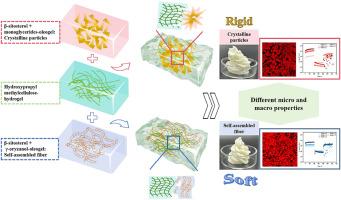
The aim of this study was to investigate the effects of various gelation mechanisms—specifically, particle crystallization (β-sitosterol + monoglycerides, SM) and self-assembled fiber (β-sitosterol + γ-oryzanol, SO)—on the structure of bigels. The results indicated that SM-bigels exhibited a bi-continuous structure characterized by high gel strength. However, the elevated oleogel content compressed the Hydroxypropyl methylcellulose (HPMC) hydrogel network, resulting in water leakage. In contrast, SO-bigels displayed a water-in-oil type structure that was softer and more elastic, featuring a more intact oil-water interfacial film and a reduced rate of liquid loss. These differences arise from the distinct interfacial behaviors associated with each gelation mechanism. SM can diffuse rapidly into the oil-water interface and crystallize quickly, thereby enhancing the interaction between the oil and water phases and improving structural strength. However, the formation of numerous crystals tends to create a rigid interfacial shell, which limits spatial effects and results in less springiness SM-bigels. In contrast, SO diffuses more slowly across the interface, leading to the formation of fewer crystals and a slightly lower degree of interaction between the oil and aqueous phases. This results in SO-bigels that are less stiff and more flexible. These textural differences influence the oxidative stability of the bigel, which is higher for the SO-bigel. This study offers valuable structural insights into the effects of different gelation mechanisms on bigels and contributes to the development of novel fat substitutes.
期刊介绍:
Food Hydrocolloids publishes original and innovative research focused on the characterization, functional properties, and applications of hydrocolloid materials used in food products. These hydrocolloids, defined as polysaccharides and proteins of commercial importance, are added to control aspects such as texture, stability, rheology, and sensory properties. The research's primary emphasis should be on the hydrocolloids themselves, with thorough descriptions of their source, nature, and physicochemical characteristics. Manuscripts are expected to clearly outline specific aims and objectives, include a fundamental discussion of research findings at the molecular level, and address the significance of the results. Studies on hydrocolloids in complex formulations should concentrate on their overall properties and mechanisms of action, while simple formulation development studies may not be considered for publication.
The main areas of interest are:
-Chemical and physicochemical characterisation
Thermal properties including glass transitions and conformational changes-
Rheological properties including viscosity, viscoelastic properties and gelation behaviour-
The influence on organoleptic properties-
Interfacial properties including stabilisation of dispersions, emulsions and foams-
Film forming properties with application to edible films and active packaging-
Encapsulation and controlled release of active compounds-
The influence on health including their role as dietary fibre-
Manipulation of hydrocolloid structure and functionality through chemical, biochemical and physical processes-
New hydrocolloids and hydrocolloid sources of commercial potential.
The Journal also publishes Review articles that provide an overview of the latest developments in topics of specific interest to researchers in this field of activity.



 京公网安备 11010802042870号
京ICP备2023020795号-1
京公网安备 11010802042870号
京ICP备2023020795号-1

 分享
分享
 求助内容:
求助内容: 应助结果提醒方式:
 扫码关注我们
