Zhu Guan-Yu, Yin Zi-Xiao, Chen Ying-Chuan, Timon Merk, Thomas Binns, Ma Ruo-Yu, Du Ting-Ting, Liu Yu-Ye, Xie Hu-Tao, Shi Lin, Yang An-Chao, Meng Fan-Gang, Wolf-Julian Neumann, Andrea A. Kühn, Zhang Jian-Guo
{"title":"Subthalamic Nucleus Oscillatory Characteristics in Meige, Cervical Dystonia and Generalized Dystonia","authors":"Zhu Guan-Yu, Yin Zi-Xiao, Chen Ying-Chuan, Timon Merk, Thomas Binns, Ma Ruo-Yu, Du Ting-Ting, Liu Yu-Ye, Xie Hu-Tao, Shi Lin, Yang An-Chao, Meng Fan-Gang, Wolf-Julian Neumann, Andrea A. Kühn, Zhang Jian-Guo","doi":"10.1002/acn3.70040","DOIUrl":null,"url":null,"abstract":"<div>\n \n \n <section>\n \n <h3> Objective</h3>\n \n <p>Deep brain stimulation offers a unique opportunity to record neural activity of the basal ganglia. While much work in dystonia has focused on the globus pallidus internus, expanding research to investigate subthalamic nucleus (STN) activity in various dystonia types is critical to provide a comprehensive understanding of dystonia pathophysiology.</p>\n </section>\n \n <section>\n \n <h3> Methods</h3>\n \n <p>STN and cortex activity were recorded from 17 patients with cervical dystonia (CD), 19 with Meige syndrome, and 9 with generalized dystonia (GD) during the lead externalized period. We investigated local and network oscillatory characteristics, including power, bursts, and coherence. Additionally, we explored the relationship between these features and the severity of dystonic symptoms within each group and conducted a comparative analysis across the different dystonia types.</p>\n </section>\n \n <section>\n \n <h3> Results</h3>\n \n <p>Peaks of low-frequency (4–13 Hz) and beta (14–30 Hz) power were present in the STN of all patients; most of the beta peaks are distributed in the high beta range (20–30 Hz). The CD and GD groups showed longer low-frequency bursts and greater high beta power in STN than the Meige group. Interestingly, the CD group showed stronger STN-cortex low-frequency coherence, while the GD group had stronger STN-cortex high beta coherence. Combined, low-frequency and beta features could predict symptom severity with a performance of 73% in the CD group and 82% in the GD group.</p>\n </section>\n \n <section>\n \n <h3> Interpretation</h3>\n \n <p>Low-frequency and high-beta oscillations are present in the STN across all three types of dystonia. The distinct patterns may be associated with different underlying pathological mechanisms.</p>\n </section>\n </div>","PeriodicalId":126,"journal":{"name":"Annals of Clinical and Translational Neurology","volume":"12 5","pages":"1082-1092"},"PeriodicalIF":3.9000,"publicationDate":"2025-04-03","publicationTypes":"Journal Article","fieldsOfStudy":null,"isOpenAccess":false,"openAccessPdf":"https://onlinelibrary.wiley.com/doi/epdf/10.1002/acn3.70040","citationCount":"0","resultStr":null,"platform":"Semanticscholar","paperid":null,"PeriodicalName":"Annals of Clinical and Translational Neurology","FirstCategoryId":"3","ListUrlMain":"https://onlinelibrary.wiley.com/doi/10.1002/acn3.70040","RegionNum":2,"RegionCategory":"医学","ArticlePicture":[],"TitleCN":null,"AbstractTextCN":null,"PMCID":null,"EPubDate":"","PubModel":"","JCR":"Q1","JCRName":"CLINICAL NEUROLOGY","Score":null,"Total":0}
引用次数: 0
Abstract
Objective
Deep brain stimulation offers a unique opportunity to record neural activity of the basal ganglia. While much work in dystonia has focused on the globus pallidus internus, expanding research to investigate subthalamic nucleus (STN) activity in various dystonia types is critical to provide a comprehensive understanding of dystonia pathophysiology.
Methods
STN and cortex activity were recorded from 17 patients with cervical dystonia (CD), 19 with Meige syndrome, and 9 with generalized dystonia (GD) during the lead externalized period. We investigated local and network oscillatory characteristics, including power, bursts, and coherence. Additionally, we explored the relationship between these features and the severity of dystonic symptoms within each group and conducted a comparative analysis across the different dystonia types.
Results
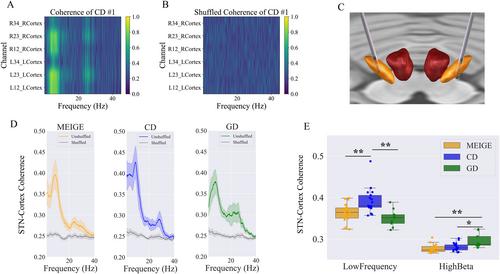
Peaks of low-frequency (4–13 Hz) and beta (14–30 Hz) power were present in the STN of all patients; most of the beta peaks are distributed in the high beta range (20–30 Hz). The CD and GD groups showed longer low-frequency bursts and greater high beta power in STN than the Meige group. Interestingly, the CD group showed stronger STN-cortex low-frequency coherence, while the GD group had stronger STN-cortex high beta coherence. Combined, low-frequency and beta features could predict symptom severity with a performance of 73% in the CD group and 82% in the GD group.
Interpretation
Low-frequency and high-beta oscillations are present in the STN across all three types of dystonia. The distinct patterns may be associated with different underlying pathological mechanisms.
期刊介绍:
Annals of Clinical and Translational Neurology is a peer-reviewed journal for rapid dissemination of high-quality research related to all areas of neurology. The journal publishes original research and scholarly reviews focused on the mechanisms and treatments of diseases of the nervous system; high-impact topics in neurologic education; and other topics of interest to the clinical neuroscience community.



 京公网安备 11010802042870号
京ICP备2023020795号-1
京公网安备 11010802042870号
京ICP备2023020795号-1

 分享
分享
 求助内容:
求助内容: 应助结果提醒方式:
 扫码关注我们
