Benjamin J S Al-Haddad, Elisabeth Olson, Erin Reardon, Emmanuel Bonney
{"title":"Neurodevelopmental screening for neonates less than 44 weeks gestation in low-income and middle-income countries: a systematic review.","authors":"Benjamin J S Al-Haddad, Elisabeth Olson, Erin Reardon, Emmanuel Bonney","doi":"10.1136/bmjgh-2024-017683","DOIUrl":null,"url":null,"abstract":"<p><strong>Introduction: </strong>With global improvements in neonatal survival, more small and sick newborns in low-income and middle-income countries (LMICs) are at increased risk of neurodevelopmental disability and delay. While there is increased recognition of the importance of early identification of neurodevelopmental differences and timely initiation of therapy, little is known about standardised neonatal neurodevelopmental screening tools in these settings.</p><p><strong>Methods: </strong>We performed a systematic review to determine what standardised neurodevelopmental assessments had been used in LMICs for neonates before 44 weeks corrected gestational age and published in the literature. We excluded short-term clinical assessments designed for specific pathologies. We performed the search across seven databases, screened studies for eligibility and inclusion and extracted bibliographic data, country, patient characteristics, assessments and study aims. Results were summarised in tabular and graphical presentation.</p><p><strong>Results: </strong>There were 2477 records screened, yielding 67 studies for inclusion. Studies in Asian countries made up 65.7%, while Latin America and Africa made up 19.4% and 16.4%, respectively. Physicians and paramedical staff performed the screening assessments in only 16.4% of studies, and 92.5% of studies used inpatient recruitment. The Neonatal Behavioural Neurological Assessment (25.4%) was the most frequently used screening tool followed by the General Movements Assessment (22.4%), the Hammersmith Neonatal Neurological Examination/Dubowitz (16.4%) and the Neonatal Behavioural Assessment Scale (10.4%).</p><p><strong>Conclusions: </strong>We did not identify any one neonatal neurodevelopmental screening assessment that is rapid, globally validated, identifies targets for intervention, has high predictive prognostic value and does not require neonatal or kinesiologic expertise or uncommon equipment. Such an assessment, in concert with evidence-based intervention, therapeutic delivery platforms, established referral pathways and trained personnel would improve functional outcomes for high-risk small and sick neonates in LMICs.</p>","PeriodicalId":9137,"journal":{"name":"BMJ Global Health","volume":"10 4","pages":""},"PeriodicalIF":6.1000,"publicationDate":"2025-04-02","publicationTypes":"Journal Article","fieldsOfStudy":null,"isOpenAccess":false,"openAccessPdf":"https://www.ncbi.nlm.nih.gov/pmc/articles/PMC11966953/pdf/","citationCount":"0","resultStr":null,"platform":"Semanticscholar","paperid":null,"PeriodicalName":"BMJ Global Health","FirstCategoryId":"3","ListUrlMain":"https://doi.org/10.1136/bmjgh-2024-017683","RegionNum":2,"RegionCategory":"医学","ArticlePicture":[],"TitleCN":null,"AbstractTextCN":null,"PMCID":null,"EPubDate":"","PubModel":"","JCR":"Q1","JCRName":"PUBLIC, ENVIRONMENTAL & OCCUPATIONAL HEALTH","Score":null,"Total":0}
引用次数: 0
Abstract
Introduction: With global improvements in neonatal survival, more small and sick newborns in low-income and middle-income countries (LMICs) are at increased risk of neurodevelopmental disability and delay. While there is increased recognition of the importance of early identification of neurodevelopmental differences and timely initiation of therapy, little is known about standardised neonatal neurodevelopmental screening tools in these settings.
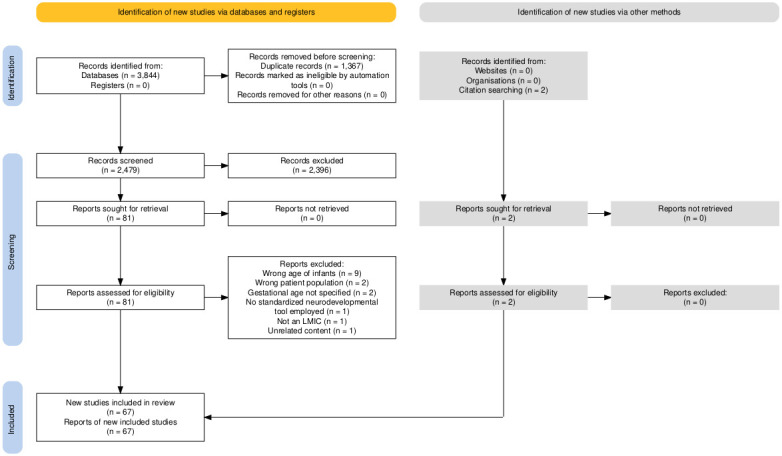
Methods: We performed a systematic review to determine what standardised neurodevelopmental assessments had been used in LMICs for neonates before 44 weeks corrected gestational age and published in the literature. We excluded short-term clinical assessments designed for specific pathologies. We performed the search across seven databases, screened studies for eligibility and inclusion and extracted bibliographic data, country, patient characteristics, assessments and study aims. Results were summarised in tabular and graphical presentation.
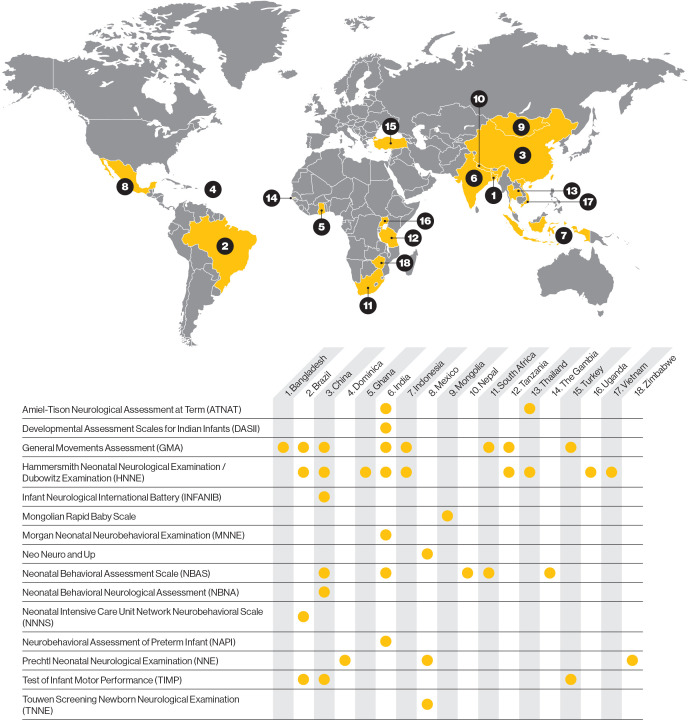
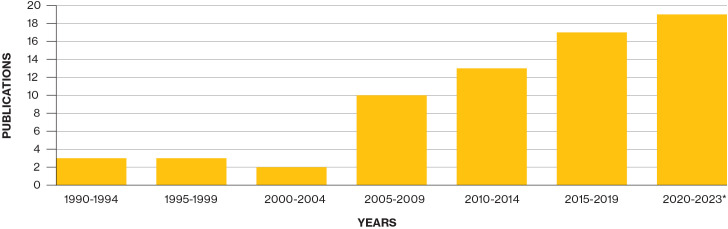
Results: There were 2477 records screened, yielding 67 studies for inclusion. Studies in Asian countries made up 65.7%, while Latin America and Africa made up 19.4% and 16.4%, respectively. Physicians and paramedical staff performed the screening assessments in only 16.4% of studies, and 92.5% of studies used inpatient recruitment. The Neonatal Behavioural Neurological Assessment (25.4%) was the most frequently used screening tool followed by the General Movements Assessment (22.4%), the Hammersmith Neonatal Neurological Examination/Dubowitz (16.4%) and the Neonatal Behavioural Assessment Scale (10.4%).
Conclusions: We did not identify any one neonatal neurodevelopmental screening assessment that is rapid, globally validated, identifies targets for intervention, has high predictive prognostic value and does not require neonatal or kinesiologic expertise or uncommon equipment. Such an assessment, in concert with evidence-based intervention, therapeutic delivery platforms, established referral pathways and trained personnel would improve functional outcomes for high-risk small and sick neonates in LMICs.
期刊介绍:
BMJ Global Health is an online Open Access journal from BMJ that focuses on publishing high-quality peer-reviewed content pertinent to individuals engaged in global health, including policy makers, funders, researchers, clinicians, and frontline healthcare workers. The journal encompasses all facets of global health, with a special emphasis on submissions addressing underfunded areas such as non-communicable diseases (NCDs). It welcomes research across all study phases and designs, from study protocols to phase I trials to meta-analyses, including small or specialized studies. The journal also encourages opinionated discussions on controversial topics.




 京公网安备 11010802042870号
京ICP备2023020795号-1
京公网安备 11010802042870号
京ICP备2023020795号-1

 分享
分享
 求助内容:
求助内容: 应助结果提醒方式:
 扫码关注我们
