{"title":"Clinical characteristics, and outcomes of severe neonatal thrombocytopenia: a retrospective cohort study in China.","authors":"Yuanyuan Shan, Ting Peng, Peng Zhang, Guoqiang Cheng","doi":"10.1186/s12887-025-05640-6","DOIUrl":null,"url":null,"abstract":"<p><strong>Background: </strong>Severe neonatal thrombocytopenia, as a rare but life-threatening disease with multiple etiologies, has limited relevant reports in China. The single-center study was performed in a severe thrombocytopenic cohort to improve the prognosis of this disease.</p><p><strong>Methods: </strong>We included all the patients diagnosed with severe thrombocytopenia (platelet counts ≤ 50 × 10<sup>3</sup>/µL) in our institution between October 2016 and February 2021, and retrospectively reviewed their electronic records. Comparisons were made according to etiology and outcome.</p><p><strong>Results: </strong>Among the 5819 inpatients, 194 with severe thrombocytopenia were included in this study, with 64.4% of the cases manifesting thrombocytopenia within 72 h of life. The highest incidence was recorded among extremely low birth weight neonates (6.5%). The main etiologies included sepsis (22.2%), genetic syndromes (14.4%), perinatal asphyxia (9.8%), necrotizing enterocolitis (NEC; 8.8%), and cytomegalovirus infection (6.7%). The median platelet nadir was 5.0 × 10<sup>3</sup>/µL [IQR:2.0 × 10<sup>3</sup>/µL-16.0 × 10<sup>3</sup>/µL], and 112 patients developed very severe thrombocytopenia (platelet counts ≤ 30 × 10<sup>3</sup>/µL), of which 21.4% were associated with late-onset sepsis. In 45 culture-positive cases, the gram-negative group had a lower level of platelets (mean [SD]: 28 [11]×10<sup>3</sup>/µL) as compared to the gram-positive group (mean [SD]: 39 [12]×10<sup>3</sup>/µL). A total of 120 cases (61.9%) exhibited evidence of hemorrhage, with patients diagnosed with NEC demonstrating the highest incidence of hemorrhage at 58.8%. The platelet counts took a median of 10 days to recover: 11 and 7 days for early and late-onset cases; 15 days without and 21 days with platelet transfusions, respectively. The overall mortality rate was 26.8%. The causes of severe thrombocytopenia in 32.7%, 19.2%, and 17.3% of patients who died were identified as sepsis, birth asphyxia, and NEC, respectively. The levels of PT (P = 0.025), APTT (P = 0.046), and lactate (P = 0.028) were lower among surviving patients.</p><p><strong>Conclusions: </strong>Sepsis, genetic syndromes, and perinatal asphyxia are the predominant etiologies of severe neonatal thrombocytopenia in China. The overall prognosis of severe neonatal thrombocytopenia is poor, but its severity and outcome were related to laboratory results (PT, APTT, and lactate) and the underlying etiology.</p>","PeriodicalId":9144,"journal":{"name":"BMC Pediatrics","volume":"25 1","pages":"275"},"PeriodicalIF":2.0000,"publicationDate":"2025-04-04","publicationTypes":"Journal Article","fieldsOfStudy":null,"isOpenAccess":false,"openAccessPdf":"https://www.ncbi.nlm.nih.gov/pmc/articles/PMC11969917/pdf/","citationCount":"0","resultStr":null,"platform":"Semanticscholar","paperid":null,"PeriodicalName":"BMC Pediatrics","FirstCategoryId":"3","ListUrlMain":"https://doi.org/10.1186/s12887-025-05640-6","RegionNum":3,"RegionCategory":"医学","ArticlePicture":[],"TitleCN":null,"AbstractTextCN":null,"PMCID":null,"EPubDate":"","PubModel":"","JCR":"Q2","JCRName":"PEDIATRICS","Score":null,"Total":0}
引用次数: 0
Abstract
Background: Severe neonatal thrombocytopenia, as a rare but life-threatening disease with multiple etiologies, has limited relevant reports in China. The single-center study was performed in a severe thrombocytopenic cohort to improve the prognosis of this disease.
Methods: We included all the patients diagnosed with severe thrombocytopenia (platelet counts ≤ 50 × 103/µL) in our institution between October 2016 and February 2021, and retrospectively reviewed their electronic records. Comparisons were made according to etiology and outcome.
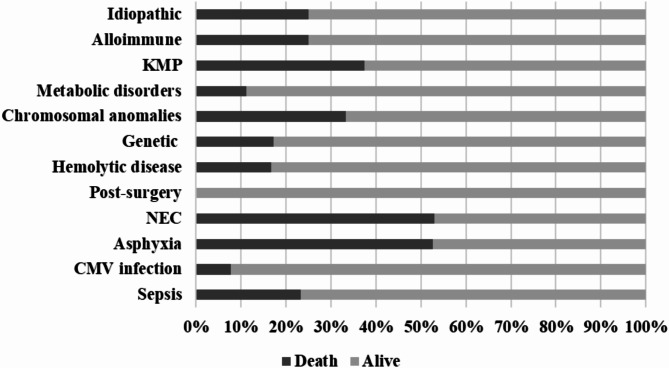
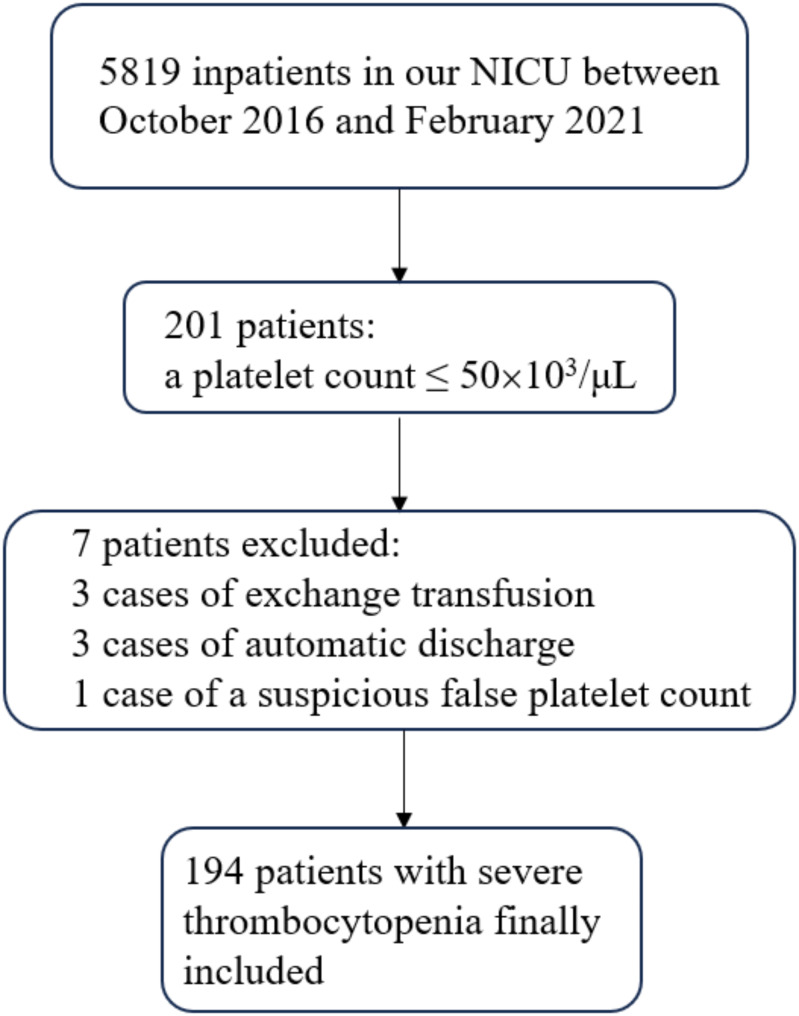
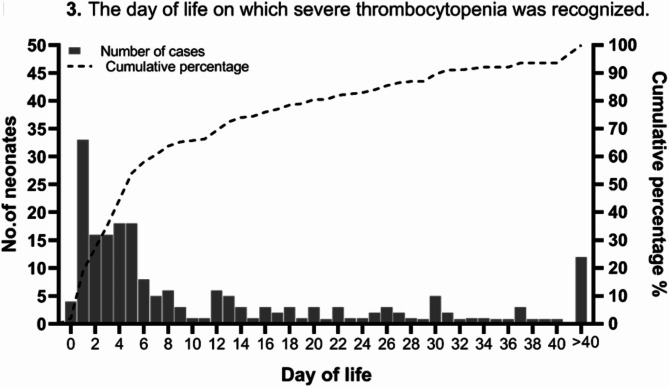
Results: Among the 5819 inpatients, 194 with severe thrombocytopenia were included in this study, with 64.4% of the cases manifesting thrombocytopenia within 72 h of life. The highest incidence was recorded among extremely low birth weight neonates (6.5%). The main etiologies included sepsis (22.2%), genetic syndromes (14.4%), perinatal asphyxia (9.8%), necrotizing enterocolitis (NEC; 8.8%), and cytomegalovirus infection (6.7%). The median platelet nadir was 5.0 × 10³/µL [IQR:2.0 × 10³/µL-16.0 × 103/µL], and 112 patients developed very severe thrombocytopenia (platelet counts ≤ 30 × 103/µL), of which 21.4% were associated with late-onset sepsis. In 45 culture-positive cases, the gram-negative group had a lower level of platelets (mean [SD]: 28 [11]×103/µL) as compared to the gram-positive group (mean [SD]: 39 [12]×103/µL). A total of 120 cases (61.9%) exhibited evidence of hemorrhage, with patients diagnosed with NEC demonstrating the highest incidence of hemorrhage at 58.8%. The platelet counts took a median of 10 days to recover: 11 and 7 days for early and late-onset cases; 15 days without and 21 days with platelet transfusions, respectively. The overall mortality rate was 26.8%. The causes of severe thrombocytopenia in 32.7%, 19.2%, and 17.3% of patients who died were identified as sepsis, birth asphyxia, and NEC, respectively. The levels of PT (P = 0.025), APTT (P = 0.046), and lactate (P = 0.028) were lower among surviving patients.
Conclusions: Sepsis, genetic syndromes, and perinatal asphyxia are the predominant etiologies of severe neonatal thrombocytopenia in China. The overall prognosis of severe neonatal thrombocytopenia is poor, but its severity and outcome were related to laboratory results (PT, APTT, and lactate) and the underlying etiology.
期刊介绍:
BMC Pediatrics is an open access journal publishing peer-reviewed research articles in all aspects of health care in neonates, children and adolescents, as well as related molecular genetics, pathophysiology, and epidemiology.



 京公网安备 11010802042870号
京ICP备2023020795号-1
京公网安备 11010802042870号
京ICP备2023020795号-1

 分享
分享
 求助内容:
求助内容: 应助结果提醒方式:
 扫码关注我们
