Luiz Felipe de Paiva Lourenção, Fabíola Isabel Suano-Souza, Fernando Luiz Affonso Fonseca, Tânia Mara Rodrigues Simões, Rosangela da Silva, Roseli Oselka Saccardo Sarni
{"title":"Impact of inflammation on anemia in children: a cross-sectional study.","authors":"Luiz Felipe de Paiva Lourenção, Fabíola Isabel Suano-Souza, Fernando Luiz Affonso Fonseca, Tânia Mara Rodrigues Simões, Rosangela da Silva, Roseli Oselka Saccardo Sarni","doi":"10.1186/s12887-025-05639-z","DOIUrl":null,"url":null,"abstract":"<p><strong>Introduction: </strong>The association of inflammation and iron deficiency could be related to up to 40% of anemia in young children.</p><p><strong>Objective: </strong>To describe the anemia and iron deficiency in children and verify possible associations with dietary practices, nutritional status and inflammatory markers.</p><p><strong>Methods: </strong>This cross-sectional study was conducted with one hundred and twelve children aged between 6 months and 3 years in Early Childhood Education Centers in Minas Gerais, Brazil. Nutritional status regarding iron and inflammatory markers was assessed using the reference values proposed by the World Health Organization.</p><p><strong>Results: </strong>Anemia and iron deficiency were observed in 58 (51.8%) and 89 (79.5%), respectively, of children evaluated. Hemoglobin values were directly associated with the z-score of height for age after adjusting for high-sensitivity C-reactive protein values (β-adjusted = 0.375; 95% CI 0.088 to 0.662; p = 0.011). The values of high-sensitivity C-reactive protein correlated directly with RDW (r = 0.202; p = 0.033), ferritin (r = 0.425; p < 0.001) and soluble transferrin receptor (r = 0.446; p < 0.001), and inversely with hemoglobin (r = -0.287; p = 0.002), serum iron (r = -0.580; p < 0.001) and transferrin saturation index (r = -0.528; p < 0.001). The ROC curve shows that RDW (AUC = 0.708; CI 95% 0.612 to 0.803) and soluble transferrin receptor (AUC = 0.588; 95% CI 0.481 to 0.694) were the variables that showed the better level of discrimination of anemia.</p><p><strong>Conclusions: </strong>The prevalence of anemia was higher than in national studies, and there was a correlation between inflammatory markers and biomarkers of iron nutritional status.</p>","PeriodicalId":9144,"journal":{"name":"BMC Pediatrics","volume":"25 1","pages":"272"},"PeriodicalIF":2.0000,"publicationDate":"2025-04-03","publicationTypes":"Journal Article","fieldsOfStudy":null,"isOpenAccess":false,"openAccessPdf":"https://www.ncbi.nlm.nih.gov/pmc/articles/PMC11967137/pdf/","citationCount":"0","resultStr":null,"platform":"Semanticscholar","paperid":null,"PeriodicalName":"BMC Pediatrics","FirstCategoryId":"3","ListUrlMain":"https://doi.org/10.1186/s12887-025-05639-z","RegionNum":3,"RegionCategory":"医学","ArticlePicture":[],"TitleCN":null,"AbstractTextCN":null,"PMCID":null,"EPubDate":"","PubModel":"","JCR":"Q2","JCRName":"PEDIATRICS","Score":null,"Total":0}
引用次数: 0
Abstract
Introduction: The association of inflammation and iron deficiency could be related to up to 40% of anemia in young children.
Objective: To describe the anemia and iron deficiency in children and verify possible associations with dietary practices, nutritional status and inflammatory markers.
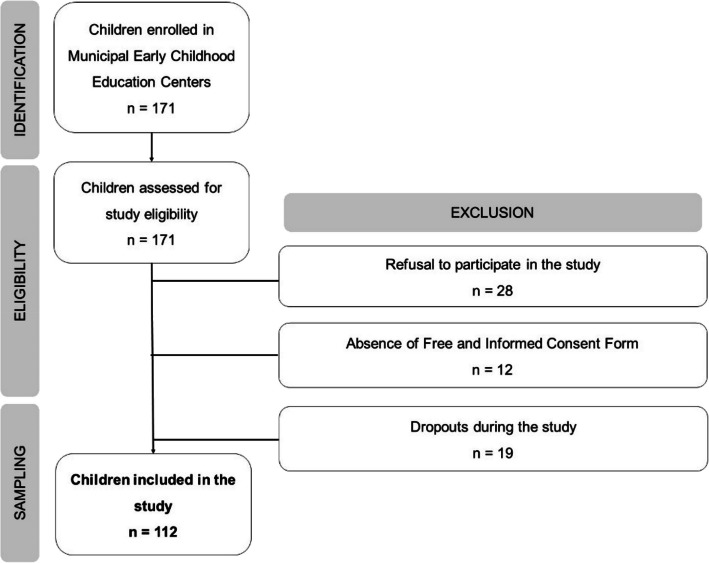
Methods: This cross-sectional study was conducted with one hundred and twelve children aged between 6 months and 3 years in Early Childhood Education Centers in Minas Gerais, Brazil. Nutritional status regarding iron and inflammatory markers was assessed using the reference values proposed by the World Health Organization.
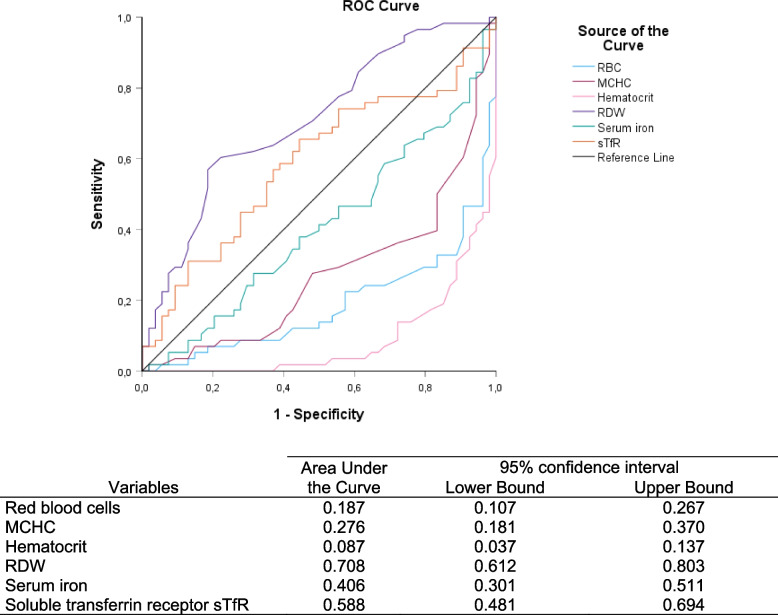
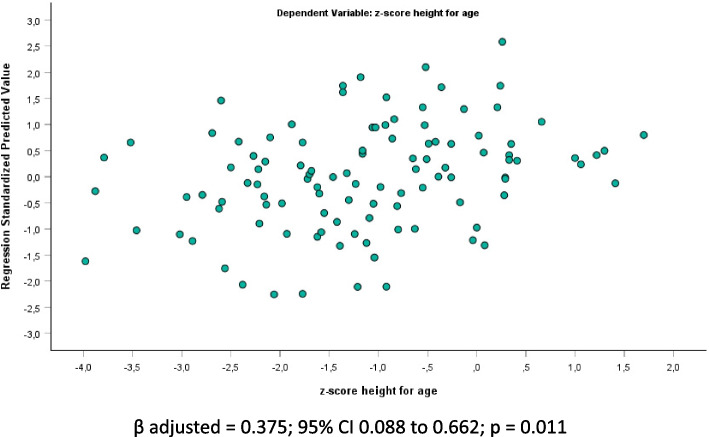
Results: Anemia and iron deficiency were observed in 58 (51.8%) and 89 (79.5%), respectively, of children evaluated. Hemoglobin values were directly associated with the z-score of height for age after adjusting for high-sensitivity C-reactive protein values (β-adjusted = 0.375; 95% CI 0.088 to 0.662; p = 0.011). The values of high-sensitivity C-reactive protein correlated directly with RDW (r = 0.202; p = 0.033), ferritin (r = 0.425; p < 0.001) and soluble transferrin receptor (r = 0.446; p < 0.001), and inversely with hemoglobin (r = -0.287; p = 0.002), serum iron (r = -0.580; p < 0.001) and transferrin saturation index (r = -0.528; p < 0.001). The ROC curve shows that RDW (AUC = 0.708; CI 95% 0.612 to 0.803) and soluble transferrin receptor (AUC = 0.588; 95% CI 0.481 to 0.694) were the variables that showed the better level of discrimination of anemia.
Conclusions: The prevalence of anemia was higher than in national studies, and there was a correlation between inflammatory markers and biomarkers of iron nutritional status.
期刊介绍:
BMC Pediatrics is an open access journal publishing peer-reviewed research articles in all aspects of health care in neonates, children and adolescents, as well as related molecular genetics, pathophysiology, and epidemiology.



 京公网安备 11010802042870号
京ICP备2023020795号-1
京公网安备 11010802042870号
京ICP备2023020795号-1

 分享
分享
 求助内容:
求助内容: 应助结果提醒方式:
 扫码关注我们
