Kai Zhou, Xiao Hu, Xuesong Yang, Yan Wu, Ke Ji, Xin Ji, Ji Zhang, Xiaojiang Wu, ZhongWu Li, Anqiang Wang, Yusheng Wang, Zhaode Bu
{"title":"Clinicopathologic characteristics and prognostic factors of pure gastric neuroendocrine carcinoma patients undergoing radical surgery.","authors":"Kai Zhou, Xiao Hu, Xuesong Yang, Yan Wu, Ke Ji, Xin Ji, Ji Zhang, Xiaojiang Wu, ZhongWu Li, Anqiang Wang, Yusheng Wang, Zhaode Bu","doi":"10.1186/s12885-025-13953-z","DOIUrl":null,"url":null,"abstract":"<p><strong>Background: </strong>There is a low incidence of gastric neuroendocrine carcinoma (G-NEC), but it is associated with particularly aggressive biological behaviours and poor prognosis compared with other gastric neoplasms. Our study aimed to investigate the clinicopathologic traits and prognostic factors of patients with pure gastric neuroendocrine carcinoma treated with radical surgery.</p><p><strong>Methods: </strong>We retrospectively analysed 60 patients with pure G-NEC who underwent radical gastrectomy between March 2010 and May 2019. 68 patient who underwent curative surgery for mixed gastric adenoneuroendocrine carcinoma (G-ANEC) from August 2012 to June 2022. The relationships between the clinicopathologic characteristics of pure G-NEC and overall survival (OS) and disease-free survival (DFS), as well as the comparison of pure-NEC with G-ANEC in terms of prognosis and treatment regimens, were evaluated using the Kaplan-Meier method and (or) Cox regression.</p><p><strong>Results: </strong>The gastroesophageal junction (GEJ) was the predilection site for G-NEC. Tumor location, histology, and lymph node metastasis status were independent prognostic factors for OS (P < 0.05). Pathological T stage and the presence or absence of lymph node metastasis were independently associated variables with DFS (P = 0.019 and P = 0.041). Large cell neuroendocrine carcinoma (LCGNEC) did not differ statistically from the small cell neuroendocrine carcinoma (SCGNEC) (P = 0.314) for OS, while mixed type (MGNEC) vs. LCGNEC did differ significantly (P = 0.031). There were no significant differences in OS and DFS between etoposide and cisplatin (EP) and S-1 + oxaliplatin (SOX) / oxaliplatin + capecitabine (XELOX). The study of 106 patients found no significant impact of NEC proportion on OS (P = 0.438) or DFS (P = 0.079). Neoadjuvant/adjuvant chemotherapy targeting NEC versus adenocarcinoma showed no statistical difference in OS (P = 0.415, P = 0.350), but there was a trend toward longer survival with NEC-targeted regimen.</p><p><strong>Conclusions: </strong>The LCGNEC did not differ statistically from the SCGNEC for OS, while the MGNEC vs. LCGNEC were different. The prognosis of G-NEC was related to the tumor location, histology, postoperative T stage, and lymph node metastasis. For gastric neuroendocrine carcinoma, prognosis does not differ statistically by NEC proportion. Chemotherapy regimens targeting lymph node metastases with an NEC component maybe better prognosis than those focusing on the adenocarcinoma component.</p>","PeriodicalId":9131,"journal":{"name":"BMC Cancer","volume":"25 1","pages":"606"},"PeriodicalIF":3.4000,"publicationDate":"2025-04-03","publicationTypes":"Journal Article","fieldsOfStudy":null,"isOpenAccess":false,"openAccessPdf":"https://www.ncbi.nlm.nih.gov/pmc/articles/PMC11970028/pdf/","citationCount":"0","resultStr":null,"platform":"Semanticscholar","paperid":null,"PeriodicalName":"BMC Cancer","FirstCategoryId":"3","ListUrlMain":"https://doi.org/10.1186/s12885-025-13953-z","RegionNum":2,"RegionCategory":"医学","ArticlePicture":[],"TitleCN":null,"AbstractTextCN":null,"PMCID":null,"EPubDate":"","PubModel":"","JCR":"Q2","JCRName":"ONCOLOGY","Score":null,"Total":0}
引用次数: 0
Abstract
Background: There is a low incidence of gastric neuroendocrine carcinoma (G-NEC), but it is associated with particularly aggressive biological behaviours and poor prognosis compared with other gastric neoplasms. Our study aimed to investigate the clinicopathologic traits and prognostic factors of patients with pure gastric neuroendocrine carcinoma treated with radical surgery.
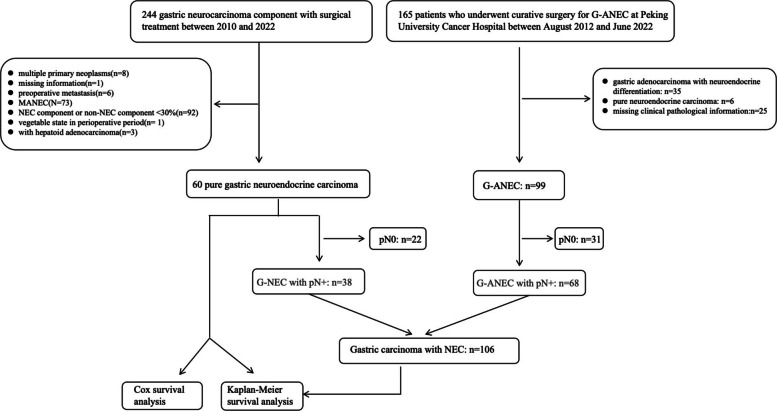
Methods: We retrospectively analysed 60 patients with pure G-NEC who underwent radical gastrectomy between March 2010 and May 2019. 68 patient who underwent curative surgery for mixed gastric adenoneuroendocrine carcinoma (G-ANEC) from August 2012 to June 2022. The relationships between the clinicopathologic characteristics of pure G-NEC and overall survival (OS) and disease-free survival (DFS), as well as the comparison of pure-NEC with G-ANEC in terms of prognosis and treatment regimens, were evaluated using the Kaplan-Meier method and (or) Cox regression.
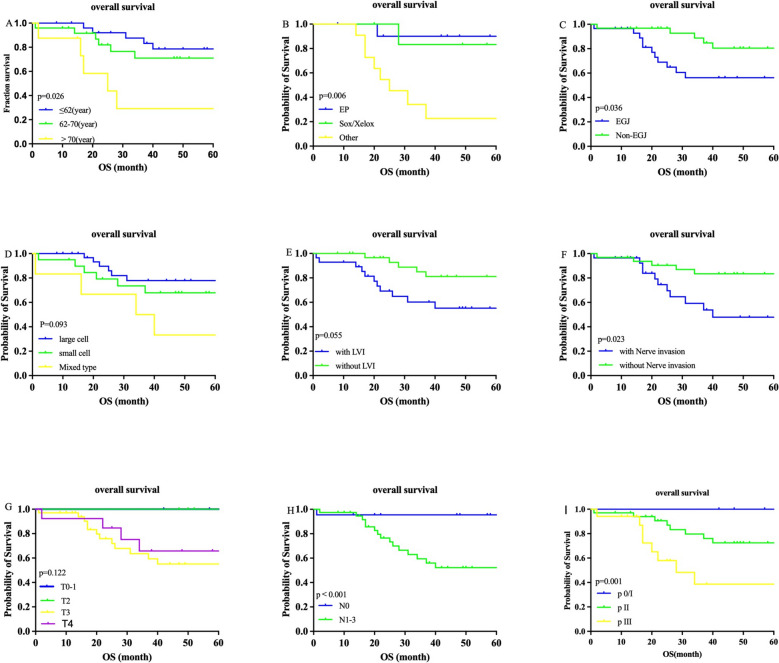
Results: The gastroesophageal junction (GEJ) was the predilection site for G-NEC. Tumor location, histology, and lymph node metastasis status were independent prognostic factors for OS (P < 0.05). Pathological T stage and the presence or absence of lymph node metastasis were independently associated variables with DFS (P = 0.019 and P = 0.041). Large cell neuroendocrine carcinoma (LCGNEC) did not differ statistically from the small cell neuroendocrine carcinoma (SCGNEC) (P = 0.314) for OS, while mixed type (MGNEC) vs. LCGNEC did differ significantly (P = 0.031). There were no significant differences in OS and DFS between etoposide and cisplatin (EP) and S-1 + oxaliplatin (SOX) / oxaliplatin + capecitabine (XELOX). The study of 106 patients found no significant impact of NEC proportion on OS (P = 0.438) or DFS (P = 0.079). Neoadjuvant/adjuvant chemotherapy targeting NEC versus adenocarcinoma showed no statistical difference in OS (P = 0.415, P = 0.350), but there was a trend toward longer survival with NEC-targeted regimen.
Conclusions: The LCGNEC did not differ statistically from the SCGNEC for OS, while the MGNEC vs. LCGNEC were different. The prognosis of G-NEC was related to the tumor location, histology, postoperative T stage, and lymph node metastasis. For gastric neuroendocrine carcinoma, prognosis does not differ statistically by NEC proportion. Chemotherapy regimens targeting lymph node metastases with an NEC component maybe better prognosis than those focusing on the adenocarcinoma component.
期刊介绍:
BMC Cancer is an open access, peer-reviewed journal that considers articles on all aspects of cancer research, including the pathophysiology, prevention, diagnosis and treatment of cancers. The journal welcomes submissions concerning molecular and cellular biology, genetics, epidemiology, and clinical trials.




 京公网安备 11010802042870号
京ICP备2023020795号-1
京公网安备 11010802042870号
京ICP备2023020795号-1

 分享
分享
 求助内容:
求助内容: 应助结果提醒方式:
 扫码关注我们
