James T Yoon, Yinglu Zhou, Mariia Mikhaleva, Daniel S Choi, Stacey M Fernandes, Philippe Armand, Amy C Bessnow, Jennifer L Crombie, David C Fisher, Eric D Jacobsen, Caron A Jacobson, Austin I Kim, Ann S LaCasce, Reid W Merryman, Oreofe O Odejide, Erin M Parry, David A Qualls, Christine E Ryan, Aswin Sekar, Jacob D Soumerai, Jon Arnason, Svitlana Tyekucheva, Matthew S Davids, Jennifer R Brown, Inhye E Ahn
{"title":"Characteristics and outcomes of patients with double refractory and double exposed chronic lymphocytic leukemia.","authors":"James T Yoon, Yinglu Zhou, Mariia Mikhaleva, Daniel S Choi, Stacey M Fernandes, Philippe Armand, Amy C Bessnow, Jennifer L Crombie, David C Fisher, Eric D Jacobsen, Caron A Jacobson, Austin I Kim, Ann S LaCasce, Reid W Merryman, Oreofe O Odejide, Erin M Parry, David A Qualls, Christine E Ryan, Aswin Sekar, Jacob D Soumerai, Jon Arnason, Svitlana Tyekucheva, Matthew S Davids, Jennifer R Brown, Inhye E Ahn","doi":"10.1182/bloodadvances.2025016006","DOIUrl":null,"url":null,"abstract":"<p><strong>Abstract: </strong>We analyzed the characteristics and outcomes of 95 patients with chronic lymphocytic leukemia (CLL) after Bruton tyrosine kinase inhibitor (BTKi) and B-cell lymphoma 2 inhibitor (BCL2i) failure. To clearly distinguish sensitivity and resistance to the targeted treatment classes, we defined double refractory (DR) CLL when progressive disease occurred during active treatment with a BTKi and a BCL2i, given sequentially or in combination, and double exposed (DE) disease when treatment with either or both of these agents was discontinued due to reasons other than progression. Thirty patients (31.6%) had DR CLL, and 65 (63.2%) had DE CLL. The DR group more frequently had unmutated immunoglobulin gene heavy chain variable (97%), TP53 aberration (73%), and BTK mutations (59%) than the DE group (75%, 46%, and 27%, respectively). The median number of total lines of therapy was 6 for DR and 3 for DE. Nearly all DR patients (97%) required subsequent therapy after developing DR CLL. The most commonly used treatment was noncovalent BTKis (34%), followed by concurrent covalent BTKi and BCL2i (28%) and CD19 chimeric antigen receptor-modified T cells (24%). Treatment for DE CLL was less frequently observed (26%). The median overall survival (OS) was 2.2 years once DR developed, despite the frequent initial responses to noncovalent BTKis or cellular therapy in the cohort. Patients with DE CLL demonstrated favorable survival (median OS not reached) and durable response to subsequent therapy.</p>","PeriodicalId":9228,"journal":{"name":"Blood advances","volume":" ","pages":"2808-2817"},"PeriodicalIF":7.1000,"publicationDate":"2025-06-10","publicationTypes":"Journal Article","fieldsOfStudy":null,"isOpenAccess":false,"openAccessPdf":"https://www.ncbi.nlm.nih.gov/pmc/articles/PMC12167808/pdf/","citationCount":"0","resultStr":null,"platform":"Semanticscholar","paperid":null,"PeriodicalName":"Blood advances","FirstCategoryId":"3","ListUrlMain":"https://doi.org/10.1182/bloodadvances.2025016006","RegionNum":1,"RegionCategory":"医学","ArticlePicture":[],"TitleCN":null,"AbstractTextCN":null,"PMCID":null,"EPubDate":"","PubModel":"","JCR":"Q1","JCRName":"HEMATOLOGY","Score":null,"Total":0}
引用次数: 0
Abstract
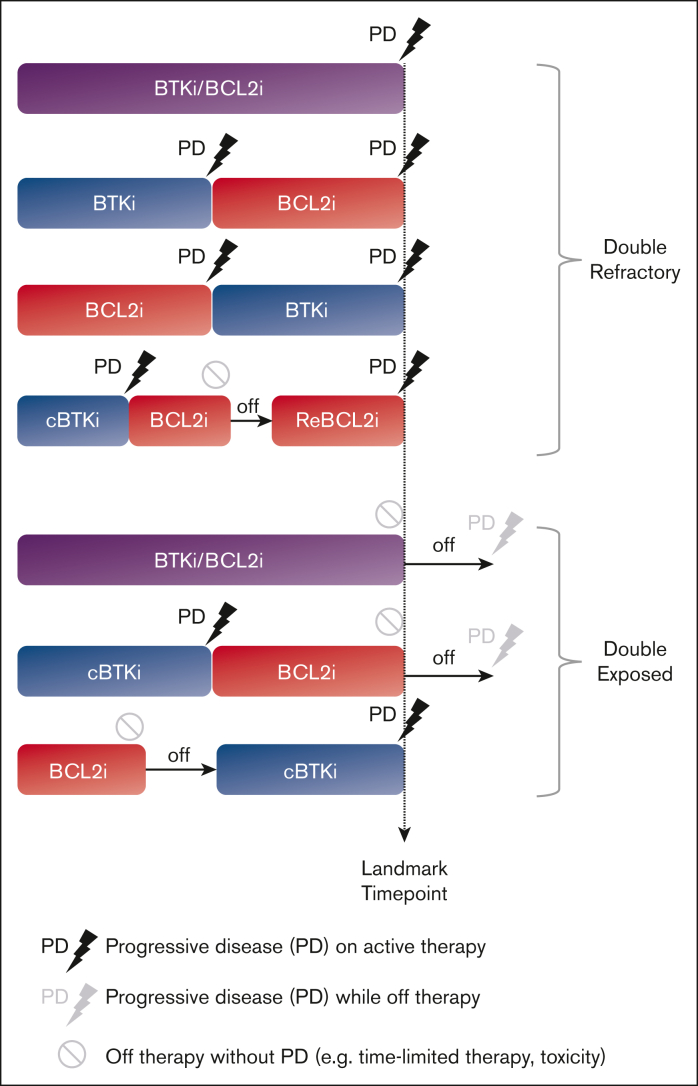
Abstract: We analyzed the characteristics and outcomes of 95 patients with chronic lymphocytic leukemia (CLL) after Bruton tyrosine kinase inhibitor (BTKi) and B-cell lymphoma 2 inhibitor (BCL2i) failure. To clearly distinguish sensitivity and resistance to the targeted treatment classes, we defined double refractory (DR) CLL when progressive disease occurred during active treatment with a BTKi and a BCL2i, given sequentially or in combination, and double exposed (DE) disease when treatment with either or both of these agents was discontinued due to reasons other than progression. Thirty patients (31.6%) had DR CLL, and 65 (63.2%) had DE CLL. The DR group more frequently had unmutated immunoglobulin gene heavy chain variable (97%), TP53 aberration (73%), and BTK mutations (59%) than the DE group (75%, 46%, and 27%, respectively). The median number of total lines of therapy was 6 for DR and 3 for DE. Nearly all DR patients (97%) required subsequent therapy after developing DR CLL. The most commonly used treatment was noncovalent BTKis (34%), followed by concurrent covalent BTKi and BCL2i (28%) and CD19 chimeric antigen receptor-modified T cells (24%). Treatment for DE CLL was less frequently observed (26%). The median overall survival (OS) was 2.2 years once DR developed, despite the frequent initial responses to noncovalent BTKis or cellular therapy in the cohort. Patients with DE CLL demonstrated favorable survival (median OS not reached) and durable response to subsequent therapy.
期刊介绍:
Blood Advances, a semimonthly medical journal published by the American Society of Hematology, marks the first addition to the Blood family in 70 years. This peer-reviewed, online-only, open-access journal was launched under the leadership of founding editor-in-chief Robert Negrin, MD, from Stanford University Medical Center in Stanford, CA, with its inaugural issue released on November 29, 2016.
Blood Advances serves as an international platform for original articles detailing basic laboratory, translational, and clinical investigations in hematology. The journal comprehensively covers all aspects of hematology, including disorders of leukocytes (both benign and malignant), erythrocytes, platelets, hemostatic mechanisms, vascular biology, immunology, and hematologic oncology. Each article undergoes a rigorous peer-review process, with selection based on the originality of the findings, the high quality of the work presented, and the clarity of the presentation.





 京公网安备 11010802042870号
京ICP备2023020795号-1
京公网安备 11010802042870号
京ICP备2023020795号-1

 分享
分享
 求助内容:
求助内容: 应助结果提醒方式:
 扫码关注我们
