Yimin Pang, Junjun Li, Hao Hu, Carolina Oi Lam Ung
{"title":"Genetic associations of prostate cancer in China: a systematic review.","authors":"Yimin Pang, Junjun Li, Hao Hu, Carolina Oi Lam Ung","doi":"10.1186/s12885-025-13830-9","DOIUrl":null,"url":null,"abstract":"<p><strong>Objectives: </strong>In recent years, there has been a notable increase in the incidence and mortality rates of prostate cancer (PCa) in China, highlighting it as a significant public health issue. This study aimed to investigate the genetic association of PCa in China to better inform national disease management and medical resource allocation.</p><p><strong>Methods: </strong>A systematic literature review was conducted using 5 English databases (Web of Science, PubMed, Embase, Cochrane, Scopus) and 1 Chinese database (CNKI) to identify articles published from database inception to October 8, 2022, which reported the genetic associations of PCa in China.</p><p><strong>Results: </strong>Of the 11,195 articles retrieved, 41 were included in the review. A total of 116 different polymorphisms (including single nucleotide polymorphisms, deletions, insertions, and repeat lengths) in 58 genes were studied in Chinese populations. Among these, 37 out of 51 polymorphisms in 28 candidate genes such as BIRC5, C2orf43, COX-2, CYR61 (IGFBP10), DNMT1, DNMT3B, EXO1, FOXP4, and 7 unmapped SNPs were found to have either a positive or negative effect on PCa risk. However, 18 variants in 5 genes remain controversial across different studies. Additionally, 23 SNPs in 16 genes were reported to be associated with disease stage, Gleason score, PSA levels, PCa risk, and clinicopathological characteristics of PCa in China.</p><p><strong>Conclusion: </strong>In Chinese populations, PCa risk and clinical features may result from individual genes, gene-gene interactions, and gene-environment interactions. These findings provide important insights into the relationship between genetic susceptibility and PCa risk in Chinese men.</p>","PeriodicalId":9131,"journal":{"name":"BMC Cancer","volume":"25 1","pages":"604"},"PeriodicalIF":3.4000,"publicationDate":"2025-04-03","publicationTypes":"Journal Article","fieldsOfStudy":null,"isOpenAccess":false,"openAccessPdf":"https://www.ncbi.nlm.nih.gov/pmc/articles/PMC11966891/pdf/","citationCount":"0","resultStr":null,"platform":"Semanticscholar","paperid":null,"PeriodicalName":"BMC Cancer","FirstCategoryId":"3","ListUrlMain":"https://doi.org/10.1186/s12885-025-13830-9","RegionNum":2,"RegionCategory":"医学","ArticlePicture":[],"TitleCN":null,"AbstractTextCN":null,"PMCID":null,"EPubDate":"","PubModel":"","JCR":"Q2","JCRName":"ONCOLOGY","Score":null,"Total":0}
引用次数: 0
Abstract
Objectives: In recent years, there has been a notable increase in the incidence and mortality rates of prostate cancer (PCa) in China, highlighting it as a significant public health issue. This study aimed to investigate the genetic association of PCa in China to better inform national disease management and medical resource allocation.
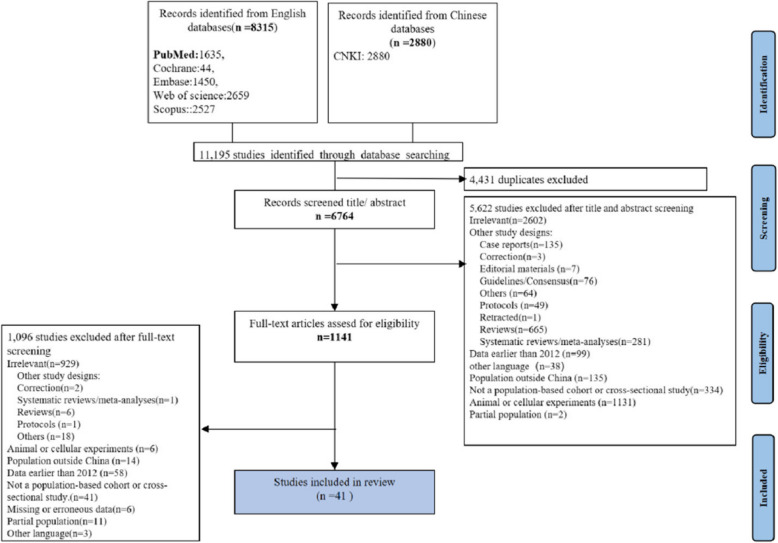
Methods: A systematic literature review was conducted using 5 English databases (Web of Science, PubMed, Embase, Cochrane, Scopus) and 1 Chinese database (CNKI) to identify articles published from database inception to October 8, 2022, which reported the genetic associations of PCa in China.
Results: Of the 11,195 articles retrieved, 41 were included in the review. A total of 116 different polymorphisms (including single nucleotide polymorphisms, deletions, insertions, and repeat lengths) in 58 genes were studied in Chinese populations. Among these, 37 out of 51 polymorphisms in 28 candidate genes such as BIRC5, C2orf43, COX-2, CYR61 (IGFBP10), DNMT1, DNMT3B, EXO1, FOXP4, and 7 unmapped SNPs were found to have either a positive or negative effect on PCa risk. However, 18 variants in 5 genes remain controversial across different studies. Additionally, 23 SNPs in 16 genes were reported to be associated with disease stage, Gleason score, PSA levels, PCa risk, and clinicopathological characteristics of PCa in China.
Conclusion: In Chinese populations, PCa risk and clinical features may result from individual genes, gene-gene interactions, and gene-environment interactions. These findings provide important insights into the relationship between genetic susceptibility and PCa risk in Chinese men.
目的:近年来,前列腺癌(PCa)在中国的发病率和死亡率显著上升,突显出前列腺癌是一个重大的公共卫生问题。本研究旨在了解中国前列腺癌的遗传关系,为国家疾病管理和医疗资源配置提供更好的信息。方法:采用5个英文数据库(Web of Science、PubMed、Embase、Cochrane、Scopus)和1个中文数据库(CNKI)进行系统文献综述,筛选自建库至2022年10月8日发表的有关中国PCa遗传关联的文章。结果:在检索到的11195篇文献中,有41篇被纳入本综述。研究了中国人群中58个基因的116种不同多态性(包括单核苷酸多态性、缺失、插入和重复长度)。其中,在BIRC5、C2orf43、COX-2、CYR61 (IGFBP10)、DNMT1、DNMT3B、EXO1、FOXP4等28个候选基因的51个多态性中,有37个被发现对PCa风险有积极或消极的影响。然而,在不同的研究中,5个基因的18个变体仍然存在争议。此外,16个基因中的23个snp被报道与中国PCa的疾病分期、Gleason评分、PSA水平、PCa风险和临床病理特征相关。结论:在中国人群中,前列腺癌的风险和临床特征可能与个体基因、基因-基因相互作用以及基因-环境相互作用有关。这些发现为中国男性遗传易感性与前列腺癌风险之间的关系提供了重要的见解。
期刊介绍:
BMC Cancer is an open access, peer-reviewed journal that considers articles on all aspects of cancer research, including the pathophysiology, prevention, diagnosis and treatment of cancers. The journal welcomes submissions concerning molecular and cellular biology, genetics, epidemiology, and clinical trials.



 京公网安备 11010802042870号
京ICP备2023020795号-1
京公网安备 11010802042870号
京ICP备2023020795号-1

 分享
分享
 求助内容:
求助内容: 应助结果提醒方式:
 扫码关注我们
