Austin Wesevich, Megan Woelkers, Ayodeji Adegunsoye, Adam J Wesevich, Mark J Ratain, Gabrielle Lapping-Carr
{"title":"Triaging acute chest syndrome clinical decision-making using bedside SaO2/FiO2 ratio.","authors":"Austin Wesevich, Megan Woelkers, Ayodeji Adegunsoye, Adam J Wesevich, Mark J Ratain, Gabrielle Lapping-Carr","doi":"10.1182/bloodadvances.2024015139","DOIUrl":null,"url":null,"abstract":"<p><strong>Abstract: </strong>Acute chest syndrome (ACS) severity is inconsistently defined, and its clinical course is difficult to predict. This retrospective observational study evaluated the utility of the ratio of pulse oximetry oxygen saturation (SaO2) to the fraction of inspired oxygen (SaO2/FiO2) in adult patients with ACS and its association with the clinical outcome of intensive care unit (ICU) transfer. Across all ACS hospitalizations at a tertiary medical center from 2017 to 2021, we characterized the SaO2/FiO2 ratio at 3 time points: emergency department (ED) presentation, ACS diagnosis, and antibiotic initiation. Of the 227 hospitalizations identified, 54% were female, the mean age was 29 years, 70% had hemoglobin SS, and 9% had obesity. Although ICU transfer was not strongly associated with the SaO2/FiO2 ratio at ED presentation (area under the curve [AUC], 0.59), it was strongly associated with the ratio at ACS diagnosis (AUC, 0.73) and antibiotic initiation (AUC, 0.74). Given the highest sensitivity at ACS diagnosis, a diagnostic SaO2/FiO2 cutoff of 310 was proposed for triaging likely ICU transfer (sensitivity, 63%; specificity, 82%; adjusted odds ratio, 8.94; 95% confidence interval [CI], 2.12-37.6; adjusted hazard ratio, 4.86; 95% CI, 1.91-12.4), with models adjusted for obesity, lung disease, and blood counts. This cutoff corresponds to an SaO2 acquired from pulse oximeter saturation <90% on 2 L/min nasal cannula support. We propose using the SaO2/FiO2 ratio cutoff of 310 prospectively as a simple bedside triage tool for adult patients with sickle cell disease hospitalized with ACS to be transferred to a higher level of care.</p>","PeriodicalId":9228,"journal":{"name":"Blood advances","volume":" ","pages":"2970-2979"},"PeriodicalIF":7.1000,"publicationDate":"2025-06-24","publicationTypes":"Journal Article","fieldsOfStudy":null,"isOpenAccess":false,"openAccessPdf":"https://www.ncbi.nlm.nih.gov/pmc/articles/PMC12197987/pdf/","citationCount":"0","resultStr":null,"platform":"Semanticscholar","paperid":null,"PeriodicalName":"Blood advances","FirstCategoryId":"3","ListUrlMain":"https://doi.org/10.1182/bloodadvances.2024015139","RegionNum":1,"RegionCategory":"医学","ArticlePicture":[],"TitleCN":null,"AbstractTextCN":null,"PMCID":null,"EPubDate":"","PubModel":"","JCR":"Q1","JCRName":"HEMATOLOGY","Score":null,"Total":0}
引用次数: 0
Abstract
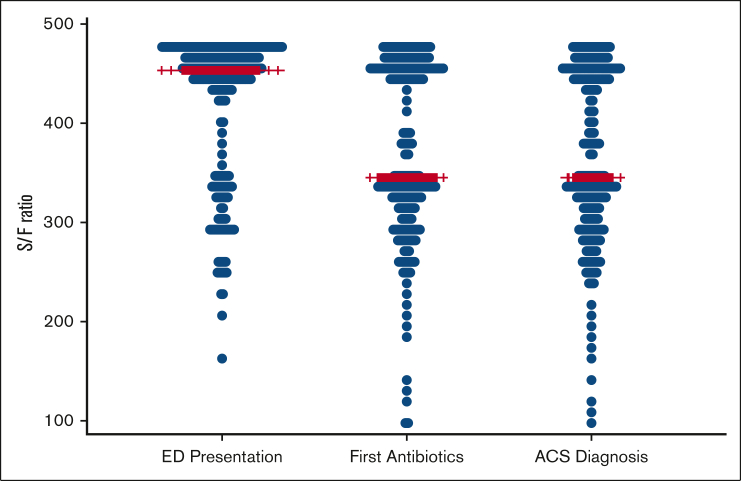
Abstract: Acute chest syndrome (ACS) severity is inconsistently defined, and its clinical course is difficult to predict. This retrospective observational study evaluated the utility of the ratio of pulse oximetry oxygen saturation (SaO2) to the fraction of inspired oxygen (SaO2/FiO2) in adult patients with ACS and its association with the clinical outcome of intensive care unit (ICU) transfer. Across all ACS hospitalizations at a tertiary medical center from 2017 to 2021, we characterized the SaO2/FiO2 ratio at 3 time points: emergency department (ED) presentation, ACS diagnosis, and antibiotic initiation. Of the 227 hospitalizations identified, 54% were female, the mean age was 29 years, 70% had hemoglobin SS, and 9% had obesity. Although ICU transfer was not strongly associated with the SaO2/FiO2 ratio at ED presentation (area under the curve [AUC], 0.59), it was strongly associated with the ratio at ACS diagnosis (AUC, 0.73) and antibiotic initiation (AUC, 0.74). Given the highest sensitivity at ACS diagnosis, a diagnostic SaO2/FiO2 cutoff of 310 was proposed for triaging likely ICU transfer (sensitivity, 63%; specificity, 82%; adjusted odds ratio, 8.94; 95% confidence interval [CI], 2.12-37.6; adjusted hazard ratio, 4.86; 95% CI, 1.91-12.4), with models adjusted for obesity, lung disease, and blood counts. This cutoff corresponds to an SaO2 acquired from pulse oximeter saturation <90% on 2 L/min nasal cannula support. We propose using the SaO2/FiO2 ratio cutoff of 310 prospectively as a simple bedside triage tool for adult patients with sickle cell disease hospitalized with ACS to be transferred to a higher level of care.
期刊介绍:
Blood Advances, a semimonthly medical journal published by the American Society of Hematology, marks the first addition to the Blood family in 70 years. This peer-reviewed, online-only, open-access journal was launched under the leadership of founding editor-in-chief Robert Negrin, MD, from Stanford University Medical Center in Stanford, CA, with its inaugural issue released on November 29, 2016.
Blood Advances serves as an international platform for original articles detailing basic laboratory, translational, and clinical investigations in hematology. The journal comprehensively covers all aspects of hematology, including disorders of leukocytes (both benign and malignant), erythrocytes, platelets, hemostatic mechanisms, vascular biology, immunology, and hematologic oncology. Each article undergoes a rigorous peer-review process, with selection based on the originality of the findings, the high quality of the work presented, and the clarity of the presentation.





 京公网安备 11010802042870号
京ICP备2023020795号-1
京公网安备 11010802042870号
京ICP备2023020795号-1

 分享
分享
 求助内容:
求助内容: 应助结果提醒方式:
 扫码关注我们
