{"title":"Sports training in virtual reality with a focus on visual perception: a systematic review.","authors":"Kerstin Witte, Dan Bürger, Stefan Pastel","doi":"10.3389/fspor.2025.1530948","DOIUrl":null,"url":null,"abstract":"<p><strong>Introduction: </strong>There is an increasing endeavor to use Virtual Reality (VR) technologies in sports training. Because visual perception is crucial for sports performance, it should also be considered in the development of VR tools. The aim of this review is to summarise the literature on the application fields and domains of sport in VR and to examine what needs to be considered when developing such VR training tools with regard to visual perception and its manipulation. Furthermore, it is still unclear to what extent the user's body or that of their teammates or opponents must be visualized in VR.</p><p><strong>Methods: </strong>The literature search was conducted based on five databases: PsychInfo, Pubmed, Scopus, SportDiscus, and IEEE Explore. Review articles and original articles written in English and published between 1 January 2015 and 31 March 2024 were considered.</p><p><strong>Results: </strong>Through a qualitative analysis of the selected research, we identified 12 reviews and 46 research articles. While the applications of VR in sports initially focussed on endurance sports at the beginning of the development of VR tools, within the last 5 years VR was found in almost all sports, such as team sports, martial arts, and individual sports. The most common sports domains in which VR is used are motor learning, training of visual perception, decision making processes, and anticipation skills, as well as many sport-specific trainings. The review provides an overview of the extent to which visual aids in VR can be used to optimize motor learning and training, also taking into account the transfer to the real world.</p><p><strong>Discussion: </strong>VR offers many opportunities to visually support sports training and motor learning. It has been shown that training in VR based purely on visual perception can be successful in many sports and sports domains. The following visualization options are already being used: different viewing perspectives, variation of the demonstrated speed of movement, use of virtual mirrors, visualization of the necessary body parts, visual manipulation to identify important stimuli, display of movement trajectories, and graphic aids. In future, more studies should be conducted to compare training under virtual conditions with training under real conditions and to investigate transfer effects. Eye tracking should also be used for this purpose in order to compare visual perception in VR and in reality. Less is known about how VR training can be realized in terms of frequency, duration, and intensity and how VR training can be combined with training in the reality world.</p>","PeriodicalId":12716,"journal":{"name":"Frontiers in Sports and Active Living","volume":"7 ","pages":"1530948"},"PeriodicalIF":2.6000,"publicationDate":"2025-03-20","publicationTypes":"Journal Article","fieldsOfStudy":null,"isOpenAccess":false,"openAccessPdf":"https://www.ncbi.nlm.nih.gov/pmc/articles/PMC11966202/pdf/","citationCount":"0","resultStr":null,"platform":"Semanticscholar","paperid":null,"PeriodicalName":"Frontiers in Sports and Active Living","FirstCategoryId":"1085","ListUrlMain":"https://doi.org/10.3389/fspor.2025.1530948","RegionNum":0,"RegionCategory":null,"ArticlePicture":[],"TitleCN":null,"AbstractTextCN":null,"PMCID":null,"EPubDate":"2025/1/1 0:00:00","PubModel":"eCollection","JCR":"Q2","JCRName":"SPORT SCIENCES","Score":null,"Total":0}
引用次数: 0
Abstract
Introduction: There is an increasing endeavor to use Virtual Reality (VR) technologies in sports training. Because visual perception is crucial for sports performance, it should also be considered in the development of VR tools. The aim of this review is to summarise the literature on the application fields and domains of sport in VR and to examine what needs to be considered when developing such VR training tools with regard to visual perception and its manipulation. Furthermore, it is still unclear to what extent the user's body or that of their teammates or opponents must be visualized in VR.
Methods: The literature search was conducted based on five databases: PsychInfo, Pubmed, Scopus, SportDiscus, and IEEE Explore. Review articles and original articles written in English and published between 1 January 2015 and 31 March 2024 were considered.
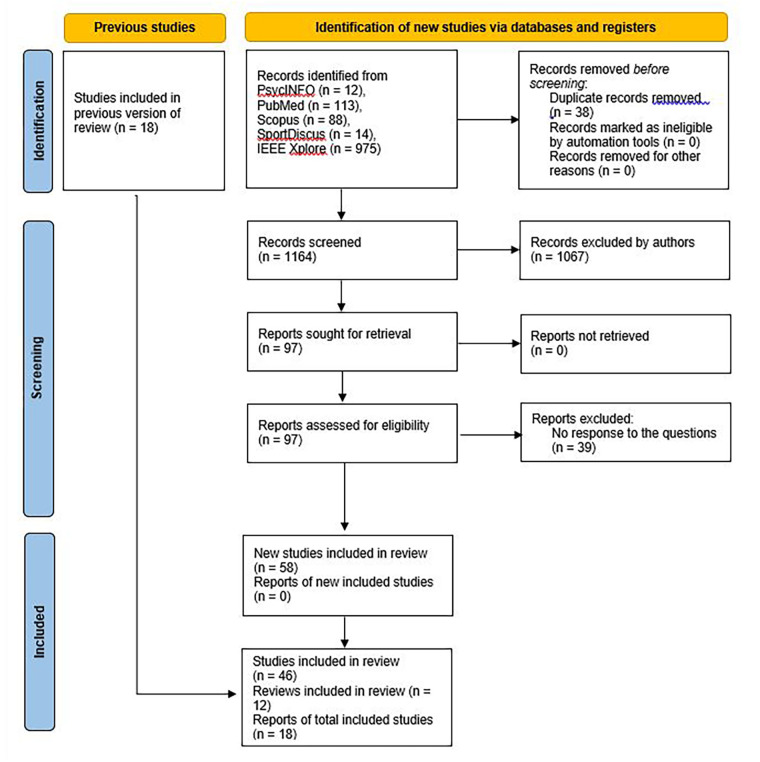
Results: Through a qualitative analysis of the selected research, we identified 12 reviews and 46 research articles. While the applications of VR in sports initially focussed on endurance sports at the beginning of the development of VR tools, within the last 5 years VR was found in almost all sports, such as team sports, martial arts, and individual sports. The most common sports domains in which VR is used are motor learning, training of visual perception, decision making processes, and anticipation skills, as well as many sport-specific trainings. The review provides an overview of the extent to which visual aids in VR can be used to optimize motor learning and training, also taking into account the transfer to the real world.
Discussion: VR offers many opportunities to visually support sports training and motor learning. It has been shown that training in VR based purely on visual perception can be successful in many sports and sports domains. The following visualization options are already being used: different viewing perspectives, variation of the demonstrated speed of movement, use of virtual mirrors, visualization of the necessary body parts, visual manipulation to identify important stimuli, display of movement trajectories, and graphic aids. In future, more studies should be conducted to compare training under virtual conditions with training under real conditions and to investigate transfer effects. Eye tracking should also be used for this purpose in order to compare visual perception in VR and in reality. Less is known about how VR training can be realized in terms of frequency, duration, and intensity and how VR training can be combined with training in the reality world.




 京公网安备 11010802042870号
京ICP备2023020795号-1
京公网安备 11010802042870号
京ICP备2023020795号-1

 分享
分享
 求助内容:
求助内容: 应助结果提醒方式:
 扫码关注我们
