Alexandra L Zilberfarb, Adesola Odunayo, Prathima Garudadri, Ashley Allen-Durrance, Chika Okafor
{"title":"The cephalic vein is readily accessible for vascular access in pediatric patients less than 12 weeks presenting to an emergency room.","authors":"Alexandra L Zilberfarb, Adesola Odunayo, Prathima Garudadri, Ashley Allen-Durrance, Chika Okafor","doi":"10.3389/fvets.2025.1495039","DOIUrl":null,"url":null,"abstract":"<p><p>Pediatric veterinary patients often require prompt medical intervention in emergency hospitals, commonly involving intravenous medications or fluids. This study aimed to characterize the most utilized venous access sites in pediatric puppies and kittens under 12 weeks of age in an emergency room setting. Ninety-four canine and 33 feline patients under 12 weeks old, with an intravenous catheter placed in the emergency room at the University of Florida, between January 1, 2021, and November 30, 2023 were included in this study. A retrospective evaluation of medical records was conducted to determine the most common vein utilized for venous access in pediatric patients. The median body weight was 4.19 kg (Q1, Q3: 2.50, 7.20) for puppies and 0.92 kgs (Q1, Q3: 0.43, 1.14) for kittens. The cephalic vein was the most common site in both species, utilized in 90.4% of puppies (85/94) and 78.8% of kittens (26/33). Puppies with lower body weights were more likely to have a catheter placed in the jugular vein; however, no significant correlation was found between the kittens' body weights and catheter site. The most used catheter size was 22G in both species. Ultimately, the cephalic vein appears to be consistently accessible for venous access in puppies and kittens under 12 weeks old, across a wide range of body weights. Catheters in the jugular vein may be preferred for puppies and kittens under 1.2 kg and 0.3 kg, respectively. Utilizing the cephalic vein for venous access may facilitate rapid and less technically challenging intravenous catheter placement in patients under 12 weeks old.</p>","PeriodicalId":12772,"journal":{"name":"Frontiers in Veterinary Science","volume":"12 ","pages":"1495039"},"PeriodicalIF":2.9000,"publicationDate":"2025-03-20","publicationTypes":"Journal Article","fieldsOfStudy":null,"isOpenAccess":false,"openAccessPdf":"https://www.ncbi.nlm.nih.gov/pmc/articles/PMC11965629/pdf/","citationCount":"0","resultStr":null,"platform":"Semanticscholar","paperid":null,"PeriodicalName":"Frontiers in Veterinary Science","FirstCategoryId":"97","ListUrlMain":"https://doi.org/10.3389/fvets.2025.1495039","RegionNum":2,"RegionCategory":"农林科学","ArticlePicture":[],"TitleCN":null,"AbstractTextCN":null,"PMCID":null,"EPubDate":"2025/1/1 0:00:00","PubModel":"eCollection","JCR":"Q1","JCRName":"VETERINARY SCIENCES","Score":null,"Total":0}
引用次数: 0
Abstract
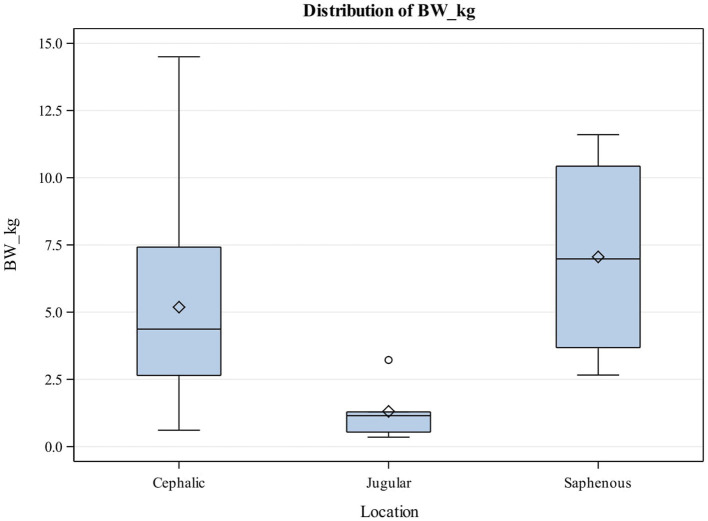
Pediatric veterinary patients often require prompt medical intervention in emergency hospitals, commonly involving intravenous medications or fluids. This study aimed to characterize the most utilized venous access sites in pediatric puppies and kittens under 12 weeks of age in an emergency room setting. Ninety-four canine and 33 feline patients under 12 weeks old, with an intravenous catheter placed in the emergency room at the University of Florida, between January 1, 2021, and November 30, 2023 were included in this study. A retrospective evaluation of medical records was conducted to determine the most common vein utilized for venous access in pediatric patients. The median body weight was 4.19 kg (Q1, Q3: 2.50, 7.20) for puppies and 0.92 kgs (Q1, Q3: 0.43, 1.14) for kittens. The cephalic vein was the most common site in both species, utilized in 90.4% of puppies (85/94) and 78.8% of kittens (26/33). Puppies with lower body weights were more likely to have a catheter placed in the jugular vein; however, no significant correlation was found between the kittens' body weights and catheter site. The most used catheter size was 22G in both species. Ultimately, the cephalic vein appears to be consistently accessible for venous access in puppies and kittens under 12 weeks old, across a wide range of body weights. Catheters in the jugular vein may be preferred for puppies and kittens under 1.2 kg and 0.3 kg, respectively. Utilizing the cephalic vein for venous access may facilitate rapid and less technically challenging intravenous catheter placement in patients under 12 weeks old.
期刊介绍:
Frontiers in Veterinary Science is a global, peer-reviewed, Open Access journal that bridges animal and human health, brings a comparative approach to medical and surgical challenges, and advances innovative biotechnology and therapy.
Veterinary research today is interdisciplinary, collaborative, and socially relevant, transforming how we understand and investigate animal health and disease. Fundamental research in emerging infectious diseases, predictive genomics, stem cell therapy, and translational modelling is grounded within the integrative social context of public and environmental health, wildlife conservation, novel biomarkers, societal well-being, and cutting-edge clinical practice and specialization. Frontiers in Veterinary Science brings a 21st-century approach—networked, collaborative, and Open Access—to communicate this progress and innovation to both the specialist and to the wider audience of readers in the field.
Frontiers in Veterinary Science publishes articles on outstanding discoveries across a wide spectrum of translational, foundational, and clinical research. The journal''s mission is to bring all relevant veterinary sciences together on a single platform with the goal of improving animal and human health.





 京公网安备 11010802042870号
京ICP备2023020795号-1
京公网安备 11010802042870号
京ICP备2023020795号-1

 分享
分享
 求助内容:
求助内容: 应助结果提醒方式:
 扫码关注我们
