Elena Beani, Mattia Franchi de 'Cavalieri, Silvia Filogna, Veronica Barzacchi, Matteo Cianchetti, Martina Maselli, Giada Martini, Valentina Menici, Giuseppe Prencipe, Elisa Sicola, Giovanni Cioni, Giuseppina Sgandurra
{"title":"Wearable sensors for measuring spontaneous upper limb use in children with unilateral cerebral palsy and typical development.","authors":"Elena Beani, Mattia Franchi de 'Cavalieri, Silvia Filogna, Veronica Barzacchi, Matteo Cianchetti, Martina Maselli, Giada Martini, Valentina Menici, Giuseppe Prencipe, Elisa Sicola, Giovanni Cioni, Giuseppina Sgandurra","doi":"10.1186/s12984-025-01601-3","DOIUrl":null,"url":null,"abstract":"<p><strong>Background: </strong>Unilateral Cerebral Palsy (UCP) is a clinical condition which mainly involves the movement and muscle tone of one side of the body, often impacting the general manual function. While there are some clinical assessment tools aimed to quantify the Upper Limbs (UpLs) use and the manual abilities, acquiring information regarding the motor abilities outside the clinical environment, such as the UpLs use and their asymmetry during daily life, could provide a more complete evaluation of the child and open a new clinical reasoning. For this purpose, wearable sensors are one of the newest approaches for continuously monitoring UpLs functions without being invasive. The aim of this study was to use wearable sensors to compare spontaneous/daily UpLs usage and asymmetry with the Assisting Hand Assessment (AHA) test, as well as comparing the daily UpLs usage behavior of children with UCP with respect to Typical Developing (TD) peers.</p><p><strong>Methods: </strong>Eighty children (54 with UCP and 26 TD) wore an Actigraph sensor on each wrist during the AHA test and then at least for the following week of daily life. The amount of use of each hand and the asymmetry were analyzed during both the AHA and the following week of daily life using linear regression analysis and ANOVA models.</p><p><strong>Results: </strong>Significant relationships were found between the asymmetry detected during the week and both the AHA scores and the asymmetry detected during the test. UCP and TD children week asymmetry distributions were significantly different; moreover, some differences were found when grouping them by MACS levels.</p><p><strong>Conclusion: </strong>This paper proposes a new and easy technological methodology for monitoring UpLs behavior in daily life. Through wearable sensor data analysis, we demonstrate a linear correlation between asymmetry measured during smi-structured assessments and daily life. Additionally, we provide evidence of distinct patterns of UpLs usage between typically developing children and children with UCP in daily life.</p><p><strong>Trial registration: </strong>Clinical Trials.gov (NCT03054441).</p>","PeriodicalId":16384,"journal":{"name":"Journal of NeuroEngineering and Rehabilitation","volume":"22 1","pages":"71"},"PeriodicalIF":5.2000,"publicationDate":"2025-04-03","publicationTypes":"Journal Article","fieldsOfStudy":null,"isOpenAccess":false,"openAccessPdf":"https://www.ncbi.nlm.nih.gov/pmc/articles/PMC11967128/pdf/","citationCount":"0","resultStr":null,"platform":"Semanticscholar","paperid":null,"PeriodicalName":"Journal of NeuroEngineering and Rehabilitation","FirstCategoryId":"5","ListUrlMain":"https://doi.org/10.1186/s12984-025-01601-3","RegionNum":2,"RegionCategory":"医学","ArticlePicture":[],"TitleCN":null,"AbstractTextCN":null,"PMCID":null,"EPubDate":"","PubModel":"","JCR":"Q1","JCRName":"ENGINEERING, BIOMEDICAL","Score":null,"Total":0}
引用次数: 0
Abstract
Background: Unilateral Cerebral Palsy (UCP) is a clinical condition which mainly involves the movement and muscle tone of one side of the body, often impacting the general manual function. While there are some clinical assessment tools aimed to quantify the Upper Limbs (UpLs) use and the manual abilities, acquiring information regarding the motor abilities outside the clinical environment, such as the UpLs use and their asymmetry during daily life, could provide a more complete evaluation of the child and open a new clinical reasoning. For this purpose, wearable sensors are one of the newest approaches for continuously monitoring UpLs functions without being invasive. The aim of this study was to use wearable sensors to compare spontaneous/daily UpLs usage and asymmetry with the Assisting Hand Assessment (AHA) test, as well as comparing the daily UpLs usage behavior of children with UCP with respect to Typical Developing (TD) peers.
Methods: Eighty children (54 with UCP and 26 TD) wore an Actigraph sensor on each wrist during the AHA test and then at least for the following week of daily life. The amount of use of each hand and the asymmetry were analyzed during both the AHA and the following week of daily life using linear regression analysis and ANOVA models.
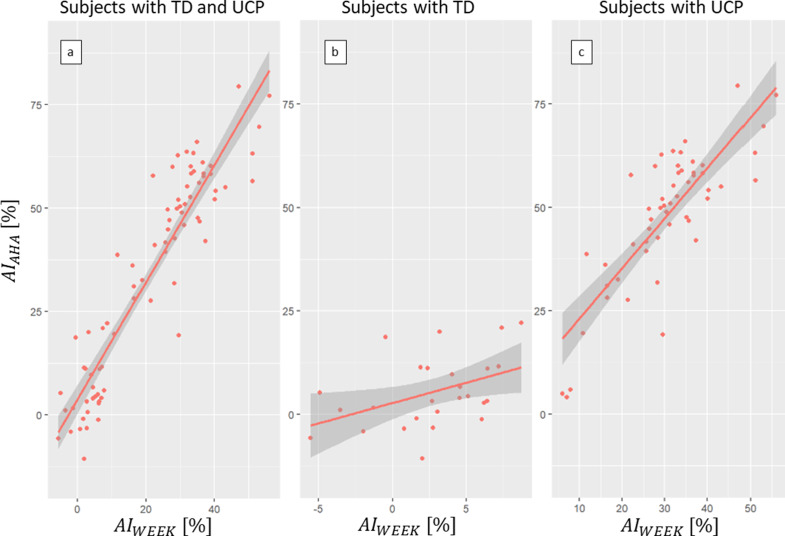
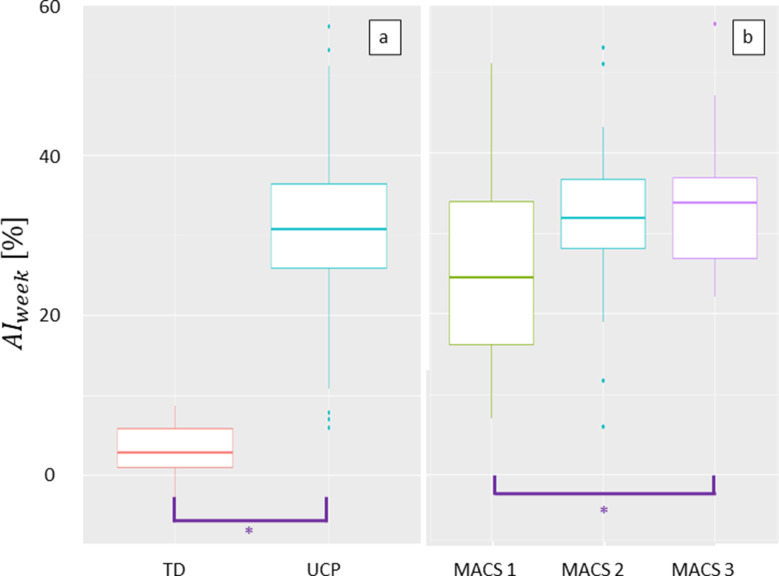
Results: Significant relationships were found between the asymmetry detected during the week and both the AHA scores and the asymmetry detected during the test. UCP and TD children week asymmetry distributions were significantly different; moreover, some differences were found when grouping them by MACS levels.
Conclusion: This paper proposes a new and easy technological methodology for monitoring UpLs behavior in daily life. Through wearable sensor data analysis, we demonstrate a linear correlation between asymmetry measured during smi-structured assessments and daily life. Additionally, we provide evidence of distinct patterns of UpLs usage between typically developing children and children with UCP in daily life.
期刊介绍:
Journal of NeuroEngineering and Rehabilitation considers manuscripts on all aspects of research that result from cross-fertilization of the fields of neuroscience, biomedical engineering, and physical medicine & rehabilitation.



 京公网安备 11010802042870号
京ICP备2023020795号-1
京公网安备 11010802042870号
京ICP备2023020795号-1

 分享
分享
 求助内容:
求助内容: 应助结果提醒方式:
 扫码关注我们
