Silvia Rojas Rueda, Hanna Sepsick, Mohammed Hammamy, Amir H. Nejat, Edwin Kee, Nathaniel C. Lawson
{"title":"The Effect of Different Surface Treatments on the Roughness, Translucency, and Staining of 3D-Printed Occlusal Device Materials","authors":"Silvia Rojas Rueda, Hanna Sepsick, Mohammed Hammamy, Amir H. Nejat, Edwin Kee, Nathaniel C. Lawson","doi":"10.1111/jerd.13476","DOIUrl":null,"url":null,"abstract":"<div>\n \n \n <section>\n \n <h3> Objectives</h3>\n \n <p>To compare surface treatments (as-printed, optical polish, resin-coated, polished) of two 3D-printed occlusal device materials (KeySplint Soft and NightGuard Flex 2) cured with or without glycerin for surface roughness, translucency, and coffee staining.</p>\n </section>\n \n <section>\n \n <h3> Materials and Methods</h3>\n \n <p>Discs (2 mm thick) from two 3D-printed occlusal resins (KeySplint Soft and NightGuard Flex 2) were printed using a DLP 3D printer (SprintRay Pro 95), cleaned (ProWash S), and cured (ProCure 2) with or without glycerin. Some specimens were printed in an optical polish tank. Specimens were either as-printed, resin-coated, or polished. Reference milled (ProArt CAD Splint) and heat-cured (Excel Formula Heat Cure Denture Base Material) specimens were also prepared. Surface roughness was analyzed using a contact profilometer. Translucency was measured using a spectrophotometer. Staining was evaluated after 24 days in coffee at 37°C. Data were analyzed with ANOVA and Tukey post hoc tests.</p>\n </section>\n \n <section>\n \n <h3> Results</h3>\n \n <p>Surface treatments and glycerin curing showed significant differences (<i>p</i> < 0.01). Polishing and resin-coating produced the smoothest surfaces. Optical polish tanks improved smoothness. Polishing increased translucency. Glycerin curing reduced staining except in polished specimens. Milled materials stained less than 3D-printed materials.</p>\n </section>\n \n <section>\n \n <h3> Conclusions</h3>\n \n <p>Polishing and resin-coating optimized roughness and translucency. Polishing or curing glycerin optimized stain resistance.</p>\n </section>\n \n <section>\n \n <h3> Clinical Significance</h3>\n \n <p>3D-printed occlusal devices should have their external surfaces polished or resin-coated and receive a final cure in glycerin to prevent staining of their internal as-printed surface. Printing in a tank with an optical polish can help to improve the roughness and translucency of the internal surface of an occlusal device.</p>\n </section>\n </div>","PeriodicalId":15988,"journal":{"name":"Journal of Esthetic and Restorative Dentistry","volume":"37 7","pages":"1940-1948"},"PeriodicalIF":4.6000,"publicationDate":"2025-04-03","publicationTypes":"Journal Article","fieldsOfStudy":null,"isOpenAccess":false,"openAccessPdf":"https://onlinelibrary.wiley.com/doi/epdf/10.1111/jerd.13476","citationCount":"0","resultStr":null,"platform":"Semanticscholar","paperid":null,"PeriodicalName":"Journal of Esthetic and Restorative Dentistry","FirstCategoryId":"3","ListUrlMain":"https://onlinelibrary.wiley.com/doi/10.1111/jerd.13476","RegionNum":3,"RegionCategory":"医学","ArticlePicture":[],"TitleCN":null,"AbstractTextCN":null,"PMCID":null,"EPubDate":"","PubModel":"","JCR":"Q1","JCRName":"DENTISTRY, ORAL SURGERY & MEDICINE","Score":null,"Total":0}
引用次数: 0
Abstract
Objectives
To compare surface treatments (as-printed, optical polish, resin-coated, polished) of two 3D-printed occlusal device materials (KeySplint Soft and NightGuard Flex 2) cured with or without glycerin for surface roughness, translucency, and coffee staining.
Materials and Methods
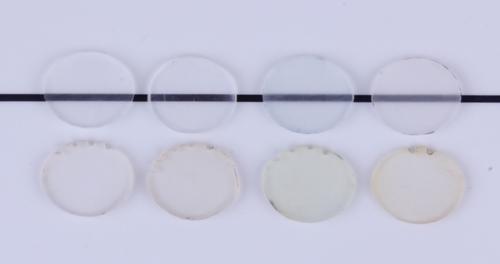
Discs (2 mm thick) from two 3D-printed occlusal resins (KeySplint Soft and NightGuard Flex 2) were printed using a DLP 3D printer (SprintRay Pro 95), cleaned (ProWash S), and cured (ProCure 2) with or without glycerin. Some specimens were printed in an optical polish tank. Specimens were either as-printed, resin-coated, or polished. Reference milled (ProArt CAD Splint) and heat-cured (Excel Formula Heat Cure Denture Base Material) specimens were also prepared. Surface roughness was analyzed using a contact profilometer. Translucency was measured using a spectrophotometer. Staining was evaluated after 24 days in coffee at 37°C. Data were analyzed with ANOVA and Tukey post hoc tests.
Results
Surface treatments and glycerin curing showed significant differences (p < 0.01). Polishing and resin-coating produced the smoothest surfaces. Optical polish tanks improved smoothness. Polishing increased translucency. Glycerin curing reduced staining except in polished specimens. Milled materials stained less than 3D-printed materials.
Conclusions
Polishing and resin-coating optimized roughness and translucency. Polishing or curing glycerin optimized stain resistance.
Clinical Significance
3D-printed occlusal devices should have their external surfaces polished or resin-coated and receive a final cure in glycerin to prevent staining of their internal as-printed surface. Printing in a tank with an optical polish can help to improve the roughness and translucency of the internal surface of an occlusal device.
期刊介绍:
The Journal of Esthetic and Restorative Dentistry (JERD) is the longest standing peer-reviewed journal devoted solely to advancing the knowledge and practice of esthetic dentistry. Its goal is to provide the very latest evidence-based information in the realm of contemporary interdisciplinary esthetic dentistry through high quality clinical papers, sound research reports and educational features.
The range of topics covered in the journal includes:
- Interdisciplinary esthetic concepts
- Implants
- Conservative adhesive restorations
- Tooth Whitening
- Prosthodontic materials and techniques
- Dental materials
- Orthodontic, periodontal and endodontic esthetics
- Esthetics related research
- Innovations in esthetics




 京公网安备 11010802042870号
京ICP备2023020795号-1
京公网安备 11010802042870号
京ICP备2023020795号-1

 分享
分享
 求助内容:
求助内容: 应助结果提醒方式:
 扫码关注我们
