WooJin Jung, Kwan Lee, Hyung-Hwan Kim, Chiyeon Lim
{"title":"How to construct analysis of covariance in clinical trials: ANCOVA with one covariate in a completely randomized design structure.","authors":"WooJin Jung, Kwan Lee, Hyung-Hwan Kim, Chiyeon Lim","doi":"10.4097/kja.24820","DOIUrl":null,"url":null,"abstract":"<p><p>Analysis of covariance (ANCOVA) is a statistical method used to assess mean differences between groups by considering factors such as covariates or fixed effects and is often used to assess efficacy endpoints in clinical trials. When performing ANCOVA, the slope of the regression model should be the same for all treatment groups, with no interaction between the group and the covariate. Therefore, before analysis, the significance of the full ANCOVA model with interactions must be tested. If the interaction in the full model is statistically significant, the model that includes the interaction should be used; otherwise, ANCOVA using a reduced model without the interaction should be performed. If the ANCOVA model is not significant, this analysis method is not appropriate and a multivariate analysis or individual regression line estimation can be considered. If the difference in means between the groups is tested by ANCOVA, the confidence interval for the adjusted mean (least-squares mean) should be calculated and tested. Because the results may change depending on the covariates used in the ANCOVA model, the covariates should be predefined before performing the analysis. If a new covariate must be defined after a clinical trial is initiated, it should be specified in the statistical analysis plan. This is considered a major amendment; thus, the covariates must be redefined before clinical trial completion and must be described in the clinical study report. A clear report describing whether the redefinition of the covariates affected the sample size or decision-making is also necessary.</p>","PeriodicalId":17855,"journal":{"name":"Korean Journal of Anesthesiology","volume":" ","pages":"315-320"},"PeriodicalIF":6.3000,"publicationDate":"2025-08-01","publicationTypes":"Journal Article","fieldsOfStudy":null,"isOpenAccess":false,"openAccessPdf":"https://www.ncbi.nlm.nih.gov/pmc/articles/PMC12326564/pdf/","citationCount":"0","resultStr":null,"platform":"Semanticscholar","paperid":null,"PeriodicalName":"Korean Journal of Anesthesiology","FirstCategoryId":"3","ListUrlMain":"https://doi.org/10.4097/kja.24820","RegionNum":4,"RegionCategory":"医学","ArticlePicture":[],"TitleCN":null,"AbstractTextCN":null,"PMCID":null,"EPubDate":"2025/4/4 0:00:00","PubModel":"Epub","JCR":"Q1","JCRName":"ANESTHESIOLOGY","Score":null,"Total":0}
引用次数: 0
Abstract
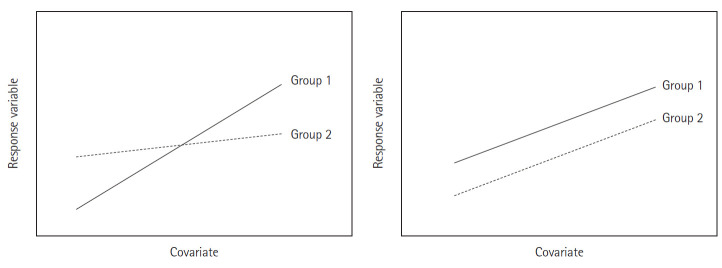
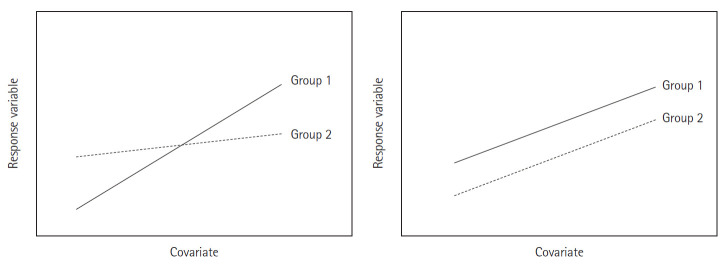
Analysis of covariance (ANCOVA) is a statistical method used to assess mean differences between groups by considering factors such as covariates or fixed effects and is often used to assess efficacy endpoints in clinical trials. When performing ANCOVA, the slope of the regression model should be the same for all treatment groups, with no interaction between the group and the covariate. Therefore, before analysis, the significance of the full ANCOVA model with interactions must be tested. If the interaction in the full model is statistically significant, the model that includes the interaction should be used; otherwise, ANCOVA using a reduced model without the interaction should be performed. If the ANCOVA model is not significant, this analysis method is not appropriate and a multivariate analysis or individual regression line estimation can be considered. If the difference in means between the groups is tested by ANCOVA, the confidence interval for the adjusted mean (least-squares mean) should be calculated and tested. Because the results may change depending on the covariates used in the ANCOVA model, the covariates should be predefined before performing the analysis. If a new covariate must be defined after a clinical trial is initiated, it should be specified in the statistical analysis plan. This is considered a major amendment; thus, the covariates must be redefined before clinical trial completion and must be described in the clinical study report. A clear report describing whether the redefinition of the covariates affected the sample size or decision-making is also necessary.




 京公网安备 11010802042870号
京ICP备2023020795号-1
京公网安备 11010802042870号
京ICP备2023020795号-1

 分享
分享
 求助内容:
求助内容: 应助结果提醒方式:
 扫码关注我们
