{"title":"A Neural Network Model for Intelligent Classification of Distal Radius Fractures Using Statistical Shape Model Extraction Features.","authors":"Xing-Bo Cai, Ze-Hui Lu, Zhi Peng, Yong-Qing Xu, Jun-Shen Huang, Hao-Tian Luo, Yu Zhao, Zhong-Qi Lou, Zi-Qi Shen, Zhang-Cong Chen, Xiong-Gang Yang, Ying Wu, Sheng Lu","doi":"10.1111/os.70034","DOIUrl":null,"url":null,"abstract":"<p><strong>Objective: </strong>Distal radius fractures account for 12%-17% of all fractures, with accurate classification being crucial for proper treatment planning. Studies have shown that in emergency settings, the misdiagnosis rate of hand/wrist fractures can reach up to 29%, particularly among non-specialist physicians due to a high workload and limited experience. While existing AI methods can detect fractures, they typically require large training datasets and are limited to fracture detection without type classification. Therefore, there is an urgent need for an efficient and accurate method that can both detect and classify different types of distal radius fractures. To develop and validate an intelligent classifier for distal radius fractures by combining a statistical shape model (SSM) with a neural network (NN) based on CT imaging data.</p><p><strong>Methods: </strong>From August 2022 to May 2023, a total of 80 CT scans were collected, including 43 normal radial bones and 37 distal radius fractures (17 Colles', 12 Barton's, and 8 Smith's fractures). We established the distal radius SSM by combining mean values with PCA (Principal Component Analysis) features and proposed six morphological indicators across four groups. The intelligent classifier (SSM + NN) was trained using SSM features as input data and different fracture types as output data. Four-fold cross-validations were performed to verify the classifier's robustness. The SSMs for both normal and fractured distal radius were successfully established based on CT data. Analysis of variance revealed significant differences in all six morphological indicators among groups (p < 0.001). The intelligent classifier achieved optimal performance when using the first 15 PCA-extracted features, with a cumulative variance contribution rate exceeding 75%. The classifier demonstrated excellent discrimination capability with a mean area under the curve (AUC) of 0.95 in four-fold cross-validation, and achieved an overall classification accuracy of 97.5% in the test set. The optimal prediction threshold range was determined to be 0.2-0.4.</p><p><strong>Results: </strong>The SSMs for both normal and fractured distal radius were successfully established based on CT data. Analysis of variance revealed significant differences in all six morphological indicators among groups (p < 0.001). The intelligent classifier achieved optimal performance when using the first 15 PCA-extracted features, with a cumulative variance contribution rate exceeding 75%. The classifier demonstrated excellent discrimination capability with a mean AUC of 0.95 in four-fold cross-validation and achieved an overall classification accuracy of 97.5% in the test set. The optimal prediction threshold range was determined to be 0.2-0.4.</p><p><strong>Conclusion: </strong>The CT-based SSM + NN intelligent classifier demonstrated excellent performance in identifying and classifying different types of distal radius fractures. This novel approach provides an efficient, accurate, and automated tool for clinical fracture diagnosis, which could potentially improve diagnostic efficiency and treatment planning in orthopedic practice.</p>","PeriodicalId":19566,"journal":{"name":"Orthopaedic Surgery","volume":" ","pages":"1513-1524"},"PeriodicalIF":2.1000,"publicationDate":"2025-05-01","publicationTypes":"Journal Article","fieldsOfStudy":null,"isOpenAccess":false,"openAccessPdf":"https://www.ncbi.nlm.nih.gov/pmc/articles/PMC12050184/pdf/","citationCount":"0","resultStr":null,"platform":"Semanticscholar","paperid":null,"PeriodicalName":"Orthopaedic Surgery","FirstCategoryId":"3","ListUrlMain":"https://doi.org/10.1111/os.70034","RegionNum":2,"RegionCategory":"医学","ArticlePicture":[],"TitleCN":null,"AbstractTextCN":null,"PMCID":null,"EPubDate":"2025/4/3 0:00:00","PubModel":"Epub","JCR":"Q2","JCRName":"ORTHOPEDICS","Score":null,"Total":0}
引用次数: 0
Abstract
Objective: Distal radius fractures account for 12%-17% of all fractures, with accurate classification being crucial for proper treatment planning. Studies have shown that in emergency settings, the misdiagnosis rate of hand/wrist fractures can reach up to 29%, particularly among non-specialist physicians due to a high workload and limited experience. While existing AI methods can detect fractures, they typically require large training datasets and are limited to fracture detection without type classification. Therefore, there is an urgent need for an efficient and accurate method that can both detect and classify different types of distal radius fractures. To develop and validate an intelligent classifier for distal radius fractures by combining a statistical shape model (SSM) with a neural network (NN) based on CT imaging data.
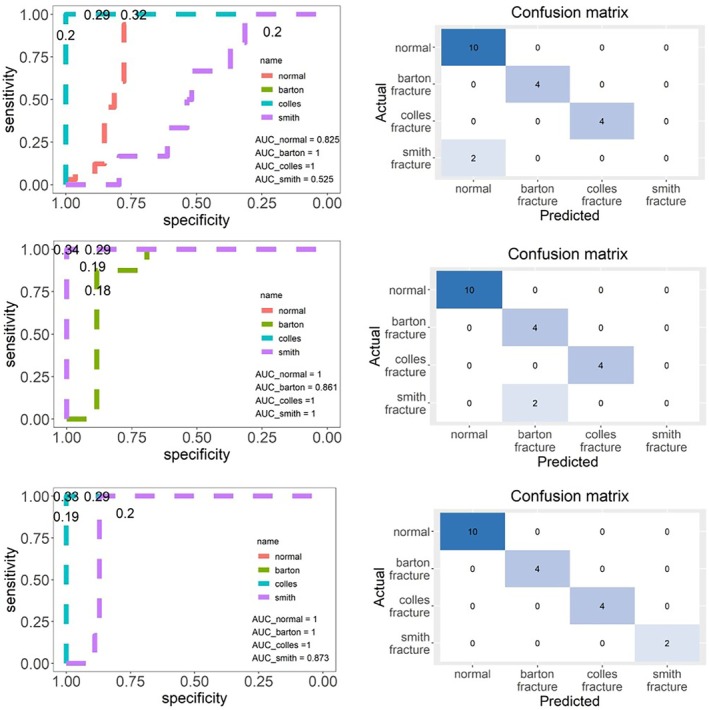
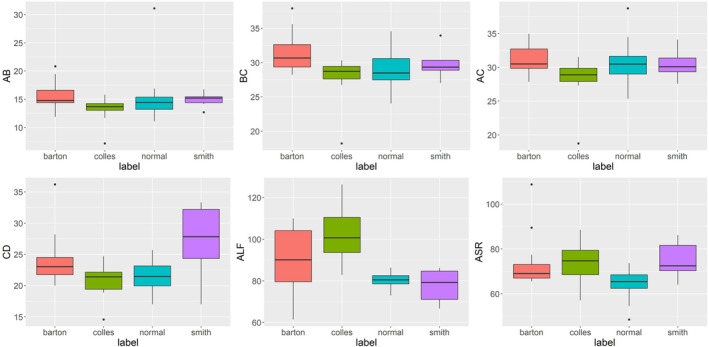
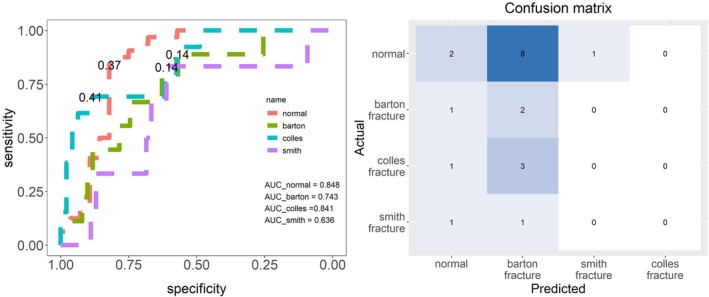
Methods: From August 2022 to May 2023, a total of 80 CT scans were collected, including 43 normal radial bones and 37 distal radius fractures (17 Colles', 12 Barton's, and 8 Smith's fractures). We established the distal radius SSM by combining mean values with PCA (Principal Component Analysis) features and proposed six morphological indicators across four groups. The intelligent classifier (SSM + NN) was trained using SSM features as input data and different fracture types as output data. Four-fold cross-validations were performed to verify the classifier's robustness. The SSMs for both normal and fractured distal radius were successfully established based on CT data. Analysis of variance revealed significant differences in all six morphological indicators among groups (p < 0.001). The intelligent classifier achieved optimal performance when using the first 15 PCA-extracted features, with a cumulative variance contribution rate exceeding 75%. The classifier demonstrated excellent discrimination capability with a mean area under the curve (AUC) of 0.95 in four-fold cross-validation, and achieved an overall classification accuracy of 97.5% in the test set. The optimal prediction threshold range was determined to be 0.2-0.4.
Results: The SSMs for both normal and fractured distal radius were successfully established based on CT data. Analysis of variance revealed significant differences in all six morphological indicators among groups (p < 0.001). The intelligent classifier achieved optimal performance when using the first 15 PCA-extracted features, with a cumulative variance contribution rate exceeding 75%. The classifier demonstrated excellent discrimination capability with a mean AUC of 0.95 in four-fold cross-validation and achieved an overall classification accuracy of 97.5% in the test set. The optimal prediction threshold range was determined to be 0.2-0.4.
Conclusion: The CT-based SSM + NN intelligent classifier demonstrated excellent performance in identifying and classifying different types of distal radius fractures. This novel approach provides an efficient, accurate, and automated tool for clinical fracture diagnosis, which could potentially improve diagnostic efficiency and treatment planning in orthopedic practice.
期刊介绍:
Orthopaedic Surgery (OS) is the official journal of the Chinese Orthopaedic Association, focusing on all aspects of orthopaedic technique and surgery.
The journal publishes peer-reviewed articles in the following categories: Original Articles, Clinical Articles, Review Articles, Guidelines, Editorials, Commentaries, Surgical Techniques, Case Reports and Meeting Reports.



 京公网安备 11010802042870号
京ICP备2023020795号-1
京公网安备 11010802042870号
京ICP备2023020795号-1

 分享
分享
 求助内容:
求助内容: 应助结果提醒方式:
 扫码关注我们
