Postoperative Variations in Shoulder Biomechanics and Kinematics in the Abduction and External Rotation Position After Remplissage With Bankart Repair for Anterior Glenohumeral Instability: A Finite Element Analysis.
Shoulong Song, Fei Zhang, Xianhao Sheng, Wentao Xiong, Yuxin Xie, Yingguan Zhu, Ji Li, Yaqiong Zhu, Yangmu Fu, Yutong Sun, Yan Wang, Qiang Zhang, Ziang Li
{"title":"Postoperative Variations in Shoulder Biomechanics and Kinematics in the Abduction and External Rotation Position After Remplissage With Bankart Repair for Anterior Glenohumeral Instability: A Finite Element Analysis.","authors":"Shoulong Song, Fei Zhang, Xianhao Sheng, Wentao Xiong, Yuxin Xie, Yingguan Zhu, Ji Li, Yaqiong Zhu, Yangmu Fu, Yutong Sun, Yan Wang, Qiang Zhang, Ziang Li","doi":"10.1177/23259671251319509","DOIUrl":null,"url":null,"abstract":"<p><strong>Background: </strong>Remplissage with Bankart repair (RMBR) is an arthroscopic procedure performed on <25% of Bankart lesions with off-track Hill-Sachs lesions (HSLs) that alters the insertion of the infraspinatus muscle into the humeral head. However, the effects of RMBR surgery on humeral head displacement due to changes in biomechanics and kinematics have not been fully elucidated.</p><p><strong>Purpose: </strong>To evaluate how the biomechanical and kinematic effects of the post-RMBR glenohumeral joint influence humeral head displacement using the finite element analysis (FEA) method.</p><p><strong>Study design: </strong>Controlled laboratory study.</p><p><strong>Methods: </strong>Biomechanical and kinematic experiments were performed on 24 established finite element (FE) models, which included 12 normal glenohumeral joint models and 12 post-RMBR glenohumeral joint models at the abduction and external rotation (ABER) position. FEA was used to compute the total displacement of the humeral head during passive anteroinferior loading and active contraction of the infraspinatus muscle.</p><p><strong>Results: </strong>Under passive anteroinferior loading, the humeral heads showed less total anterior displacement after RMBR than did normal glenohumeral joints in the ABER position (1.94 ± 0.48 vs 5.19 ± 1.91 mm; <i>P</i> = .003). When the infraspinatus muscle was stimulated to contract, the humeral heads of post-RMBR glenohumeral joints exhibited greater total posterior displacement in the ABER position than did the normal glenohumeral joints (4.22 ± 0.23 vs 2.44 ± 0.56 mm; <i>P</i> < .001).</p><p><strong>Conclusion: </strong>Displacement of the humeral head is influenced by changes in the insertion of the infraspinatus tendon after RMBR surgery, which consequently affects the lever arm and torque generated by the infraspinatus muscle on the humeral head.</p><p><strong>Clinical relevance: </strong>The FEA results confirmed that a change in the insertion of the infraspinatus tendon alters the lever arm and torque produced by the infraspinatus muscle on the humeral head. This leads to changes in the displacement of the humeral head in the ABER position after the RMBR procedure. These findings deepen the understanding of RMBR surgery in clinical practice and can assist physicians in deciding whether to choose this surgical approach in patients with combined HSL.</p>","PeriodicalId":19646,"journal":{"name":"Orthopaedic Journal of Sports Medicine","volume":"13 4","pages":"23259671251319509"},"PeriodicalIF":2.5000,"publicationDate":"2025-04-02","publicationTypes":"Journal Article","fieldsOfStudy":null,"isOpenAccess":false,"openAccessPdf":"https://www.ncbi.nlm.nih.gov/pmc/articles/PMC11967234/pdf/","citationCount":"0","resultStr":null,"platform":"Semanticscholar","paperid":null,"PeriodicalName":"Orthopaedic Journal of Sports Medicine","FirstCategoryId":"3","ListUrlMain":"https://doi.org/10.1177/23259671251319509","RegionNum":3,"RegionCategory":"医学","ArticlePicture":[],"TitleCN":null,"AbstractTextCN":null,"PMCID":null,"EPubDate":"2025/4/1 0:00:00","PubModel":"eCollection","JCR":"Q2","JCRName":"ORTHOPEDICS","Score":null,"Total":0}
引用次数: 0
Abstract
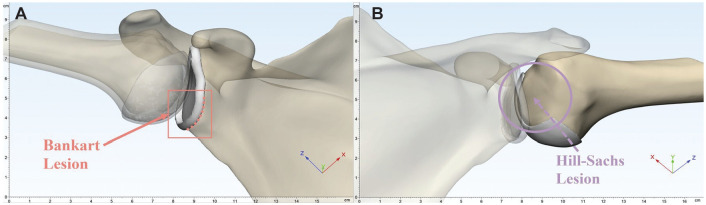
Background: Remplissage with Bankart repair (RMBR) is an arthroscopic procedure performed on <25% of Bankart lesions with off-track Hill-Sachs lesions (HSLs) that alters the insertion of the infraspinatus muscle into the humeral head. However, the effects of RMBR surgery on humeral head displacement due to changes in biomechanics and kinematics have not been fully elucidated.
Purpose: To evaluate how the biomechanical and kinematic effects of the post-RMBR glenohumeral joint influence humeral head displacement using the finite element analysis (FEA) method.
Study design: Controlled laboratory study.
Methods: Biomechanical and kinematic experiments were performed on 24 established finite element (FE) models, which included 12 normal glenohumeral joint models and 12 post-RMBR glenohumeral joint models at the abduction and external rotation (ABER) position. FEA was used to compute the total displacement of the humeral head during passive anteroinferior loading and active contraction of the infraspinatus muscle.
Results: Under passive anteroinferior loading, the humeral heads showed less total anterior displacement after RMBR than did normal glenohumeral joints in the ABER position (1.94 ± 0.48 vs 5.19 ± 1.91 mm; P = .003). When the infraspinatus muscle was stimulated to contract, the humeral heads of post-RMBR glenohumeral joints exhibited greater total posterior displacement in the ABER position than did the normal glenohumeral joints (4.22 ± 0.23 vs 2.44 ± 0.56 mm; P < .001).
Conclusion: Displacement of the humeral head is influenced by changes in the insertion of the infraspinatus tendon after RMBR surgery, which consequently affects the lever arm and torque generated by the infraspinatus muscle on the humeral head.
Clinical relevance: The FEA results confirmed that a change in the insertion of the infraspinatus tendon alters the lever arm and torque produced by the infraspinatus muscle on the humeral head. This leads to changes in the displacement of the humeral head in the ABER position after the RMBR procedure. These findings deepen the understanding of RMBR surgery in clinical practice and can assist physicians in deciding whether to choose this surgical approach in patients with combined HSL.
期刊介绍:
The Orthopaedic Journal of Sports Medicine (OJSM), developed by the American Orthopaedic Society for Sports Medicine (AOSSM), is a global, peer-reviewed, open access journal that combines the interests of researchers and clinical practitioners across orthopaedic sports medicine, arthroscopy, and knee arthroplasty.
Topics include original research in the areas of:
-Orthopaedic Sports Medicine, including surgical and nonsurgical treatment of orthopaedic sports injuries
-Arthroscopic Surgery (Shoulder/Elbow/Wrist/Hip/Knee/Ankle/Foot)
-Relevant translational research
-Sports traumatology/epidemiology
-Knee and shoulder arthroplasty
The OJSM also publishes relevant systematic reviews and meta-analyses.
This journal is a member of the Committee on Publication Ethics (COPE).





 京公网安备 11010802042870号
京ICP备2023020795号-1
京公网安备 11010802042870号
京ICP备2023020795号-1

 分享
分享
 求助内容:
求助内容: 应助结果提醒方式:
 扫码关注我们
