{"title":"The protective effects of Saudi propolis against hepatic injury induced by gold nanoparticles in adult male albino rats.","authors":"Sarah A Althubyani","doi":"10.14202/vetworld.2025.252-262","DOIUrl":null,"url":null,"abstract":"<p><strong>Background and aim: </strong>Gold nanoparticles (GNPs) are widely used in industrial and medical applications due to their unique properties but may induce oxidative stress and hepatotoxicity. Propolis, a bee-derived natural product with potent antioxidant and anti-inflammatory properties, shows promise as a hepatoprotective agent. This study evaluates the protective effects of Saudi propolis against GNP-induced hepatic damage by examining oxidative stress, lipid metabolism, and liver function. This study aimed to investigate the hepatoprotective effects of Saudi propolis against oxidative damage and lipid dysregulation induced by GNPs in male albino rats.</p><p><strong>Materials and methods: </strong>A total of 180 adult male rats were divided into six groups: (1) Control (saline), (2) Propolis (100 mg/kg), (3) GNPs (10 nm, 0.2 mg/kg/day), (4) GNPs (30 nm, 0.2 mg/kg/day), (5) GNPs (10 nm) + propolis, and (6) GNPs (30 nm) + propolis. Treatments were administered daily for 5, 10, or 15 days. Blood and liver samples were analyzed for oxidative stress markers, liver enzymes (aspartate transaminase, alanine transaminase, alkaline phosphatase, and glutamyl transpeptidase), lipid peroxidation (malondialdehyde [MDA]), antioxidant enzymes (superoxide dismutase [SOD] and glutathione peroxides [GPx]), and lipid profiles (cholesterol [CHO] and triglyceride [TG]).</p><p><strong>Results: </strong>Rats treated with GNPs showed elevated liver enzymes, lipid peroxidation, and oxidative stress, accompanied by increased CHO and TG levels. In contrast, co-administration of Saudi propolis significantly mitigated these effects, restoring MDA, SOD, and GPx levels close to control values. The hepatoprotective effects were more pronounced for 10 nm GNPs than 30 nm. After 15 days, TG levels returned to near-normal levels, while CHO levels improved but remained elevated.</p><p><strong>Conclusion: </strong>Saudi propolis exhibits significant protective effects against GNP-induced hepatic damage, primarily due to its antioxidant properties and ability to reduce oxidative stress and lipid peroxidation. The findings provide evidence for the therapeutic potential of propolis in managing nanoparticle-induced liver toxicity.</p>","PeriodicalId":23587,"journal":{"name":"Veterinary World","volume":"18 2","pages":"252-262"},"PeriodicalIF":2.0000,"publicationDate":"2025-02-01","publicationTypes":"Journal Article","fieldsOfStudy":null,"isOpenAccess":false,"openAccessPdf":"https://www.ncbi.nlm.nih.gov/pmc/articles/PMC11963590/pdf/","citationCount":"0","resultStr":null,"platform":"Semanticscholar","paperid":null,"PeriodicalName":"Veterinary World","FirstCategoryId":"1085","ListUrlMain":"https://doi.org/10.14202/vetworld.2025.252-262","RegionNum":0,"RegionCategory":null,"ArticlePicture":[],"TitleCN":null,"AbstractTextCN":null,"PMCID":null,"EPubDate":"2025/2/8 0:00:00","PubModel":"Epub","JCR":"Q2","JCRName":"AGRICULTURE, DAIRY & ANIMAL SCIENCE","Score":null,"Total":0}
引用次数: 0
Abstract
Background and aim: Gold nanoparticles (GNPs) are widely used in industrial and medical applications due to their unique properties but may induce oxidative stress and hepatotoxicity. Propolis, a bee-derived natural product with potent antioxidant and anti-inflammatory properties, shows promise as a hepatoprotective agent. This study evaluates the protective effects of Saudi propolis against GNP-induced hepatic damage by examining oxidative stress, lipid metabolism, and liver function. This study aimed to investigate the hepatoprotective effects of Saudi propolis against oxidative damage and lipid dysregulation induced by GNPs in male albino rats.
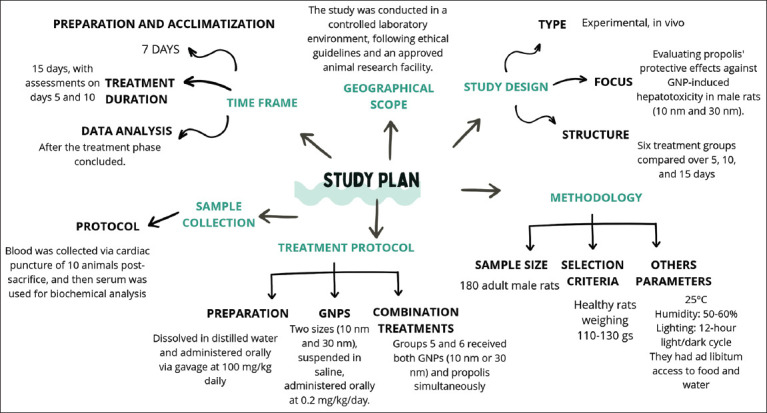
Materials and methods: A total of 180 adult male rats were divided into six groups: (1) Control (saline), (2) Propolis (100 mg/kg), (3) GNPs (10 nm, 0.2 mg/kg/day), (4) GNPs (30 nm, 0.2 mg/kg/day), (5) GNPs (10 nm) + propolis, and (6) GNPs (30 nm) + propolis. Treatments were administered daily for 5, 10, or 15 days. Blood and liver samples were analyzed for oxidative stress markers, liver enzymes (aspartate transaminase, alanine transaminase, alkaline phosphatase, and glutamyl transpeptidase), lipid peroxidation (malondialdehyde [MDA]), antioxidant enzymes (superoxide dismutase [SOD] and glutathione peroxides [GPx]), and lipid profiles (cholesterol [CHO] and triglyceride [TG]).
Results: Rats treated with GNPs showed elevated liver enzymes, lipid peroxidation, and oxidative stress, accompanied by increased CHO and TG levels. In contrast, co-administration of Saudi propolis significantly mitigated these effects, restoring MDA, SOD, and GPx levels close to control values. The hepatoprotective effects were more pronounced for 10 nm GNPs than 30 nm. After 15 days, TG levels returned to near-normal levels, while CHO levels improved but remained elevated.
Conclusion: Saudi propolis exhibits significant protective effects against GNP-induced hepatic damage, primarily due to its antioxidant properties and ability to reduce oxidative stress and lipid peroxidation. The findings provide evidence for the therapeutic potential of propolis in managing nanoparticle-induced liver toxicity.
期刊介绍:
Veterinary World publishes high quality papers focusing on Veterinary and Animal Science. The fields of study are bacteriology, parasitology, pathology, virology, immunology, mycology, public health, biotechnology, meat science, fish diseases, nutrition, gynecology, genetics, wildlife, laboratory animals, animal models of human infections, prion diseases and epidemiology. Studies on zoonotic and emerging infections are highly appreciated. Review articles are highly appreciated. All articles published by Veterinary World are made freely and permanently accessible online. All articles to Veterinary World are posted online immediately as they are ready for publication.






 京公网安备 11010802042870号
京ICP备2023020795号-1
京公网安备 11010802042870号
京ICP备2023020795号-1

 分享
分享
 求助内容:
求助内容: 应助结果提醒方式:
 扫码关注我们
