David McMinn, Tom Grant, Laura DeFord-Watts, Veronica Porkess, Margarita Lens, Christopher Rapier, Wilson Q Joe, Timothy A Becker, Walter Bender
{"title":"Using artificial intelligence to expedite and enhance plain language summary abstract writing of scientific content.","authors":"David McMinn, Tom Grant, Laura DeFord-Watts, Veronica Porkess, Margarita Lens, Christopher Rapier, Wilson Q Joe, Timothy A Becker, Walter Bender","doi":"10.1093/jamiaopen/ooaf023","DOIUrl":null,"url":null,"abstract":"<p><strong>Objective: </strong>To assess the capacity of a bespoke artificial intelligence (AI) process to help medical writers efficiently generate quality plain language summary abstracts (PLSAs).</p><p><strong>Materials and methods: </strong>Three independent studies were conducted. In Studies 1 and 3, original scientific abstracts (OSAs; <i>n</i> = 48, <i>n</i> = 2) and corresponding PLSAs written by medical writers versus bespoke AI were assessed using standard readability metrics. Study 2 compared time and effort of medical writers (<i>n</i> = 10) drafting PLSAs starting with an OSA (<i>n</i> = 6) versus the output of 1 bespoke AI (<i>n</i> = 6) and 1 non-bespoke AI (<i>n</i> = 6) process. These PLSAs (<i>n</i> = 72) were assessed by subject matter experts (SMEs; <i>n</i> = 3) for accuracy and physicians (<i>n</i> = 7) for patient suitability. Lastly, in Study 3, medical writers (<i>n</i> = 22) and patients/patient advocates (<i>n </i>= 5) compared quality of medical writer and bespoke AI-generated PLSAs.</p><p><strong>Results: </strong>In Study 1, bespoke AI PLSAs were easier to read than medical writer PLSAs across all readability metrics (<i>P</i> <.01). In Study 2, bespoke AI output saved medical writers >40% in time for PLSA creation and required less effort than unassisted writing. SME-assessed quality was higher for AI-assisted PLSAs, and physicians preferred bespoke AI-generated outputs for patient use. In Study 3, bespoke AI PLSAs were more readable and rated of higher quality than medical writer PLSAs.</p><p><strong>Discussion: </strong>The bespoke AI process may enhance access to health information by helping medical writers produce PLSAs of scientific content that are fit for purpose.</p><p><strong>Conclusion: </strong>The bespoke AI process can more efficiently create better quality, more readable first draft PLSAs versus medical writer-generated PLSAs.</p>","PeriodicalId":36278,"journal":{"name":"JAMIA Open","volume":"8 2","pages":"ooaf023"},"PeriodicalIF":3.4000,"publicationDate":"2025-04-03","publicationTypes":"Journal Article","fieldsOfStudy":null,"isOpenAccess":false,"openAccessPdf":"https://www.ncbi.nlm.nih.gov/pmc/articles/PMC11967854/pdf/","citationCount":"0","resultStr":null,"platform":"Semanticscholar","paperid":null,"PeriodicalName":"JAMIA Open","FirstCategoryId":"1085","ListUrlMain":"https://doi.org/10.1093/jamiaopen/ooaf023","RegionNum":0,"RegionCategory":null,"ArticlePicture":[],"TitleCN":null,"AbstractTextCN":null,"PMCID":null,"EPubDate":"2025/4/1 0:00:00","PubModel":"eCollection","JCR":"Q2","JCRName":"HEALTH CARE SCIENCES & SERVICES","Score":null,"Total":0}
引用次数: 0
Abstract
Objective: To assess the capacity of a bespoke artificial intelligence (AI) process to help medical writers efficiently generate quality plain language summary abstracts (PLSAs).
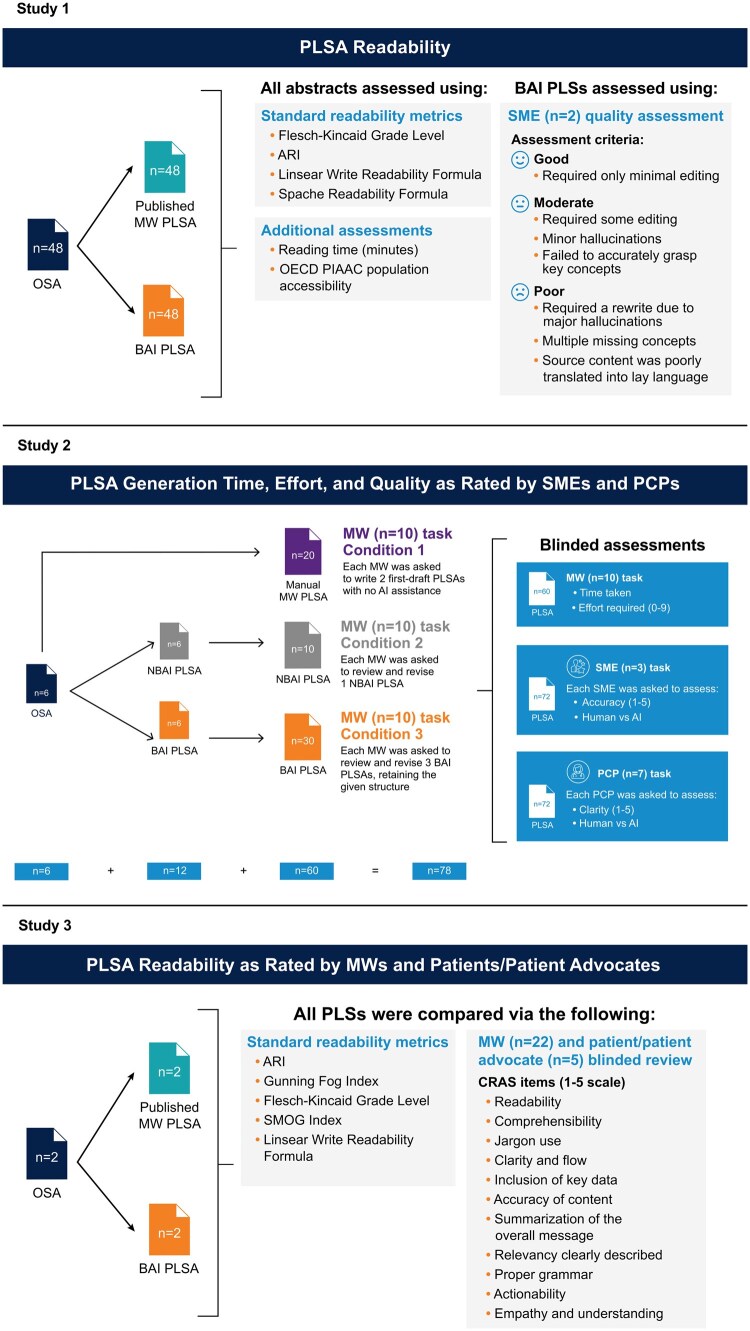
Materials and methods: Three independent studies were conducted. In Studies 1 and 3, original scientific abstracts (OSAs; n = 48, n = 2) and corresponding PLSAs written by medical writers versus bespoke AI were assessed using standard readability metrics. Study 2 compared time and effort of medical writers (n = 10) drafting PLSAs starting with an OSA (n = 6) versus the output of 1 bespoke AI (n = 6) and 1 non-bespoke AI (n = 6) process. These PLSAs (n = 72) were assessed by subject matter experts (SMEs; n = 3) for accuracy and physicians (n = 7) for patient suitability. Lastly, in Study 3, medical writers (n = 22) and patients/patient advocates (n = 5) compared quality of medical writer and bespoke AI-generated PLSAs.
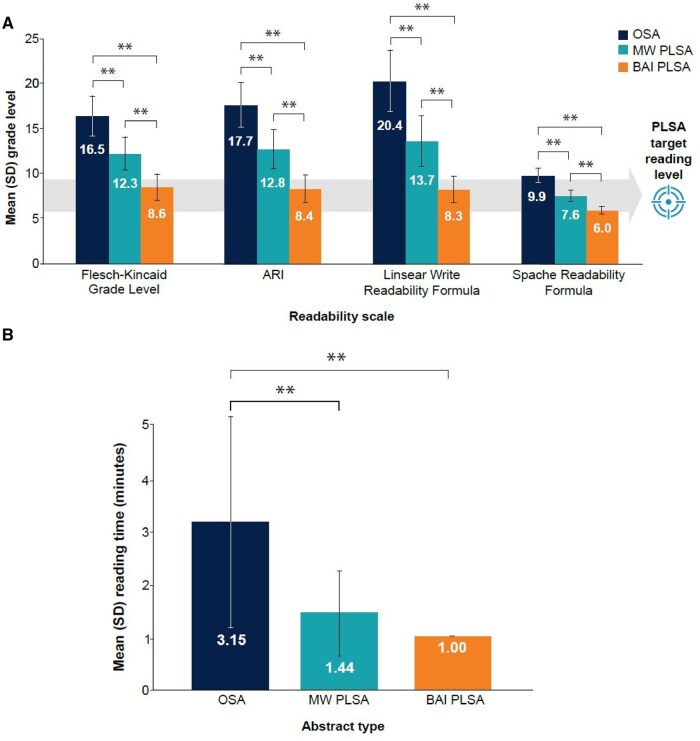
Results: In Study 1, bespoke AI PLSAs were easier to read than medical writer PLSAs across all readability metrics (P <.01). In Study 2, bespoke AI output saved medical writers >40% in time for PLSA creation and required less effort than unassisted writing. SME-assessed quality was higher for AI-assisted PLSAs, and physicians preferred bespoke AI-generated outputs for patient use. In Study 3, bespoke AI PLSAs were more readable and rated of higher quality than medical writer PLSAs.
Discussion: The bespoke AI process may enhance access to health information by helping medical writers produce PLSAs of scientific content that are fit for purpose.
Conclusion: The bespoke AI process can more efficiently create better quality, more readable first draft PLSAs versus medical writer-generated PLSAs.




 京公网安备 11010802042870号
京ICP备2023020795号-1
京公网安备 11010802042870号
京ICP备2023020795号-1

 分享
分享
 求助内容:
求助内容: 应助结果提醒方式:
 扫码关注我们
