Factor Structure, Internal Consistency, and Measurement Invariance of the Eating Pathology Symptoms Inventory (EPSI) in Transgender and Gender-Diverse Adults

IF 4.3 2区 医学 Q1 NUTRITION & DIETETICS International Journal of Eating Disorders Pub Date : 2025-04-04 DOI:10.1002/eat.24433
Jason M. Nagata, Christopher D. Otmar, Audrey Lopez, Emilio J. Compte, Jason M. Lavender, Tiffany A. Brown, Kelsie T. Forbush, Annesa Flentje, Micah E. Lubensky, Juno Obedin-Maliver, Mitchell R. Lunn
{"title":"Factor Structure, Internal Consistency, and Measurement Invariance of the Eating Pathology Symptoms Inventory (EPSI) in Transgender and Gender-Diverse Adults","authors":"Jason M. Nagata,&nbsp;Christopher D. Otmar,&nbsp;Audrey Lopez,&nbsp;Emilio J. Compte,&nbsp;Jason M. Lavender,&nbsp;Tiffany A. Brown,&nbsp;Kelsie T. Forbush,&nbsp;Annesa Flentje,&nbsp;Micah E. Lubensky,&nbsp;Juno Obedin-Maliver,&nbsp;Mitchell R. Lunn","doi":"10.1002/eat.24433","DOIUrl":null,"url":null,"abstract":"<div>\n \n \n <section>\n \n <h3> Objective</h3>\n \n <p>This study aimed to examine the psychometric properties, including factor structure, internal consistency, and measurement invariance of the Eating Pathology Symptoms Inventory (EPSI) in a large national sample of transgender and gender-diverse (TGD) adults.</p>\n </section>\n \n <section>\n \n <h3> Method</h3>\n \n <p>The sample consisted of 2098 TGD adults—including transgender men (<i>n</i> = 599), transgender women (<i>n</i> = 293), and gender-diverse individuals (<i>n</i> = 1206)—who completed online self-report surveys. Using a subset of the sample, exploratory factor analysis (EFA) was conducted to identify underlying factor structures, followed by confirmatory factor analysis (CFA) to confirm the model fit within each population in the remainder of the sample. Multi-group confirmatory factor analysis (MG-CFA) was used to assess measurement invariance across transgender men, transgender women, and gender-diverse individuals.</p>\n </section>\n \n <section>\n \n <h3> Results</h3>\n \n <p>The EPSI's eight-factor structure was supported across all three TGD groups with strong model fit: transgender men (CFI = 0.985, RMSEA = 0.047, SRMR = 0.078), transgender women (CFI = 0.948, RMSEA = 0.048, SRMR = 0.085), and gender-diverse individuals (CFI = 0.962, RMSEA = 0.040, SRMR = 0.060). Measurement invariance analyses supported that the EPSI was invariant across the groups, facilitating meaningful group comparisons using the inventory. Internal consistency, assessed using McDonald's omega, was acceptable for all subscales (<i>ω</i> = 0.74–0.94).</p>\n </section>\n \n <section>\n \n <h3> Discussion</h3>\n \n <p>This study provides psychometric support for the EPSI in TGD groups. The results indicate that the EPSI performs reliably and consistently across these groups for assessing eating pathology among gender minority people.</p>\n </section>\n </div>","PeriodicalId":51067,"journal":{"name":"International Journal of Eating Disorders","volume":"58 7","pages":"1265-1277"},"PeriodicalIF":4.3000,"publicationDate":"2025-04-04","publicationTypes":"Journal Article","fieldsOfStudy":null,"isOpenAccess":false,"openAccessPdf":"https://onlinelibrary.wiley.com/doi/epdf/10.1002/eat.24433","citationCount":"0","resultStr":null,"platform":"Semanticscholar","paperid":null,"PeriodicalName":"International Journal of Eating Disorders","FirstCategoryId":"3","ListUrlMain":"https://onlinelibrary.wiley.com/doi/10.1002/eat.24433","RegionNum":2,"RegionCategory":"医学","ArticlePicture":[],"TitleCN":null,"AbstractTextCN":null,"PMCID":null,"EPubDate":"","PubModel":"","JCR":"Q1","JCRName":"NUTRITION & DIETETICS","Score":null,"Total":0}
引用次数: 0

Abstract

Objective

This study aimed to examine the psychometric properties, including factor structure, internal consistency, and measurement invariance of the Eating Pathology Symptoms Inventory (EPSI) in a large national sample of transgender and gender-diverse (TGD) adults.

Method

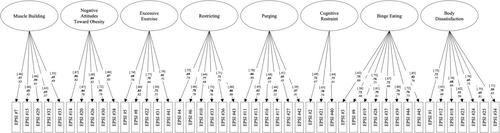
The sample consisted of 2098 TGD adults—including transgender men (n = 599), transgender women (n = 293), and gender-diverse individuals (n = 1206)—who completed online self-report surveys. Using a subset of the sample, exploratory factor analysis (EFA) was conducted to identify underlying factor structures, followed by confirmatory factor analysis (CFA) to confirm the model fit within each population in the remainder of the sample. Multi-group confirmatory factor analysis (MG-CFA) was used to assess measurement invariance across transgender men, transgender women, and gender-diverse individuals.

Results

The EPSI's eight-factor structure was supported across all three TGD groups with strong model fit: transgender men (CFI = 0.985, RMSEA = 0.047, SRMR = 0.078), transgender women (CFI = 0.948, RMSEA = 0.048, SRMR = 0.085), and gender-diverse individuals (CFI = 0.962, RMSEA = 0.040, SRMR = 0.060). Measurement invariance analyses supported that the EPSI was invariant across the groups, facilitating meaningful group comparisons using the inventory. Internal consistency, assessed using McDonald's omega, was acceptable for all subscales (ω = 0.74–0.94).

Discussion

This study provides psychometric support for the EPSI in TGD groups. The results indicate that the EPSI performs reliably and consistently across these groups for assessing eating pathology among gender minority people.

Abstract Image

查看原文
分享 分享
微信好友 朋友圈 QQ好友 复制链接
本刊更多论文
变性和性别多元化成年人饮食病理症状量表(EPSI)的因子结构、内部一致性和测量不变性。
研究目的本研究旨在对全国变性和性别多元化(TGD)成年人样本进行大规模抽样调查,以检验饮食病理症状量表(EPSI)的心理计量特性,包括因子结构、内部一致性和测量不变性:样本由 2098 名变性和性别多元化(TGD)成年人组成,包括变性男性(n = 599)、变性女性(n = 293)和性别多元化个体(n = 1206),他们完成了在线自我报告调查。利用样本的子集进行探索性因子分析(EFA),以确定潜在的因子结构,然后进行确证性因子分析(CFA),以确认其余样本中每个人群的模型拟合度。多组确认性因子分析(MG-CFA)用于评估跨性别男性、跨性别女性和不同性别个体的测量不变性:EPSI的八因子结构在所有三个变性人群体中都得到了支持,模型拟合度很高:变性男性(CFI = 0.985,RMSEA = 0.047,SRMR = 0.078)、变性女性(CFI = 0.948,RMSEA = 0.048,SRMR = 0.085)和性别多元化个体(CFI = 0.962,RMSEA = 0.040,SRMR = 0.060)。测量不变性分析表明,EPSI 在各组间具有不变性,这有助于使用该量表进行有意义的组间比较。所有分量表的内部一致性均可接受(ω = 0.74-0.94):本研究为 TGD 群体中的 EPSI 提供了心理测量学支持。结果表明,在评估性别少数人群的饮食病理学方面,EPSI 在这些群体中的表现可靠且一致。
本文章由计算机程序翻译,如有差异,请以英文原文为准。
求助全文
约1分钟内获得全文 去求助
来源期刊
CiteScore
10.00
自引率
12.70%
发文量
204
审稿时长
4-8 weeks
期刊介绍: Articles featured in the journal describe state-of-the-art scientific research on theory, methodology, etiology, clinical practice, and policy related to eating disorders, as well as contributions that facilitate scholarly critique and discussion of science and practice in the field. Theoretical and empirical work on obesity or healthy eating falls within the journal’s scope inasmuch as it facilitates the advancement of efforts to describe and understand, prevent, or treat eating disorders. IJED welcomes submissions from all regions of the world and representing all levels of inquiry (including basic science, clinical trials, implementation research, and dissemination studies), and across a full range of scientific methods, disciplines, and approaches.
期刊最新文献
Examining Avoidant/Restrictive Food Intake Disorder and Food Selectivity Across the Body Mass Index Spectrum in Children Presenting at an Outpatient, Multidisciplinary Feeding Clinic. Associations of Racial Trauma Symptoms With Positive Eating Disorder Screens Among US Young Adults in the Healthy Minds Study. Demographic and Clinical Predictors of Multiple Admissions in Inpatient Eating Disorder Treatment. Issue Information: Editorial Board & Table of Contents Reducing the Harms of Social Media for Youth: An Urgent Call for Comprehensive Action.
×
引用
GB/T 7714-2015
复制
MLA
复制
APA
复制
导出至
BibTeX EndNote RefMan NoteFirst NoteExpress
×
×
提示
您的信息不完整,为了账户安全,请先补充。
现在去补充
×
提示
您因"违规操作"
具体请查看互助需知
我知道了
×
提示
现在去查看 取消
×
提示
确定
0
微信
客服QQ
Book学术公众号 扫码关注我们
反馈
×
意见反馈
请填写您的意见或建议
请填写您的手机或邮箱
已复制链接
已复制链接
快去分享给好友吧!
我知道了
×
扫码分享
扫码分享
Book学术官方微信
Book学术文献互助
Book学术文献互助群
群 号:604180095
Book学术
文献互助 智能选刊 最新文献 互助须知 联系我们:info@booksci.cn
Book学术提供免费学术资源搜索服务,方便国内外学者检索中英文文献。致力于提供最便捷和优质的服务体验。
Copyright © 2023 Book学术 All rights reserved.
ghs 京公网安备 11010802042870号 京ICP备2023020795号-1