Role of serum high-sensitive C-reactive protein to predict severity of pre-eclampsia in a high-population resource-poor country: a prospective observational study.
{"title":"Role of serum high-sensitive C-reactive protein to predict severity of pre-eclampsia in a high-population resource-poor country: a prospective observational study.","authors":"Jhuma Biswas, Mousumi Datta, Kaushik Kar, Divyangana Mitra, Lakavath Jyothi, Arghya Maitra","doi":"10.2185/jrm.2024-031","DOIUrl":null,"url":null,"abstract":"<p><strong>Objective: </strong>To determine the role of high-sensitive C-reactive protein (hsCRP) in predicting the severity of preeclampsia in a high-population, resource-poor country.</p><p><strong>Patients and methods: </strong>This prospective cohort study was conducted at the Department of Obstetrics and Gynaecology of Calcutta National Medical College, India, from March 2021 to September 2022. A total of 180 participants were divided into three equal groups: patients with severe preeclampsia and non-severe preeclampsia and healthy pregnant women.</p><p><strong>Results: </strong>The levels of the biomarkers hsCRP and uric acid differed significantly between women with preeclampsia and healthy women, with cutoff levels of 3.72 mg/L and 5.15mg/dL, respectively, as determined using receiver operating characteristic (ROC) curve analysis. HsCRP was also able to differentiate severe preeclampsia from non-severe preeclampsia at a cutoff level ≥8.75 mg/L (high Youden index >0.6). However, uric acid levels failed to discriminate between pregnant women with severe and non-severe preeclampsia. Elevated hsCRP levels were strongly associated with low birth weight of newborns in pregnant women with preeclampsia and healthy control groups (<i>P</i>=0.001) and with disease severity (<i>P</i><0.001), respectively.</p><p><strong>Conclusions: </strong>HsCRP can be used as an important diagnostic tool to exclude and evaluate the severity of preeclampsia.</p>","PeriodicalId":73939,"journal":{"name":"Journal of rural medicine : JRM","volume":"20 2","pages":"71-77"},"PeriodicalIF":0.0000,"publicationDate":"2025-04-01","publicationTypes":"Journal Article","fieldsOfStudy":null,"isOpenAccess":false,"openAccessPdf":"https://www.ncbi.nlm.nih.gov/pmc/articles/PMC11962192/pdf/","citationCount":"0","resultStr":null,"platform":"Semanticscholar","paperid":null,"PeriodicalName":"Journal of rural medicine : JRM","FirstCategoryId":"1085","ListUrlMain":"https://doi.org/10.2185/jrm.2024-031","RegionNum":0,"RegionCategory":null,"ArticlePicture":[],"TitleCN":null,"AbstractTextCN":null,"PMCID":null,"EPubDate":"","PubModel":"","JCR":"","JCRName":"","Score":null,"Total":0}
引用次数: 0
Abstract
Objective: To determine the role of high-sensitive C-reactive protein (hsCRP) in predicting the severity of preeclampsia in a high-population, resource-poor country.
Patients and methods: This prospective cohort study was conducted at the Department of Obstetrics and Gynaecology of Calcutta National Medical College, India, from March 2021 to September 2022. A total of 180 participants were divided into three equal groups: patients with severe preeclampsia and non-severe preeclampsia and healthy pregnant women.
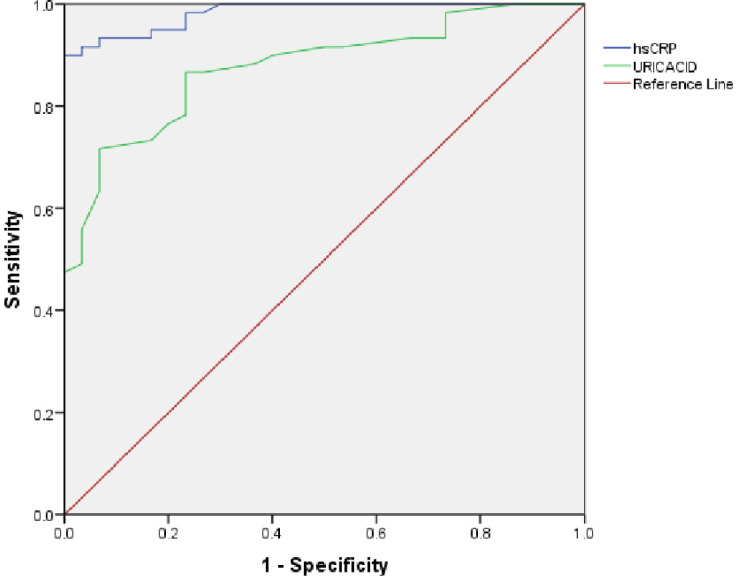
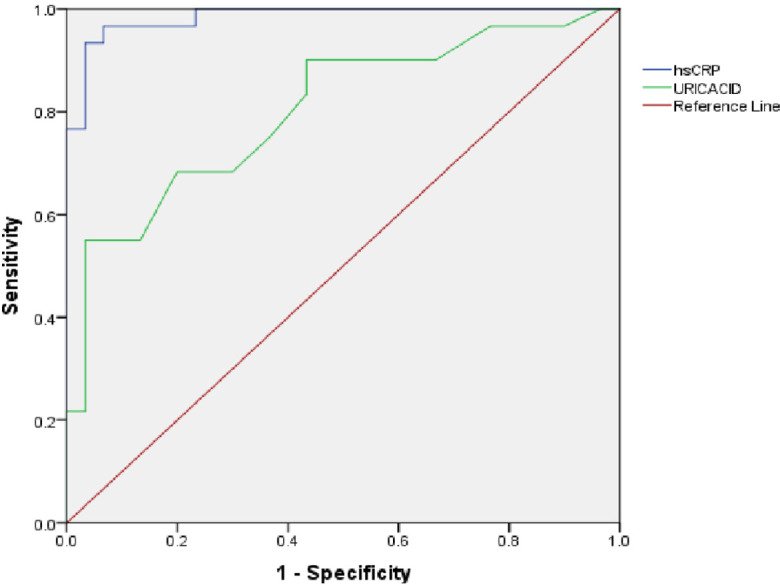
Results: The levels of the biomarkers hsCRP and uric acid differed significantly between women with preeclampsia and healthy women, with cutoff levels of 3.72 mg/L and 5.15mg/dL, respectively, as determined using receiver operating characteristic (ROC) curve analysis. HsCRP was also able to differentiate severe preeclampsia from non-severe preeclampsia at a cutoff level ≥8.75 mg/L (high Youden index >0.6). However, uric acid levels failed to discriminate between pregnant women with severe and non-severe preeclampsia. Elevated hsCRP levels were strongly associated with low birth weight of newborns in pregnant women with preeclampsia and healthy control groups (P=0.001) and with disease severity (P<0.001), respectively.
Conclusions: HsCRP can be used as an important diagnostic tool to exclude and evaluate the severity of preeclampsia.



 京公网安备 11010802042870号
京ICP备2023020795号-1
京公网安备 11010802042870号
京ICP备2023020795号-1

 分享
分享

 求助内容:
求助内容: 应助结果提醒方式:
 扫码关注我们
