Fixed pitch size small-sided games in young soccer players: effects of different age categories and competitive levels on the physical and physiological responses.
Bilel Cherni, Hamza Marzouki, Okba Selmi, Bruno Gonçalves, Karim Chamari, Yung-Sheng Chen, Anissa Bouassida
{"title":"Fixed pitch size small-sided games in young soccer players: effects of different age categories and competitive levels on the physical and physiological responses.","authors":"Bilel Cherni, Hamza Marzouki, Okba Selmi, Bruno Gonçalves, Karim Chamari, Yung-Sheng Chen, Anissa Bouassida","doi":"10.5114/biolsport.2025.144298","DOIUrl":null,"url":null,"abstract":"<p><p>We compared the physical and physiological responses of young soccer players of different ages U13 (Under 13 years), U15, and U17 and competitive levels (elite and sub-elite) during fixed-pitch size smallsided games (SSGs) performed under different formats. In a cross-sectional design, seventy-two male players (12 players in each group) performed 3-a-side and 4-a-side SSGs with a fixed-pitch size (40 × 20 m). The total distance covered (TD), peak velocity (Vpeak), the distances covered at different running speed zones (0 to < 7.0, 7.0 to < 14.0, 14.0 to < 18.0, and ≥ 18.0 km.h<sup>-1</sup>), peak heart rate (HRpeak), HRmean, expressed as percentage of the theoretical HR<sub>max</sub>Theo, and blood lactate concentration post-SSGs (BLa) were recorded. Players in the 3-a-side SSGs covered more TD, distances covered at different speeds and Vpeak than those of the 4-a-side SSGs across all age categories of both competitive levels (p < 0.05). The 3-a-side SSGs induced higher BLa in all elite groups (p < 0.05), and U13-sub-elite players (p=0.004). HR<sub>peak</sub>(%HR<sub>max</sub>Theo) and HR<sub>mean</sub>(%HR<sub>max</sub>Theo) were greater in the 4-a-side SSGs than the 3-a-side SSGs in most age categories of both competitive levels (p < 0.05). In the zone-3, the U13- and U15-elite covered more distance than U17 in both formats. In both formats, elite players covered larger TD and distances at zone-1 and zone-4 sub-elite players (p < 0.05). BLa was higher in U17-sub-elite compared to their elite counterparts in the 4-a-side SSGs. Our study shows that 3-a-side SSGs are physically more demanding than 4-a-side, especially for elite players. Tailoring training to age and competitive level is crucial for optimising player development.</p>","PeriodicalId":55365,"journal":{"name":"Biology of Sport","volume":"42 2","pages":"187-197"},"PeriodicalIF":4.2000,"publicationDate":"2025-04-01","publicationTypes":"Journal Article","fieldsOfStudy":null,"isOpenAccess":false,"openAccessPdf":"https://www.ncbi.nlm.nih.gov/pmc/articles/PMC11963139/pdf/","citationCount":"0","resultStr":null,"platform":"Semanticscholar","paperid":null,"PeriodicalName":"Biology of Sport","FirstCategoryId":"3","ListUrlMain":"https://doi.org/10.5114/biolsport.2025.144298","RegionNum":2,"RegionCategory":"医学","ArticlePicture":[],"TitleCN":null,"AbstractTextCN":null,"PMCID":null,"EPubDate":"2024/10/23 0:00:00","PubModel":"Epub","JCR":"Q1","JCRName":"SPORT SCIENCES","Score":null,"Total":0}
引用次数: 0
Abstract
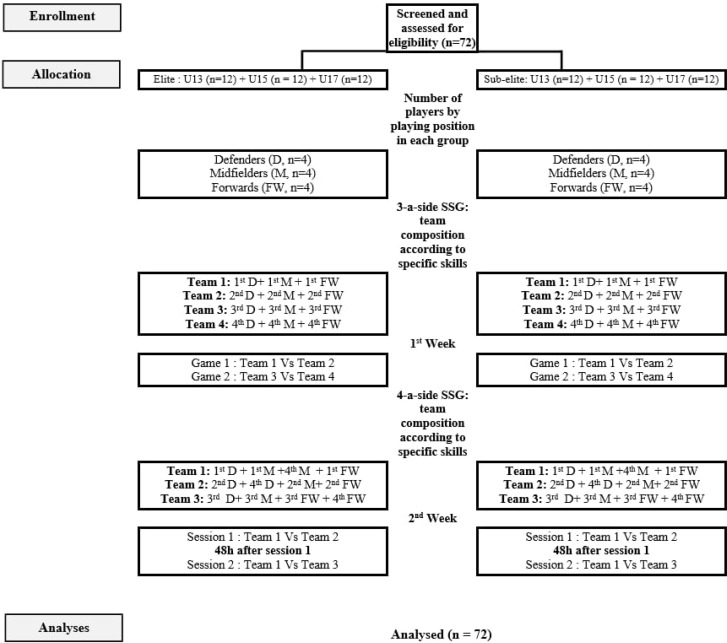
We compared the physical and physiological responses of young soccer players of different ages U13 (Under 13 years), U15, and U17 and competitive levels (elite and sub-elite) during fixed-pitch size smallsided games (SSGs) performed under different formats. In a cross-sectional design, seventy-two male players (12 players in each group) performed 3-a-side and 4-a-side SSGs with a fixed-pitch size (40 × 20 m). The total distance covered (TD), peak velocity (Vpeak), the distances covered at different running speed zones (0 to < 7.0, 7.0 to < 14.0, 14.0 to < 18.0, and ≥ 18.0 km.h-1), peak heart rate (HRpeak), HRmean, expressed as percentage of the theoretical HRmaxTheo, and blood lactate concentration post-SSGs (BLa) were recorded. Players in the 3-a-side SSGs covered more TD, distances covered at different speeds and Vpeak than those of the 4-a-side SSGs across all age categories of both competitive levels (p < 0.05). The 3-a-side SSGs induced higher BLa in all elite groups (p < 0.05), and U13-sub-elite players (p=0.004). HRpeak(%HRmaxTheo) and HRmean(%HRmaxTheo) were greater in the 4-a-side SSGs than the 3-a-side SSGs in most age categories of both competitive levels (p < 0.05). In the zone-3, the U13- and U15-elite covered more distance than U17 in both formats. In both formats, elite players covered larger TD and distances at zone-1 and zone-4 sub-elite players (p < 0.05). BLa was higher in U17-sub-elite compared to their elite counterparts in the 4-a-side SSGs. Our study shows that 3-a-side SSGs are physically more demanding than 4-a-side, especially for elite players. Tailoring training to age and competitive level is crucial for optimising player development.
期刊介绍:
Biology of Sport is the official journal of the Institute of Sport in Warsaw, Poland, published since 1984.
Biology of Sport is an international scientific peer-reviewed journal, published quarterly in both paper and electronic format. The journal publishes articles concerning basic and applied sciences in sport: sports and exercise physiology, sports immunology and medicine, sports genetics, training and testing, pharmacology, as well as in other biological aspects related to sport. Priority is given to inter-disciplinary papers.



 京公网安备 11010802042870号
京ICP备2023020795号-1
京公网安备 11010802042870号
京ICP备2023020795号-1

 分享
分享
 求助内容:
求助内容: 应助结果提醒方式:
 扫码关注我们
