{"title":"How different training sessions affect the sleep of professional soccer players.","authors":"Eider Barba, David Casamichana, Julen Castellano","doi":"10.5114/biolsport.2025.142644","DOIUrl":null,"url":null,"abstract":"<p><p>This study aimed to compare microcycle loading and sleep patterns concerning successive match days (MD) using objective measurements of sleep and external training load (eTL). Twenty professional female soccer players (mean age: 23.3 ± 3.5 years) were monitored using a multi-sensor sleep-tracker for sleep patterns and global positioning system devices for eTL. Sleep variables included total sleep time (TOTAL), awake time (AWAKE), REM sleep, deep sleep time (DEEP), light sleep time (LIGHT), percentage of sleep time spent moving (REST), and sleep onset latency (ONSET). eTL variables included total distance covered (TD), distance at various speed thresholds, accelerations (ACC3), and decelerations (DEC3). 1) eTL influenced sleep; 2) TOTAL and REM were reduced after high eTL sessions (MD-3); 3) MD-2 facilitated recovery and improved post-session sleep compared to MD-4 and MD-3; 4) post-session TOTAL and DEEP sleep times on MD-1 were shorter compared to pre-session times, but there was no difference in REM sleep. Additionally, DEEP had a negative correlation with eTL variables, while REST had a positive correlation with certain eTL variables. REM sleep was affected after high eTL sessions, indicating that fatigue negatively impacted sleep. However, sleep increased after lower eTL sessions. Players slept less with less DEEP sleep the day before a competition (MD-1 post-session sleep). Monitoring sleep during microcycle acquisition and loading phases could assess sleep changes. Strategies should be implemented to improve sleep during loading phases and the night before matches.</p>","PeriodicalId":55365,"journal":{"name":"Biology of Sport","volume":"42 2","pages":"125-133"},"PeriodicalIF":4.2000,"publicationDate":"2025-04-01","publicationTypes":"Journal Article","fieldsOfStudy":null,"isOpenAccess":false,"openAccessPdf":"https://www.ncbi.nlm.nih.gov/pmc/articles/PMC11963127/pdf/","citationCount":"0","resultStr":null,"platform":"Semanticscholar","paperid":null,"PeriodicalName":"Biology of Sport","FirstCategoryId":"3","ListUrlMain":"https://doi.org/10.5114/biolsport.2025.142644","RegionNum":2,"RegionCategory":"医学","ArticlePicture":[],"TitleCN":null,"AbstractTextCN":null,"PMCID":null,"EPubDate":"2024/10/15 0:00:00","PubModel":"Epub","JCR":"Q1","JCRName":"SPORT SCIENCES","Score":null,"Total":0}
引用次数: 0
Abstract
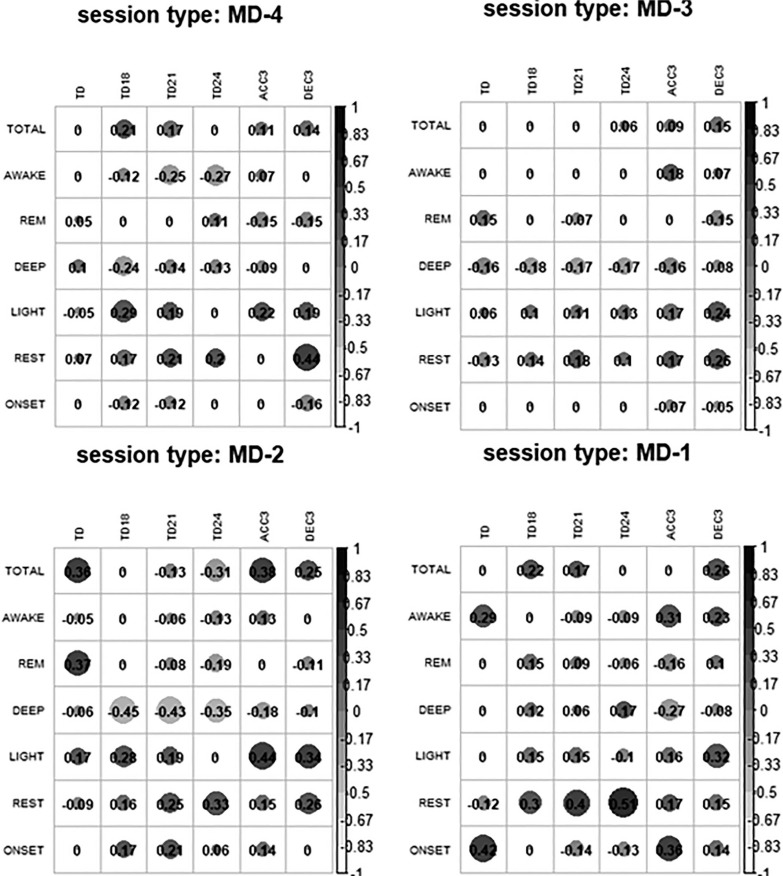
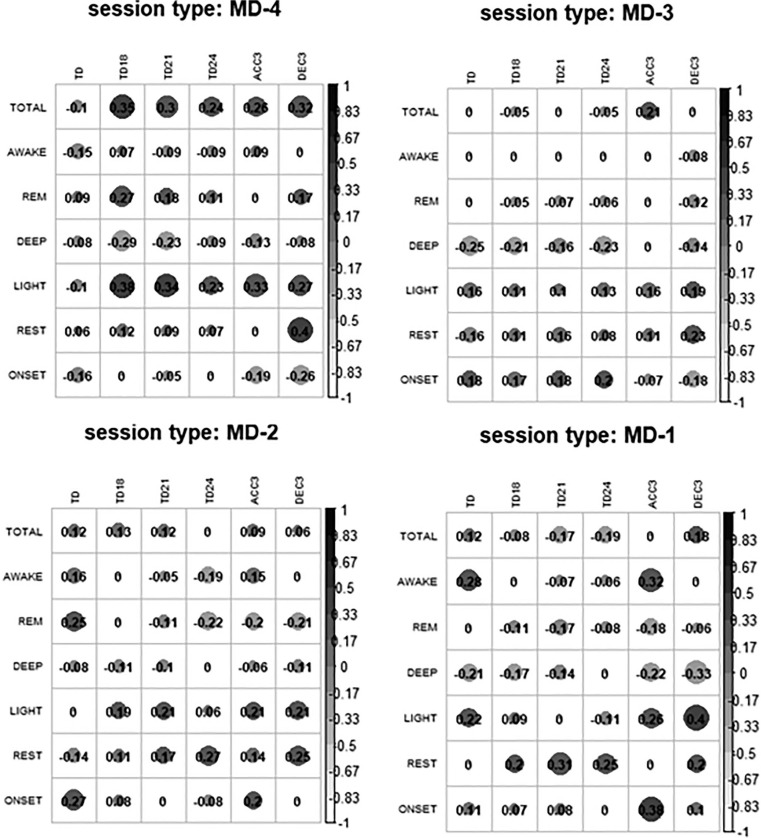
This study aimed to compare microcycle loading and sleep patterns concerning successive match days (MD) using objective measurements of sleep and external training load (eTL). Twenty professional female soccer players (mean age: 23.3 ± 3.5 years) were monitored using a multi-sensor sleep-tracker for sleep patterns and global positioning system devices for eTL. Sleep variables included total sleep time (TOTAL), awake time (AWAKE), REM sleep, deep sleep time (DEEP), light sleep time (LIGHT), percentage of sleep time spent moving (REST), and sleep onset latency (ONSET). eTL variables included total distance covered (TD), distance at various speed thresholds, accelerations (ACC3), and decelerations (DEC3). 1) eTL influenced sleep; 2) TOTAL and REM were reduced after high eTL sessions (MD-3); 3) MD-2 facilitated recovery and improved post-session sleep compared to MD-4 and MD-3; 4) post-session TOTAL and DEEP sleep times on MD-1 were shorter compared to pre-session times, but there was no difference in REM sleep. Additionally, DEEP had a negative correlation with eTL variables, while REST had a positive correlation with certain eTL variables. REM sleep was affected after high eTL sessions, indicating that fatigue negatively impacted sleep. However, sleep increased after lower eTL sessions. Players slept less with less DEEP sleep the day before a competition (MD-1 post-session sleep). Monitoring sleep during microcycle acquisition and loading phases could assess sleep changes. Strategies should be implemented to improve sleep during loading phases and the night before matches.
期刊介绍:
Biology of Sport is the official journal of the Institute of Sport in Warsaw, Poland, published since 1984.
Biology of Sport is an international scientific peer-reviewed journal, published quarterly in both paper and electronic format. The journal publishes articles concerning basic and applied sciences in sport: sports and exercise physiology, sports immunology and medicine, sports genetics, training and testing, pharmacology, as well as in other biological aspects related to sport. Priority is given to inter-disciplinary papers.



 京公网安备 11010802042870号
京ICP备2023020795号-1
京公网安备 11010802042870号
京ICP备2023020795号-1

 分享
分享
 求助内容:
求助内容: 应助结果提醒方式:
 扫码关注我们
