Symptomatic Common Carotid Artery Stenosis With a Persistent Primitive Hypoglossal Artery Presenting With Posterior Circulation Symptoms and Technical Challenges in Stenting.
{"title":"Symptomatic Common Carotid Artery Stenosis With a Persistent Primitive Hypoglossal Artery Presenting With Posterior Circulation Symptoms and Technical Challenges in Stenting.","authors":"Keisuke Kadooka, Roselyn Pamatmat, Kotaro Ueda, Shimpei Tsuboki, Takafumi Mitsutake, Michihiro Tanaka","doi":"10.7759/cureus.81562","DOIUrl":null,"url":null,"abstract":"<p><p>The persistent primitive hypoglossal artery (PPHA) is a rare variant of the persistent carotid-vertebrobasilar anastomoses. When PPHA coexists with carotid artery stenoses, it typically presents ischemic symptoms of the anterior circulation. However, we report a unique case of common carotid artery (CCA) stenosis with PPHA presenting exclusively ischemic symptoms of the posterior circulation, which posed significant diagnostic challenges and required innovative modifications in embolic protection strategies during carotid artery stenting. A 65-year-old woman experienced recurrent bilateral ptosis, diplopia, and transient bilateral visual loss, suggestive of posterior circulation ischemia. Imaging revealed significant left CCA stenosis with a PPHA supplying the posterior circulation. Due to the large diameter of the CCA, standard distal protection was unfeasible. Instead, distal balloon protection was innovatively applied at the bifurcation of the PPHA and the internal carotid artery, where the slightly narrower diameter facilitated successful stenting. The postoperative course was favorable, with no recurrence of symptoms. PPHA-associated carotid stenosis can cause posterior circulation symptoms, complicating diagnosis. Understanding anatomical and hemodynamic variations like PPHA is crucial for effective treatment and ensuring optimal outcomes.</p>","PeriodicalId":93960,"journal":{"name":"Cureus","volume":"17 4","pages":"e81562"},"PeriodicalIF":1.3000,"publicationDate":"2025-04-01","publicationTypes":"Journal Article","fieldsOfStudy":null,"isOpenAccess":false,"openAccessPdf":"https://www.ncbi.nlm.nih.gov/pmc/articles/PMC11966179/pdf/","citationCount":"0","resultStr":null,"platform":"Semanticscholar","paperid":null,"PeriodicalName":"Cureus","FirstCategoryId":"1085","ListUrlMain":"https://doi.org/10.7759/cureus.81562","RegionNum":0,"RegionCategory":null,"ArticlePicture":[],"TitleCN":null,"AbstractTextCN":null,"PMCID":null,"EPubDate":"","PubModel":"","JCR":"Q3","JCRName":"MEDICINE, GENERAL & INTERNAL","Score":null,"Total":0}
引用次数: 0
Abstract
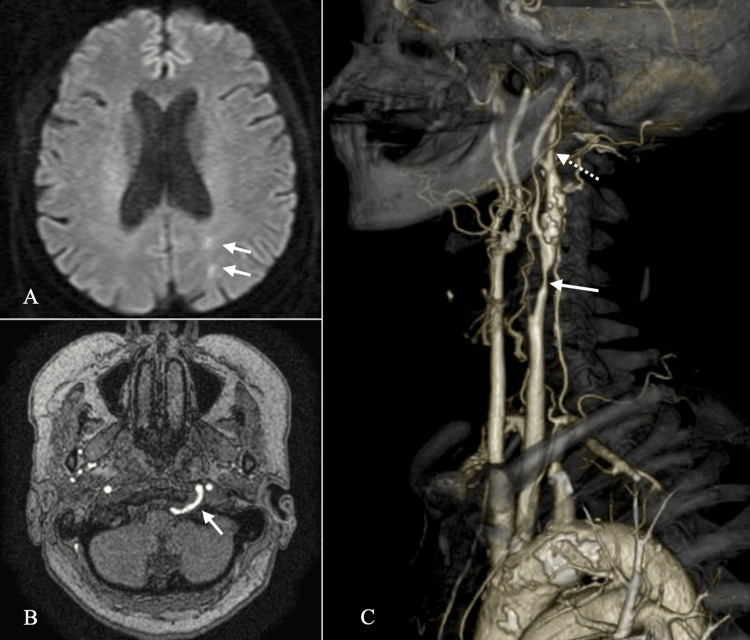
The persistent primitive hypoglossal artery (PPHA) is a rare variant of the persistent carotid-vertebrobasilar anastomoses. When PPHA coexists with carotid artery stenoses, it typically presents ischemic symptoms of the anterior circulation. However, we report a unique case of common carotid artery (CCA) stenosis with PPHA presenting exclusively ischemic symptoms of the posterior circulation, which posed significant diagnostic challenges and required innovative modifications in embolic protection strategies during carotid artery stenting. A 65-year-old woman experienced recurrent bilateral ptosis, diplopia, and transient bilateral visual loss, suggestive of posterior circulation ischemia. Imaging revealed significant left CCA stenosis with a PPHA supplying the posterior circulation. Due to the large diameter of the CCA, standard distal protection was unfeasible. Instead, distal balloon protection was innovatively applied at the bifurcation of the PPHA and the internal carotid artery, where the slightly narrower diameter facilitated successful stenting. The postoperative course was favorable, with no recurrence of symptoms. PPHA-associated carotid stenosis can cause posterior circulation symptoms, complicating diagnosis. Understanding anatomical and hemodynamic variations like PPHA is crucial for effective treatment and ensuring optimal outcomes.




 京公网安备 11010802042870号
京ICP备2023020795号-1
京公网安备 11010802042870号
京ICP备2023020795号-1

 分享
分享

 求助内容:
求助内容: 应助结果提醒方式:
 扫码关注我们
