{"title":"Translational research approach to social orienting deficits in autism: the role of superior colliculus-ventral tegmental pathway","authors":"Alessandro Contestabile, Nada Kojovic, Giulia Casarotto, Farnaz Delavari, Patric Hagmann, Marie Schaer, Camilla Bellone","doi":"10.1038/s41380-025-02962-w","DOIUrl":null,"url":null,"abstract":"Autism Spectrum Disorder (ASD) is characterized by impairments in social interaction and repetitive behaviors. A key characteristic of ASD is a decreased interest in social interactions, which affects individuals’ ability to engage with their social environment. This study explores the neurobiological basis of these social deficits, focusing on the pathway between the Superior Colliculus (SC) and the Ventral Tegmental Area (VTA). Adopting a translational approach, our research used Shank3 knockout mice (Shank3−/−), which parallel a clinical cohort of young children with ASD, to investigate these mechanisms. We observed consistent deficits in social orienting across species. In children with ASD, fMRI analyses revealed a significant decrease in connectivity between the SC and VTA. Additionally, using miniscopes in mice, we identified a reduction in the frequency of calcium transients in SC neurons projecting to the VTA, accompanied by changes in neuronal correlation and intrinsic cellular properties. Notably, the interneuronal correlation in Shank3−/− mice and the functional connectivity of the SC to VTA pathway in children with ASD correlated with the severity of social deficits. Our findings underscore the potential of the SC-VTA pathway as a biomarker for ASD and open new avenues for therapeutic interventions, highlighting the importance of early detection and targeted treatment strategies.","PeriodicalId":19008,"journal":{"name":"Molecular Psychiatry","volume":"30 8","pages":"3729-3739"},"PeriodicalIF":10.1000,"publicationDate":"2025-04-05","publicationTypes":"Journal Article","fieldsOfStudy":null,"isOpenAccess":false,"openAccessPdf":"https://www.nature.comhttps://www.nature.com/articles/s41380-025-02962-w.pdf","citationCount":"0","resultStr":null,"platform":"Semanticscholar","paperid":null,"PeriodicalName":"Molecular Psychiatry","FirstCategoryId":"3","ListUrlMain":"https://www.nature.com/articles/s41380-025-02962-w","RegionNum":1,"RegionCategory":"医学","ArticlePicture":[],"TitleCN":null,"AbstractTextCN":null,"PMCID":null,"EPubDate":"","PubModel":"","JCR":"Q1","JCRName":"BIOCHEMISTRY & MOLECULAR BIOLOGY","Score":null,"Total":0}
引用次数: 0
Abstract
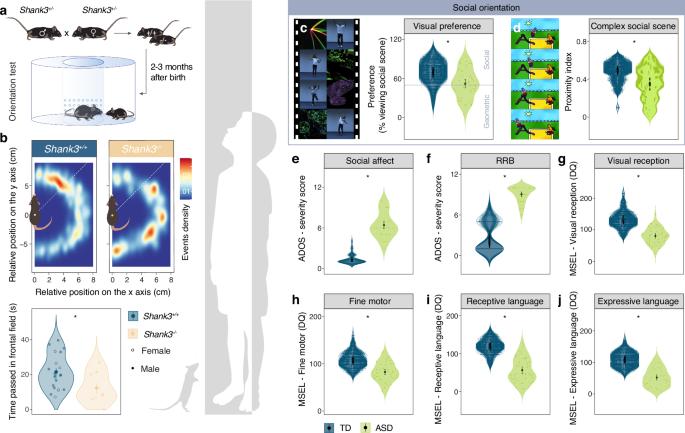
Autism Spectrum Disorder (ASD) is characterized by impairments in social interaction and repetitive behaviors. A key characteristic of ASD is a decreased interest in social interactions, which affects individuals’ ability to engage with their social environment. This study explores the neurobiological basis of these social deficits, focusing on the pathway between the Superior Colliculus (SC) and the Ventral Tegmental Area (VTA). Adopting a translational approach, our research used Shank3 knockout mice (Shank3−/−), which parallel a clinical cohort of young children with ASD, to investigate these mechanisms. We observed consistent deficits in social orienting across species. In children with ASD, fMRI analyses revealed a significant decrease in connectivity between the SC and VTA. Additionally, using miniscopes in mice, we identified a reduction in the frequency of calcium transients in SC neurons projecting to the VTA, accompanied by changes in neuronal correlation and intrinsic cellular properties. Notably, the interneuronal correlation in Shank3−/− mice and the functional connectivity of the SC to VTA pathway in children with ASD correlated with the severity of social deficits. Our findings underscore the potential of the SC-VTA pathway as a biomarker for ASD and open new avenues for therapeutic interventions, highlighting the importance of early detection and targeted treatment strategies.
期刊介绍:
Molecular Psychiatry focuses on publishing research that aims to uncover the biological mechanisms behind psychiatric disorders and their treatment. The journal emphasizes studies that bridge pre-clinical and clinical research, covering cellular, molecular, integrative, clinical, imaging, and psychopharmacology levels.




 京公网安备 11010802042870号
京ICP备2023020795号-1
京公网安备 11010802042870号
京ICP备2023020795号-1

 分享
分享
 求助内容:
求助内容: 应助结果提醒方式:
 扫码关注我们
