{"title":"Pushing the boundary of the stability and band gap Pareto front by going towards high-entropy perovskites†","authors":"Zhendian Zhang, Victor Fung and Guoxiang Hu","doi":"10.1039/D4NR05013D","DOIUrl":null,"url":null,"abstract":"<p >Lead-free Cs<small><sub>2</sub></small>BX<small><sub>6</sub></small> (B = Zr<small><sup>4+</sup></small>, Sn<small><sup>4+</sup></small>, Te<small><sup>4+</sup></small>, Hf<small><sup>4+</sup></small>, Re<small><sup>4+</sup></small>, Os<small><sup>4+</sup></small>, Ir<small><sup>4+</sup></small>, and Pt<small><sup>4+</sup></small> and X = Cl<small><sup>−</sup></small>, Br<small><sup>−</sup></small>, and I<small><sup>−</sup></small>) vacancy-ordered double perovskites have gained significant attention due to their high performance in solar cell devices. Besides mitigating toxicity concerns associated with the use of lead, the presence of a formally tetravalent B-site in Cs<small><sub>2</sub></small>BX<small><sub>6</sub></small> has been demonstrated to improve the stability against air and moisture. Recently, experimental studies have shown that high-entropy forms of vacancy-ordered double perovskites can be synthesized and stabilized at room temperature, which opens new opportunities for designing better solar cell absorbers. In this work, we employed high throughput density functional theory (DFT) calculations using the HSE06 hybrid functional to study 546 medium-to-high-entropy vacancy-ordered double perovskites. Our results show that Cs<small><sub>2</sub></small>{B<small><sub>1</sub></small>B<small><sub>2</sub></small>B<small><sub>3</sub></small>B<small><sub>4</sub></small>}<small><sub>1</sub></small>X<small><sub>6</sub></small> and Cs<small><sub>2</sub></small>{B<small><sub>1</sub></small>B<small><sub>2</sub></small>B<small><sub>3</sub></small>B<small><sub>4</sub></small>}<small><sub>1</sub></small>{XX′}<small><sub>6</sub></small> perovskites can break the existing linear scaling relationships between the bandgap and formation energy observed in the pure Cs<small><sub>2</sub></small>BX<small><sub>6</sub></small> and Cs<small><sub>2</sub></small>B{XX′}<small><sub>6</sub></small> perovskites, which enables materials that simultaneously exhibit an optimal band gap of ∼1.3 eV for single-junction solar cells along with a low formation energy. Electronic structure analysis reveals that this can be attributed to the weak coupling between the BX<small><sub>6</sub></small> octahedra in Cs<small><sub>2</sub></small>{B<small><sub>1</sub></small>B<small><sub>2</sub></small>B<small><sub>3</sub></small>B<small><sub>4</sub></small>}<small><sub>1</sub></small>X<small><sub>6</sub></small> and Cs<small><sub>2</sub></small>{B<small><sub>1</sub></small>B<small><sub>2</sub></small>B<small><sub>3</sub></small>B<small><sub>4</sub></small>}<small><sub>1</sub></small>{XX′}<small><sub>6</sub></small>. Based on these findings, we identified the analytical equations that can be used to efficiently predict the band gap and formation energy of high-entropy perovskites from their constituent pure perovskites. Our study offers simple and practical guidelines for the design and synthesis of novel high-entropy perovskites with improved photovoltaic performance.</p>","PeriodicalId":92,"journal":{"name":"Nanoscale","volume":" 18","pages":" 11376-11384"},"PeriodicalIF":5.1000,"publicationDate":"2025-04-04","publicationTypes":"Journal Article","fieldsOfStudy":null,"isOpenAccess":false,"openAccessPdf":"https://pubs.rsc.org/en/content/articlepdf/2025/nr/d4nr05013d?page=search","citationCount":"0","resultStr":null,"platform":"Semanticscholar","paperid":null,"PeriodicalName":"Nanoscale","FirstCategoryId":"88","ListUrlMain":"https://pubs.rsc.org/en/content/articlelanding/2025/nr/d4nr05013d","RegionNum":3,"RegionCategory":"材料科学","ArticlePicture":[],"TitleCN":null,"AbstractTextCN":null,"PMCID":null,"EPubDate":"","PubModel":"","JCR":"Q1","JCRName":"CHEMISTRY, MULTIDISCIPLINARY","Score":null,"Total":0}
引用次数: 0
Abstract
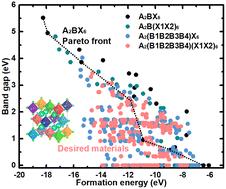
Lead-free Cs2BX6 (B = Zr4+, Sn4+, Te4+, Hf4+, Re4+, Os4+, Ir4+, and Pt4+ and X = Cl−, Br−, and I−) vacancy-ordered double perovskites have gained significant attention due to their high performance in solar cell devices. Besides mitigating toxicity concerns associated with the use of lead, the presence of a formally tetravalent B-site in Cs2BX6 has been demonstrated to improve the stability against air and moisture. Recently, experimental studies have shown that high-entropy forms of vacancy-ordered double perovskites can be synthesized and stabilized at room temperature, which opens new opportunities for designing better solar cell absorbers. In this work, we employed high throughput density functional theory (DFT) calculations using the HSE06 hybrid functional to study 546 medium-to-high-entropy vacancy-ordered double perovskites. Our results show that Cs2{B1B2B3B4}1X6 and Cs2{B1B2B3B4}1{XX′}6 perovskites can break the existing linear scaling relationships between the bandgap and formation energy observed in the pure Cs2BX6 and Cs2B{XX′}6 perovskites, which enables materials that simultaneously exhibit an optimal band gap of ∼1.3 eV for single-junction solar cells along with a low formation energy. Electronic structure analysis reveals that this can be attributed to the weak coupling between the BX6 octahedra in Cs2{B1B2B3B4}1X6 and Cs2{B1B2B3B4}1{XX′}6. Based on these findings, we identified the analytical equations that can be used to efficiently predict the band gap and formation energy of high-entropy perovskites from their constituent pure perovskites. Our study offers simple and practical guidelines for the design and synthesis of novel high-entropy perovskites with improved photovoltaic performance.
期刊介绍:
Nanoscale is a high-impact international journal, publishing high-quality research across nanoscience and nanotechnology. Nanoscale publishes a full mix of research articles on experimental and theoretical work, including reviews, communications, and full papers.Highly interdisciplinary, this journal appeals to scientists, researchers and professionals interested in nanoscience and nanotechnology, quantum materials and quantum technology, including the areas of physics, chemistry, biology, medicine, materials, energy/environment, information technology, detection science, healthcare and drug discovery, and electronics.



 京公网安备 11010802042870号
京ICP备2023020795号-1
京公网安备 11010802042870号
京ICP备2023020795号-1

 分享
分享
 求助内容:
求助内容: 应助结果提醒方式:
 扫码关注我们
