Haldrian Iriawan, Graham Leverick, Barış Alkan, Daniel Delgado, John Eom, Hongbin Xu, Sunmoon Yu, Livia Giordano, Annette Trunschke, Ifan E. L. Stephens, Yang Shao-Horn
{"title":"Assessing the Activity of Transition Metal Oxides for the Electrochemical N2 Oxidation to Nitrate","authors":"Haldrian Iriawan, Graham Leverick, Barış Alkan, Daniel Delgado, John Eom, Hongbin Xu, Sunmoon Yu, Livia Giordano, Annette Trunschke, Ifan E. L. Stephens, Yang Shao-Horn","doi":"10.1021/acscatal.4c07924","DOIUrl":null,"url":null,"abstract":"The electrochemical oxidation of dinitrogen (N<sub>2</sub>) to nitrate (NO<sub>3</sub><sup>–</sup>) is an attractive method for decentralized fertilizer production. Yet, scarce experimental evidence with trace NO<sub>3</sub><sup>–</sup> produced in reported catalysts hints at the kinetics challenge and motivates a search for reliable electrocatalysts. We addressed the gaps in the understanding of N<sub>2</sub> oxidation by computing three pathways: the (1) direct electrochemical pathway that extends all the way to NO<sub>3</sub><sup>–</sup>, (2) surface lattice oxygen pathway on perovskites, and (3) surface-adsorbed oxygen pathway. These computations revealed the unfavorable trade-off between N<sub>2</sub> activation and NO<sub>2</sub> desorption/O vacancy filling step energies, which potentially limit the N<sub>2</sub> oxidation activity and render the parasitic OER dominant. However, several oxides which possess reactive surface oxygen and inert/moderate OER activity were identified as more promising for experimental assessment. We then experimentally examined 20+ transition metal oxides, namely, ABO<sub>3</sub> perovskites (A = La, Sr, Ca, Bi and B = Co, Mn, Fe) and MO<sub>2</sub> rutiles (IrO<sub>2</sub>, RuO<sub>2</sub>, TiO<sub>2</sub>, SnO<sub>2</sub>, and Fe- and Ir-doped TiO<sub>2</sub> and SnO<sub>2</sub>) in alkaline and neutral electrolytes. Electrochemical measurements via up to 22 h chronoamperometry showed minimal NO<sub>3</sub><sup>–</sup> concentrations of <1 ppm<sub>N</sub> via UV–vis spectroscopy, which were comparable to those measured in the absence of N<sub>2</sub>. Time-dependent investigations of different substrates (i.e., carbon paper and Ti foil), increasing catalyst loadings in H-cells and flow cells, as well as high-surface-area La<sub>0.5</sub>Sr<sub>0.5</sub>CoO<sub>3</sub> and La<sub>0.5</sub>Sr<sub>0.5</sub>MnO<sub>3</sub> showed that the observed NO<sub>3</sub><sup>–</sup> concentrations were not greater than those measured without N<sub>2</sub> with experimental certainty. This work underscores the need for proliferating NO<sub><i>x</i></sub> production (mass<sub>prod</sub>) beyond system size (mass<sub>sys</sub>) or rigorous quantitative <sup>15</sup>N<sub>2</sub>-labeling to provide concrete evidence for true N<sub>2</sub> oxidation and encourages exploration of ambient N<sub>2</sub> oxidation beyond conventional approaches.","PeriodicalId":9,"journal":{"name":"ACS Catalysis ","volume":"18 1","pages":""},"PeriodicalIF":13.1000,"publicationDate":"2025-04-03","publicationTypes":"Journal Article","fieldsOfStudy":null,"isOpenAccess":false,"openAccessPdf":"","citationCount":"0","resultStr":null,"platform":"Semanticscholar","paperid":null,"PeriodicalName":"ACS Catalysis ","FirstCategoryId":"92","ListUrlMain":"https://doi.org/10.1021/acscatal.4c07924","RegionNum":1,"RegionCategory":"化学","ArticlePicture":[],"TitleCN":null,"AbstractTextCN":null,"PMCID":null,"EPubDate":"","PubModel":"","JCR":"Q1","JCRName":"CHEMISTRY, PHYSICAL","Score":null,"Total":0}
引用次数: 0
Abstract
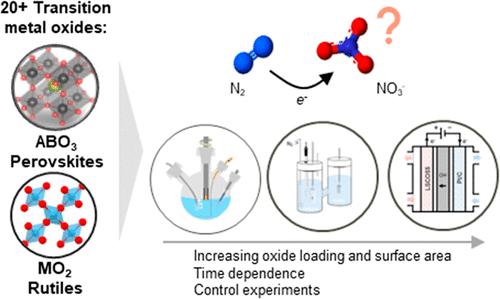
The electrochemical oxidation of dinitrogen (N2) to nitrate (NO3–) is an attractive method for decentralized fertilizer production. Yet, scarce experimental evidence with trace NO3– produced in reported catalysts hints at the kinetics challenge and motivates a search for reliable electrocatalysts. We addressed the gaps in the understanding of N2 oxidation by computing three pathways: the (1) direct electrochemical pathway that extends all the way to NO3–, (2) surface lattice oxygen pathway on perovskites, and (3) surface-adsorbed oxygen pathway. These computations revealed the unfavorable trade-off between N2 activation and NO2 desorption/O vacancy filling step energies, which potentially limit the N2 oxidation activity and render the parasitic OER dominant. However, several oxides which possess reactive surface oxygen and inert/moderate OER activity were identified as more promising for experimental assessment. We then experimentally examined 20+ transition metal oxides, namely, ABO3 perovskites (A = La, Sr, Ca, Bi and B = Co, Mn, Fe) and MO2 rutiles (IrO2, RuO2, TiO2, SnO2, and Fe- and Ir-doped TiO2 and SnO2) in alkaline and neutral electrolytes. Electrochemical measurements via up to 22 h chronoamperometry showed minimal NO3– concentrations of <1 ppmN via UV–vis spectroscopy, which were comparable to those measured in the absence of N2. Time-dependent investigations of different substrates (i.e., carbon paper and Ti foil), increasing catalyst loadings in H-cells and flow cells, as well as high-surface-area La0.5Sr0.5CoO3 and La0.5Sr0.5MnO3 showed that the observed NO3– concentrations were not greater than those measured without N2 with experimental certainty. This work underscores the need for proliferating NOx production (massprod) beyond system size (masssys) or rigorous quantitative 15N2-labeling to provide concrete evidence for true N2 oxidation and encourages exploration of ambient N2 oxidation beyond conventional approaches.
期刊介绍:
ACS Catalysis is an esteemed journal that publishes original research in the fields of heterogeneous catalysis, molecular catalysis, and biocatalysis. It offers broad coverage across diverse areas such as life sciences, organometallics and synthesis, photochemistry and electrochemistry, drug discovery and synthesis, materials science, environmental protection, polymer discovery and synthesis, and energy and fuels.
The scope of the journal is to showcase innovative work in various aspects of catalysis. This includes new reactions and novel synthetic approaches utilizing known catalysts, the discovery or modification of new catalysts, elucidation of catalytic mechanisms through cutting-edge investigations, practical enhancements of existing processes, as well as conceptual advances in the field. Contributions to ACS Catalysis can encompass both experimental and theoretical research focused on catalytic molecules, macromolecules, and materials that exhibit catalytic turnover.



 京公网安备 11010802042870号
京ICP备2023020795号-1
京公网安备 11010802042870号
京ICP备2023020795号-1

 分享
分享
 求助内容:
求助内容: 应助结果提醒方式:
 扫码关注我们
