Accelerating the Hit-To-Lead Optimization of a SARS-CoV-2 Mpro Inhibitor Series by Combining High-Throughput Medicinal Chemistry and Computational Simulations
Julien Hazemann, Thierry Kimmerlin, Aengus Mac Sweeney, Geoffroy Bourquin, Roland Lange, Daniel Ritz, Sylvia Richard-Bildstein, Sylvain Regeon, Paul Czodrowski
{"title":"Accelerating the Hit-To-Lead Optimization of a SARS-CoV-2 Mpro Inhibitor Series by Combining High-Throughput Medicinal Chemistry and Computational Simulations","authors":"Julien Hazemann, Thierry Kimmerlin, Aengus Mac Sweeney, Geoffroy Bourquin, Roland Lange, Daniel Ritz, Sylvia Richard-Bildstein, Sylvain Regeon, Paul Czodrowski","doi":"10.1021/acs.jmedchem.4c02941","DOIUrl":null,"url":null,"abstract":"In this study, we performed the hit-to-lead optimization of a SARS-CoV-2 Mpro diazepane hit (identified by computational methods in a previous work) by combining computational simulations with high-throughput medicinal chemistry (HTMC). Leveraging the 3D structural information of Mpro, we refined the original hit by targeting the S1 and S2 binding pockets of the protein. Additionally, we identified a novel exit vector pointing toward the S1′ pocket, which significantly enhanced the binding affinity. This strategy enabled us to transform, rapidly with a limited number of compounds synthesized, a 14 μM hit into a potent 16 nM lead compound, for which key pharmacological properties were subsequently evaluated. This result demonstrated that combining computational technologies such as machine learning, molecular docking, and molecular dynamics simulation with HTMC can efficiently accelerate hit identification and subsequent lead generation.","PeriodicalId":46,"journal":{"name":"Journal of Medicinal Chemistry","volume":"81 1","pages":""},"PeriodicalIF":6.8000,"publicationDate":"2025-04-05","publicationTypes":"Journal Article","fieldsOfStudy":null,"isOpenAccess":false,"openAccessPdf":"","citationCount":"0","resultStr":null,"platform":"Semanticscholar","paperid":null,"PeriodicalName":"Journal of Medicinal Chemistry","FirstCategoryId":"3","ListUrlMain":"https://doi.org/10.1021/acs.jmedchem.4c02941","RegionNum":1,"RegionCategory":"医学","ArticlePicture":[],"TitleCN":null,"AbstractTextCN":null,"PMCID":null,"EPubDate":"","PubModel":"","JCR":"Q1","JCRName":"CHEMISTRY, MEDICINAL","Score":null,"Total":0}
引用次数: 0
Abstract
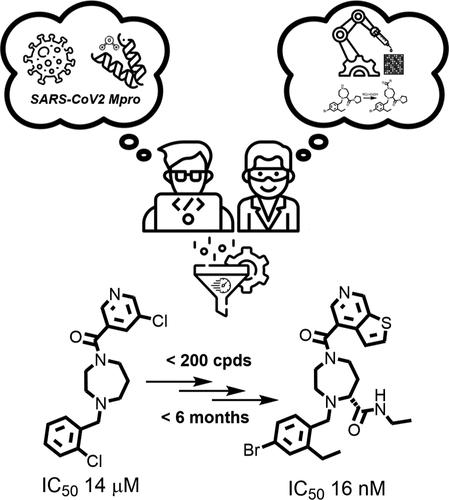
In this study, we performed the hit-to-lead optimization of a SARS-CoV-2 Mpro diazepane hit (identified by computational methods in a previous work) by combining computational simulations with high-throughput medicinal chemistry (HTMC). Leveraging the 3D structural information of Mpro, we refined the original hit by targeting the S1 and S2 binding pockets of the protein. Additionally, we identified a novel exit vector pointing toward the S1′ pocket, which significantly enhanced the binding affinity. This strategy enabled us to transform, rapidly with a limited number of compounds synthesized, a 14 μM hit into a potent 16 nM lead compound, for which key pharmacological properties were subsequently evaluated. This result demonstrated that combining computational technologies such as machine learning, molecular docking, and molecular dynamics simulation with HTMC can efficiently accelerate hit identification and subsequent lead generation.
期刊介绍:
The Journal of Medicinal Chemistry is a prestigious biweekly peer-reviewed publication that focuses on the multifaceted field of medicinal chemistry. Since its inception in 1959 as the Journal of Medicinal and Pharmaceutical Chemistry, it has evolved to become a cornerstone in the dissemination of research findings related to the design, synthesis, and development of therapeutic agents.
The Journal of Medicinal Chemistry is recognized for its significant impact in the scientific community, as evidenced by its 2022 impact factor of 7.3. This metric reflects the journal's influence and the importance of its content in shaping the future of drug discovery and development. The journal serves as a vital resource for chemists, pharmacologists, and other researchers interested in the molecular mechanisms of drug action and the optimization of therapeutic compounds.



 京公网安备 11010802042870号
京ICP备2023020795号-1
京公网安备 11010802042870号
京ICP备2023020795号-1

 分享
分享
 求助内容:
求助内容: 应助结果提醒方式:
 扫码关注我们
