A Water-Soluble Aggregation-Induced Emission Photosensitizer with Intrinsic Antibacterial Activity as an Antiplanktonic and Antibiofilm Therapeutic Agent
Cheung-Hin Hung, Ka Hin Chan, Wai-Po Kong, Ruo-Lan Du, Kang Ding, Zhiguang Liang, Yong Wang, Kwok-Yin Wong
{"title":"A Water-Soluble Aggregation-Induced Emission Photosensitizer with Intrinsic Antibacterial Activity as an Antiplanktonic and Antibiofilm Therapeutic Agent","authors":"Cheung-Hin Hung, Ka Hin Chan, Wai-Po Kong, Ruo-Lan Du, Kang Ding, Zhiguang Liang, Yong Wang, Kwok-Yin Wong","doi":"10.1021/acs.jmedchem.5c00403","DOIUrl":null,"url":null,"abstract":"Photosensitizers (PSs) with aggregation-induced emission (AIE) properties have gained popularity for treating bacterial infections. However, most AIE PSs have a poor water solubility and low selectivity, limiting their applications in biological systems. Herein, we report a water-soluble and bacteria-targeting AIE PS that exhibits minimum cytotoxicity toward human cells with and without light irradiation. Acting as a narrow-spectrum antibacterial agent without light irradiation, TPA-1 eradicates planktonic <i>Staphylococcus aureus</i> and inhibits biofilm formation by targeting the <i>S. aureus</i> membrane, inhibiting the supercoiling activity of <i>S. aureus</i> DNA gyrase, and causing the downregulation of multiple essential proteins. Upon light irradiation, TPA-1 generates reactive oxygen species (ROS) that cause membrane damage, resulting in excellent antiplanktonic and antibiofilm activities against <i>S. aureus</i> and <i>Pseudomonas aeruginosa</i>, significantly reducing the number of viable bacteria in biofilms and promoting wound healing <i>in vivo</i>.","PeriodicalId":46,"journal":{"name":"Journal of Medicinal Chemistry","volume":"217 1","pages":""},"PeriodicalIF":6.8000,"publicationDate":"2025-04-05","publicationTypes":"Journal Article","fieldsOfStudy":null,"isOpenAccess":false,"openAccessPdf":"","citationCount":"0","resultStr":null,"platform":"Semanticscholar","paperid":null,"PeriodicalName":"Journal of Medicinal Chemistry","FirstCategoryId":"3","ListUrlMain":"https://doi.org/10.1021/acs.jmedchem.5c00403","RegionNum":1,"RegionCategory":"医学","ArticlePicture":[],"TitleCN":null,"AbstractTextCN":null,"PMCID":null,"EPubDate":"","PubModel":"","JCR":"Q1","JCRName":"CHEMISTRY, MEDICINAL","Score":null,"Total":0}
引用次数: 0
Abstract
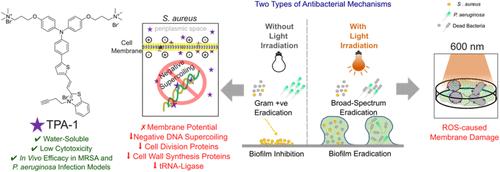
Photosensitizers (PSs) with aggregation-induced emission (AIE) properties have gained popularity for treating bacterial infections. However, most AIE PSs have a poor water solubility and low selectivity, limiting their applications in biological systems. Herein, we report a water-soluble and bacteria-targeting AIE PS that exhibits minimum cytotoxicity toward human cells with and without light irradiation. Acting as a narrow-spectrum antibacterial agent without light irradiation, TPA-1 eradicates planktonic Staphylococcus aureus and inhibits biofilm formation by targeting the S. aureus membrane, inhibiting the supercoiling activity of S. aureus DNA gyrase, and causing the downregulation of multiple essential proteins. Upon light irradiation, TPA-1 generates reactive oxygen species (ROS) that cause membrane damage, resulting in excellent antiplanktonic and antibiofilm activities against S. aureus and Pseudomonas aeruginosa, significantly reducing the number of viable bacteria in biofilms and promoting wound healing in vivo.
期刊介绍:
The Journal of Medicinal Chemistry is a prestigious biweekly peer-reviewed publication that focuses on the multifaceted field of medicinal chemistry. Since its inception in 1959 as the Journal of Medicinal and Pharmaceutical Chemistry, it has evolved to become a cornerstone in the dissemination of research findings related to the design, synthesis, and development of therapeutic agents.
The Journal of Medicinal Chemistry is recognized for its significant impact in the scientific community, as evidenced by its 2022 impact factor of 7.3. This metric reflects the journal's influence and the importance of its content in shaping the future of drug discovery and development. The journal serves as a vital resource for chemists, pharmacologists, and other researchers interested in the molecular mechanisms of drug action and the optimization of therapeutic compounds.



 京公网安备 11010802042870号
京ICP备2023020795号-1
京公网安备 11010802042870号
京ICP备2023020795号-1

 分享
分享
 求助内容:
求助内容: 应助结果提醒方式:
 扫码关注我们
