Structure-Based Design and Optimization Lead to the Identification of a Novel Potent sEH Inhibitor with PPARγ Partial Agonist Activity against Inflammatory and Metabolic-Related Diseases
Ruolin Cao, Maoying Zhang, Minggang Qi, Zhen Zhang, Christophe Morisseau, Chunwei Zhou, Tianqi Sun, Junning Zhuang, Lu Chen, Cheng Xu, Zhongbo Liu, Bruce D. Hammock, Guoliang Chen
{"title":"Structure-Based Design and Optimization Lead to the Identification of a Novel Potent sEH Inhibitor with PPARγ Partial Agonist Activity against Inflammatory and Metabolic-Related Diseases","authors":"Ruolin Cao, Maoying Zhang, Minggang Qi, Zhen Zhang, Christophe Morisseau, Chunwei Zhou, Tianqi Sun, Junning Zhuang, Lu Chen, Cheng Xu, Zhongbo Liu, Bruce D. Hammock, Guoliang Chen","doi":"10.1021/acs.jmedchem.5c00402","DOIUrl":null,"url":null,"abstract":"The peroxisome proliferator-activated receptor-γ (PPARγ) serves as a pivotal regulator of lipid balance, adipogenesis, and inflammatory processes. PPARγ full agonists display strong curative effects but also serious adverse effects. Here, we found a novel 4-(cyclohexyloxy)phenyl acetate scaffold with partial PPARγ agonist activity, and its structure–activity relationship was studied. We also describe the structure-guided lead optimization of orally bioavailable <b>SP-C01</b> as a dual modulator of soluble epoxide hydrolase (sEH) and partial PPARγ, which can inhibit Ser273 phosphorylation. In mice, oral administration of <b>SP-C01</b> at a dose of 5 g/kg resulted in excellent safety; a significant reduction in the negative consequences of lipid accumulation and water–sodium retention; and no gastrointestinal adverse effects, weight gain, or cardiotoxicity. In addition, <b>SP-C01</b> has shown a better effect than pioglitazone (<b>Pio.</b>) in type 2 diabetes and nonalcoholic steatohepatitis. Additionally, <b>SP-C01</b> has demonstrated potent anti-inflammatory and analgesic properties in models of both neuropathic and inflammatory pain.","PeriodicalId":46,"journal":{"name":"Journal of Medicinal Chemistry","volume":"42 1","pages":""},"PeriodicalIF":6.8000,"publicationDate":"2025-04-04","publicationTypes":"Journal Article","fieldsOfStudy":null,"isOpenAccess":false,"openAccessPdf":"","citationCount":"0","resultStr":null,"platform":"Semanticscholar","paperid":null,"PeriodicalName":"Journal of Medicinal Chemistry","FirstCategoryId":"3","ListUrlMain":"https://doi.org/10.1021/acs.jmedchem.5c00402","RegionNum":1,"RegionCategory":"医学","ArticlePicture":[],"TitleCN":null,"AbstractTextCN":null,"PMCID":null,"EPubDate":"","PubModel":"","JCR":"Q1","JCRName":"CHEMISTRY, MEDICINAL","Score":null,"Total":0}
引用次数: 0
Abstract
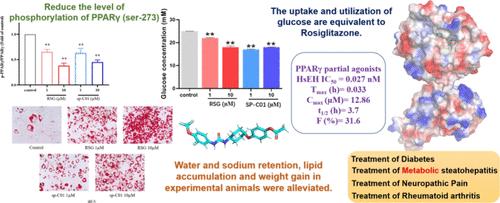
The peroxisome proliferator-activated receptor-γ (PPARγ) serves as a pivotal regulator of lipid balance, adipogenesis, and inflammatory processes. PPARγ full agonists display strong curative effects but also serious adverse effects. Here, we found a novel 4-(cyclohexyloxy)phenyl acetate scaffold with partial PPARγ agonist activity, and its structure–activity relationship was studied. We also describe the structure-guided lead optimization of orally bioavailable SP-C01 as a dual modulator of soluble epoxide hydrolase (sEH) and partial PPARγ, which can inhibit Ser273 phosphorylation. In mice, oral administration of SP-C01 at a dose of 5 g/kg resulted in excellent safety; a significant reduction in the negative consequences of lipid accumulation and water–sodium retention; and no gastrointestinal adverse effects, weight gain, or cardiotoxicity. In addition, SP-C01 has shown a better effect than pioglitazone (Pio.) in type 2 diabetes and nonalcoholic steatohepatitis. Additionally, SP-C01 has demonstrated potent anti-inflammatory and analgesic properties in models of both neuropathic and inflammatory pain.
期刊介绍:
The Journal of Medicinal Chemistry is a prestigious biweekly peer-reviewed publication that focuses on the multifaceted field of medicinal chemistry. Since its inception in 1959 as the Journal of Medicinal and Pharmaceutical Chemistry, it has evolved to become a cornerstone in the dissemination of research findings related to the design, synthesis, and development of therapeutic agents.
The Journal of Medicinal Chemistry is recognized for its significant impact in the scientific community, as evidenced by its 2022 impact factor of 7.3. This metric reflects the journal's influence and the importance of its content in shaping the future of drug discovery and development. The journal serves as a vital resource for chemists, pharmacologists, and other researchers interested in the molecular mechanisms of drug action and the optimization of therapeutic compounds.



 京公网安备 11010802042870号
京ICP备2023020795号-1
京公网安备 11010802042870号
京ICP备2023020795号-1

 分享
分享
 求助内容:
求助内容: 应助结果提醒方式:
 扫码关注我们
