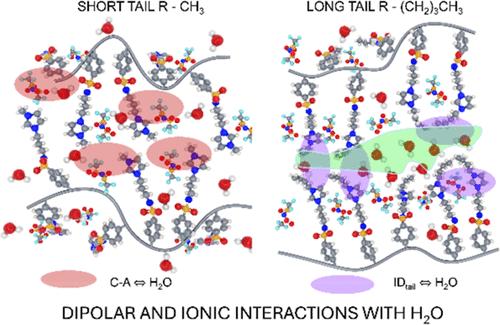
{"title":"Encoding Dipolar and Ionic Interactions in Comb-Like Poly(ionic Liquids)","authors":"Md Wali Ullah, Jiahui Liu, Marek W. Urban","doi":"10.1021/acs.macromol.4c03101","DOIUrl":null,"url":null,"abstract":"This study elucidates the origin of inter- and intrachain interactions in a new family of poly(ionic liquids) (PILs) containing alternating hydrophobic and hydrophilic groups terminated with variable-length aliphatic tails. The repeating units are sequentially synthesized and are composed of quadrupole (styrene), polar sulphonyl (−SO<sub>2</sub>), dipolar aliphatic spacer, cation–anion pair, and variable-length aliphatic (methyl to <i>n</i>-butyl) tails. They participate in quadrupole (Q), dipolar (D), induced dipole (ID), ionic (C–A), and a combination of thereof interactions. When perturbed by polar H<sub>2</sub>O molecules or electric fields (EFs), molecular events revealed by spectroscopic analysis supported by molecular dynamic (MD) simulations enabled encoding of the origin of intra- and interchain interactions and their impact on electrical responses. This study shows that conductivity increases for longer aliphatic tails, particularly when perturbed by H<sub>2</sub>O, attributed to enhanced ID ⇔ H<sub>2</sub>O interactions. At the same time, quadrupole interactions remain unchanged but enhance the mechanical integrity. Encoding the dynamics and strength of the Q ⇔ Q, D ⇔ D, ID ⇔ ID, and C–A interactions without generating protic environments may provide an opportunity for designing new generations of solid-state electrolytes exclusively relying on nonfaradic electrochemical processes that may lead to electrode decomposition or generation of undesirable side reactions.","PeriodicalId":51,"journal":{"name":"Macromolecules","volume":"60 1","pages":""},"PeriodicalIF":5.2000,"publicationDate":"2025-04-04","publicationTypes":"Journal Article","fieldsOfStudy":null,"isOpenAccess":false,"openAccessPdf":"","citationCount":"0","resultStr":null,"platform":"Semanticscholar","paperid":null,"PeriodicalName":"Macromolecules","FirstCategoryId":"92","ListUrlMain":"https://doi.org/10.1021/acs.macromol.4c03101","RegionNum":1,"RegionCategory":"化学","ArticlePicture":[],"TitleCN":null,"AbstractTextCN":null,"PMCID":null,"EPubDate":"","PubModel":"","JCR":"Q1","JCRName":"POLYMER SCIENCE","Score":null,"Total":0}
引用次数: 0
Abstract
This study elucidates the origin of inter- and intrachain interactions in a new family of poly(ionic liquids) (PILs) containing alternating hydrophobic and hydrophilic groups terminated with variable-length aliphatic tails. The repeating units are sequentially synthesized and are composed of quadrupole (styrene), polar sulphonyl (−SO2), dipolar aliphatic spacer, cation–anion pair, and variable-length aliphatic (methyl to n-butyl) tails. They participate in quadrupole (Q), dipolar (D), induced dipole (ID), ionic (C–A), and a combination of thereof interactions. When perturbed by polar H2O molecules or electric fields (EFs), molecular events revealed by spectroscopic analysis supported by molecular dynamic (MD) simulations enabled encoding of the origin of intra- and interchain interactions and their impact on electrical responses. This study shows that conductivity increases for longer aliphatic tails, particularly when perturbed by H2O, attributed to enhanced ID ⇔ H2O interactions. At the same time, quadrupole interactions remain unchanged but enhance the mechanical integrity. Encoding the dynamics and strength of the Q ⇔ Q, D ⇔ D, ID ⇔ ID, and C–A interactions without generating protic environments may provide an opportunity for designing new generations of solid-state electrolytes exclusively relying on nonfaradic electrochemical processes that may lead to electrode decomposition or generation of undesirable side reactions.
期刊介绍:
Macromolecules publishes original, fundamental, and impactful research on all aspects of polymer science. Topics of interest include synthesis (e.g., controlled polymerizations, polymerization catalysis, post polymerization modification, new monomer structures and polymer architectures, and polymerization mechanisms/kinetics analysis); phase behavior, thermodynamics, dynamic, and ordering/disordering phenomena (e.g., self-assembly, gelation, crystallization, solution/melt/solid-state characteristics); structure and properties (e.g., mechanical and rheological properties, surface/interfacial characteristics, electronic and transport properties); new state of the art characterization (e.g., spectroscopy, scattering, microscopy, rheology), simulation (e.g., Monte Carlo, molecular dynamics, multi-scale/coarse-grained modeling), and theoretical methods. Renewable/sustainable polymers, polymer networks, responsive polymers, electro-, magneto- and opto-active macromolecules, inorganic polymers, charge-transporting polymers (ion-containing, semiconducting, and conducting), nanostructured polymers, and polymer composites are also of interest. Typical papers published in Macromolecules showcase important and innovative concepts, experimental methods/observations, and theoretical/computational approaches that demonstrate a fundamental advance in the understanding of polymers.



 京公网安备 11010802042870号
京ICP备2023020795号-1
京公网安备 11010802042870号
京ICP备2023020795号-1

 分享
分享
 求助内容:
求助内容: 应助结果提醒方式:
 扫码关注我们
