Daniel C. Barzycki, Dana Ezzeddine, Sachin Shanbhag, Ralm G. Ricarte
{"title":"Linear Viscoelasticity of Polystyrene Vitrimers: Segmental Motions and the Slow Arrhenius Process","authors":"Daniel C. Barzycki, Dana Ezzeddine, Sachin Shanbhag, Ralm G. Ricarte","doi":"10.1021/acs.macromol.4c03161","DOIUrl":null,"url":null,"abstract":"Vitrimers are polymer networks connected by associative cross-links─covalent linkages that maintain network connectivity but exchange through reversible chemical reactions. Associative cross-links significantly change the dynamics of the molten polymer. This study focuses on the linear viscoelasticity of polystyrene vitrimers (PS-<i>v</i>) bearing imine cross-links. PS-<i>v</i> samples were prepared by condensation between precursor copolymers with pendant aldehydes and 1,6-hexanediamine cross-linker. The number-average molecular weights of the precursors were 6 and 8 kDa, and the amine-to-aldehyde molar ratio (<i>r</i>) ranged between 0.8 and 2.4. The glass transition temperature exhibited a nonmonotonic relationship with <i>r</i>. The linear viscoelasticity of PS-<i>v</i> was evaluated using a combination of small amplitude oscillatory shear (SAOS), stress relaxation, and creep and recovery. Time–temperature superposition analyses indicated two distinct relaxation regimes: (I) fast high frequency dynamics with a Williams–Landel–Ferry temperature dependence and (II) slow low frequency dynamics with Arrhenius behavior. The fast regime represented the segmental relaxations of the vitrimer backbone. The slow regime was described as a slow Arrhenius process (SAP), in which the long time dynamics have a temperature-independent rheological activation energy. For all PS-<i>v</i> samples in this study, the observed SAP had a much weaker temperature dependence than expected from sticky Rouse model predictions. Increasing <i>r</i> altered the plateau modulus and SAOS crossover frequency but did not affect the temperature dependences of the segmental motions or SAP. To describe the origin of the SAP, three hypotheses are proposed: cross-linker diffusion, polymer matrix effects, and local elasticity fluctuations.","PeriodicalId":51,"journal":{"name":"Macromolecules","volume":"81 1","pages":""},"PeriodicalIF":5.2000,"publicationDate":"2025-04-04","publicationTypes":"Journal Article","fieldsOfStudy":null,"isOpenAccess":false,"openAccessPdf":"","citationCount":"0","resultStr":null,"platform":"Semanticscholar","paperid":null,"PeriodicalName":"Macromolecules","FirstCategoryId":"92","ListUrlMain":"https://doi.org/10.1021/acs.macromol.4c03161","RegionNum":1,"RegionCategory":"化学","ArticlePicture":[],"TitleCN":null,"AbstractTextCN":null,"PMCID":null,"EPubDate":"","PubModel":"","JCR":"Q1","JCRName":"POLYMER SCIENCE","Score":null,"Total":0}
引用次数: 0
Abstract
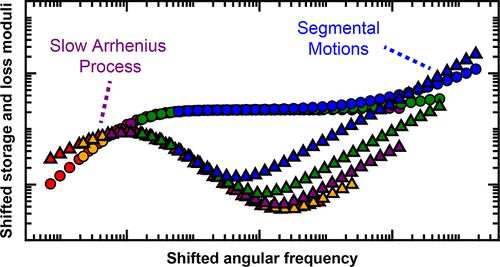
Vitrimers are polymer networks connected by associative cross-links─covalent linkages that maintain network connectivity but exchange through reversible chemical reactions. Associative cross-links significantly change the dynamics of the molten polymer. This study focuses on the linear viscoelasticity of polystyrene vitrimers (PS-v) bearing imine cross-links. PS-v samples were prepared by condensation between precursor copolymers with pendant aldehydes and 1,6-hexanediamine cross-linker. The number-average molecular weights of the precursors were 6 and 8 kDa, and the amine-to-aldehyde molar ratio (r) ranged between 0.8 and 2.4. The glass transition temperature exhibited a nonmonotonic relationship with r. The linear viscoelasticity of PS-v was evaluated using a combination of small amplitude oscillatory shear (SAOS), stress relaxation, and creep and recovery. Time–temperature superposition analyses indicated two distinct relaxation regimes: (I) fast high frequency dynamics with a Williams–Landel–Ferry temperature dependence and (II) slow low frequency dynamics with Arrhenius behavior. The fast regime represented the segmental relaxations of the vitrimer backbone. The slow regime was described as a slow Arrhenius process (SAP), in which the long time dynamics have a temperature-independent rheological activation energy. For all PS-v samples in this study, the observed SAP had a much weaker temperature dependence than expected from sticky Rouse model predictions. Increasing r altered the plateau modulus and SAOS crossover frequency but did not affect the temperature dependences of the segmental motions or SAP. To describe the origin of the SAP, three hypotheses are proposed: cross-linker diffusion, polymer matrix effects, and local elasticity fluctuations.
期刊介绍:
Macromolecules publishes original, fundamental, and impactful research on all aspects of polymer science. Topics of interest include synthesis (e.g., controlled polymerizations, polymerization catalysis, post polymerization modification, new monomer structures and polymer architectures, and polymerization mechanisms/kinetics analysis); phase behavior, thermodynamics, dynamic, and ordering/disordering phenomena (e.g., self-assembly, gelation, crystallization, solution/melt/solid-state characteristics); structure and properties (e.g., mechanical and rheological properties, surface/interfacial characteristics, electronic and transport properties); new state of the art characterization (e.g., spectroscopy, scattering, microscopy, rheology), simulation (e.g., Monte Carlo, molecular dynamics, multi-scale/coarse-grained modeling), and theoretical methods. Renewable/sustainable polymers, polymer networks, responsive polymers, electro-, magneto- and opto-active macromolecules, inorganic polymers, charge-transporting polymers (ion-containing, semiconducting, and conducting), nanostructured polymers, and polymer composites are also of interest. Typical papers published in Macromolecules showcase important and innovative concepts, experimental methods/observations, and theoretical/computational approaches that demonstrate a fundamental advance in the understanding of polymers.



 京公网安备 11010802042870号
京ICP备2023020795号-1
京公网安备 11010802042870号
京ICP备2023020795号-1

 分享
分享
 求助内容:
求助内容: 应助结果提醒方式:
 扫码关注我们
