Xiaojie Liang, Fangzhong Liu, Haonan Yue, Yaoyong Dong, Lijuan Chen, Ting Song, Yong Pei, Xianyou Wang, Bei Long, Yao Xiao and Xiongwei Wu
{"title":"Interlayer engineering-induced charge redistribution in Bi2Te3 toward efficient Zn2+ and NH4+ storage†","authors":"Xiaojie Liang, Fangzhong Liu, Haonan Yue, Yaoyong Dong, Lijuan Chen, Ting Song, Yong Pei, Xianyou Wang, Bei Long, Yao Xiao and Xiongwei Wu","doi":"10.1039/D5SC01210D","DOIUrl":null,"url":null,"abstract":"<p >Bismuth-based materials show promise for aqueous energy storage systems due to their unique layered structures and high storage capacity. Some bismuth-based materials have been applied to store Zn<small><sup>2+</sup></small> or NH<small><sub>4</sub></small><small><sup>+</sup></small>, indicating that one bismuth-based compound may be innovatively used in both zinc-ion and ammonium-ion batteries (ZIBs and AIBs). Herein, we successfully design a poly(3,4-ethylenedioxythiophene) (PEDOT) coated and embedded Bi<small><sub>2</sub></small>Te<small><sub>3</sub></small> (Bi<small><sub>2</sub></small>Te<small><sub>3</sub></small>@PEDOT). Theoretical calculations and experimental studies demonstrate that the PEDOT coating and its intercalation into the interlayer enhance the structural stability of Bi<small><sub>2</sub></small>Te<small><sub>3</sub></small> and significantly improve the storage capacities for Zn<small><sup>2+</sup></small> and NH<small><sub>4</sub></small><small><sup>+</sup></small>. The PEDOT intercalation results in an increased interlayer spacing and a charge redistribution in the interlayer, facilitating charge transfer. Additionally, the insertion-type mechanism of Zn<small><sup>2+</sup></small> and NH<small><sub>4</sub></small><small><sup>+</sup></small> in Bi<small><sub>2</sub></small>Te<small><sub>3</sub></small>@PEDOT is revealed through <em>ex situ</em> tests. The optimized electrode (5 mg cm<small><sup>−2</sup></small>) exhibits high discharge capacities of 385 mA h g<small><sup>−1</sup></small> in ZIBs and 235 mA h g<small><sup>−1</sup></small> in AIBs at 0.2 A g<small><sup>−1</sup></small> and long-term cycle stability. Bi<small><sub>2</sub></small>Te<small><sub>3</sub></small>@PEDOT performs robustly even at a high mass loading of 10 mg cm<small><sup>−2</sup></small>. Bi<small><sub>2</sub></small>Te<small><sub>3</sub></small>@PEDOT//MnO<small><sub>2</sub></small> (ZIBs) and Bi<small><sub>2</sub></small>Te<small><sub>3</sub></small>@PEDOT//ZnMn<small><sub>2</sub></small>O<small><sub>4</sub></small> (AIBs) full cells offer high reversible capacities. This work provides a reference for designing bifunctional energy storage materials.</p>","PeriodicalId":9909,"journal":{"name":"Chemical Science","volume":" 19","pages":" 8523-8531"},"PeriodicalIF":7.4000,"publicationDate":"2025-04-05","publicationTypes":"Journal Article","fieldsOfStudy":null,"isOpenAccess":false,"openAccessPdf":"https://pubs.rsc.org/en/content/articlepdf/2025/sc/d5sc01210d?page=search","citationCount":"0","resultStr":null,"platform":"Semanticscholar","paperid":null,"PeriodicalName":"Chemical Science","FirstCategoryId":"92","ListUrlMain":"https://pubs.rsc.org/en/content/articlelanding/2025/sc/d5sc01210d","RegionNum":1,"RegionCategory":"化学","ArticlePicture":[],"TitleCN":null,"AbstractTextCN":null,"PMCID":null,"EPubDate":"","PubModel":"","JCR":"Q1","JCRName":"CHEMISTRY, MULTIDISCIPLINARY","Score":null,"Total":0}
引用次数: 0
Abstract
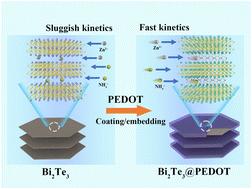
Bismuth-based materials show promise for aqueous energy storage systems due to their unique layered structures and high storage capacity. Some bismuth-based materials have been applied to store Zn2+ or NH4+, indicating that one bismuth-based compound may be innovatively used in both zinc-ion and ammonium-ion batteries (ZIBs and AIBs). Herein, we successfully design a poly(3,4-ethylenedioxythiophene) (PEDOT) coated and embedded Bi2Te3 (Bi2Te3@PEDOT). Theoretical calculations and experimental studies demonstrate that the PEDOT coating and its intercalation into the interlayer enhance the structural stability of Bi2Te3 and significantly improve the storage capacities for Zn2+ and NH4+. The PEDOT intercalation results in an increased interlayer spacing and a charge redistribution in the interlayer, facilitating charge transfer. Additionally, the insertion-type mechanism of Zn2+ and NH4+ in Bi2Te3@PEDOT is revealed through ex situ tests. The optimized electrode (5 mg cm−2) exhibits high discharge capacities of 385 mA h g−1 in ZIBs and 235 mA h g−1 in AIBs at 0.2 A g−1 and long-term cycle stability. Bi2Te3@PEDOT performs robustly even at a high mass loading of 10 mg cm−2. Bi2Te3@PEDOT//MnO2 (ZIBs) and Bi2Te3@PEDOT//ZnMn2O4 (AIBs) full cells offer high reversible capacities. This work provides a reference for designing bifunctional energy storage materials.
期刊介绍:
Chemical Science is a journal that encompasses various disciplines within the chemical sciences. Its scope includes publishing ground-breaking research with significant implications for its respective field, as well as appealing to a wider audience in related areas. To be considered for publication, articles must showcase innovative and original advances in their field of study and be presented in a manner that is understandable to scientists from diverse backgrounds. However, the journal generally does not publish highly specialized research.




 京公网安备 11010802042870号
京ICP备2023020795号-1
京公网安备 11010802042870号
京ICP备2023020795号-1

 分享
分享
 求助内容:
求助内容: 应助结果提醒方式:
 扫码关注我们
