Baidyanath Roy, Tamal Dey, Shaona Bose, Somnath Mahato, Narayan Chandra Das and Samit K. Ray
{"title":"Superior photoconversion efficiency of nanocrystal sensitized solar cells based on all-inorganic CsPbX3 (X = Br, I) perovskites†","authors":"Baidyanath Roy, Tamal Dey, Shaona Bose, Somnath Mahato, Narayan Chandra Das and Samit K. Ray","doi":"10.1039/D4NR04752D","DOIUrl":null,"url":null,"abstract":"<p >Nanocrystal-sensitized solar cells have emerged as potential alternatives to traditional photovoltaic technology due to their unique light absorption and emission characteristics and size-dependent bandgap. In this work, we report the successful synthesis of cubic-phase CsPbI<small><sub>3</sub></small> and CsPbBr<small><sub>3</sub></small> nanocrystals for their use as photosensitizers in solar cells, referred to as perovskite nanocrystal-sensitized solar cells (PNCSSCs). Among the two systems, CsPbI<small><sub>3</sub></small> is found to be superior for PNCSSCs because of its high absorption efficiency, lower bandgap, and higher photoluminescence yield, as compared to CsPbBr<small><sub>3</sub></small>. Our study examines the structural, compositional, optical, and electrical properties of these perovskite nanocrystals, focusing on their contributions to photoconversion efficiency. CsPbBr<small><sub>3</sub></small> nanocrystals exhibit a band gap of ∼2.4 eV along with defect states-induced short carrier lifetime of around 18 ns. In contrast, CsPbI<small><sub>3</sub></small> demonstrates a band gap of ∼1.8 eV closer to the peak of the solar spectrum with a much longer carrier lifetime of ∼130 ns, which facilitates better separation and collection of photogenerated charge carriers. Consequently, CsPbI<small><sub>3</sub></small> nanocrystal-sensitized solar cells fabricated with mesoporous TiO<small><sub>2</sub></small> reveal a photoconversion efficiency of ∼12.5%, as compared to 3.8% for CsPbBr<small><sub>3</sub></small> nanocrystal solar cells. To the best of our knowledge, this is the highest reported photoconversion efficiency in solution-processed perovskite nanocrystal-sensitized solar cells.</p>","PeriodicalId":92,"journal":{"name":"Nanoscale","volume":" 17","pages":" 10743-10751"},"PeriodicalIF":5.1000,"publicationDate":"2025-04-05","publicationTypes":"Journal Article","fieldsOfStudy":null,"isOpenAccess":false,"openAccessPdf":"","citationCount":"0","resultStr":null,"platform":"Semanticscholar","paperid":null,"PeriodicalName":"Nanoscale","FirstCategoryId":"88","ListUrlMain":"https://pubs.rsc.org/en/content/articlelanding/2025/nr/d4nr04752d","RegionNum":3,"RegionCategory":"材料科学","ArticlePicture":[],"TitleCN":null,"AbstractTextCN":null,"PMCID":null,"EPubDate":"","PubModel":"","JCR":"Q1","JCRName":"CHEMISTRY, MULTIDISCIPLINARY","Score":null,"Total":0}
引用次数: 0
Abstract
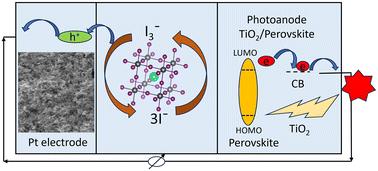
Nanocrystal-sensitized solar cells have emerged as potential alternatives to traditional photovoltaic technology due to their unique light absorption and emission characteristics and size-dependent bandgap. In this work, we report the successful synthesis of cubic-phase CsPbI3 and CsPbBr3 nanocrystals for their use as photosensitizers in solar cells, referred to as perovskite nanocrystal-sensitized solar cells (PNCSSCs). Among the two systems, CsPbI3 is found to be superior for PNCSSCs because of its high absorption efficiency, lower bandgap, and higher photoluminescence yield, as compared to CsPbBr3. Our study examines the structural, compositional, optical, and electrical properties of these perovskite nanocrystals, focusing on their contributions to photoconversion efficiency. CsPbBr3 nanocrystals exhibit a band gap of ∼2.4 eV along with defect states-induced short carrier lifetime of around 18 ns. In contrast, CsPbI3 demonstrates a band gap of ∼1.8 eV closer to the peak of the solar spectrum with a much longer carrier lifetime of ∼130 ns, which facilitates better separation and collection of photogenerated charge carriers. Consequently, CsPbI3 nanocrystal-sensitized solar cells fabricated with mesoporous TiO2 reveal a photoconversion efficiency of ∼12.5%, as compared to 3.8% for CsPbBr3 nanocrystal solar cells. To the best of our knowledge, this is the highest reported photoconversion efficiency in solution-processed perovskite nanocrystal-sensitized solar cells.
期刊介绍:
Nanoscale is a high-impact international journal, publishing high-quality research across nanoscience and nanotechnology. Nanoscale publishes a full mix of research articles on experimental and theoretical work, including reviews, communications, and full papers.Highly interdisciplinary, this journal appeals to scientists, researchers and professionals interested in nanoscience and nanotechnology, quantum materials and quantum technology, including the areas of physics, chemistry, biology, medicine, materials, energy/environment, information technology, detection science, healthcare and drug discovery, and electronics.



 京公网安备 11010802042870号
京ICP备2023020795号-1
京公网安备 11010802042870号
京ICP备2023020795号-1

 分享
分享
 求助内容:
求助内容: 应助结果提醒方式:
 扫码关注我们
