{"title":"Molecular Coverage Modulates Chiral Surface-Enhanced Raman Scattering on Chiral Plasmonic Nanoparticles","authors":"Dandan Lu, Guizeng Yang, Yunlong Tao, Guoxin Cao, Xuehao Sun, Chuang Liu, Lichao Sun, Qingfeng Zhang","doi":"10.1021/acs.analchem.4c06639","DOIUrl":null,"url":null,"abstract":"Sensitive recognition of enantiomer has aroused extensive interest due to its importance in diverse fields ranging from pharmaceuticals to catalysis and biomedicine. Chiral surface-enhanced Raman scattering (SERS) by chiral plasmonic substrates has emerged as a promising tool for the recognition of enantiomers with high sensitivity as well as molecular fingerprinting capability. However, the impact of the molecular states including surface packing density and configurations of surface-adsorbed chiral molecules on chiral SERS has been largely unexplored. Herein, we demonstrate that chiral SERS by chiral plasmonic nanoparticles (NPs) is sensitively dependent on the molecular coverage of enantiomers. Au helical nanocubes with tunable optical properties and intense near-field enhancements were chosen as the chiral plasmonic substrates for chiral SERS. By changing the concentration and structure of enantiomers, the impact of the molecular states including surface packing density and configurations of enantiomers on chiral SERS is revealed. Finally, we demonstrate the use of achiral molecules as internal molecular spacers for achieving the ultrasensitive detection of enantiomer. The insights gained from this work not only shed light on the underlying mechanisms dictating the chiral SERS by chiral plasmonic NPs but also strongly suggest a promising approach to the sensitive detection of molecular chirality using Raman spectroscopy.","PeriodicalId":27,"journal":{"name":"Analytical Chemistry","volume":"93 1","pages":""},"PeriodicalIF":6.7000,"publicationDate":"2025-04-04","publicationTypes":"Journal Article","fieldsOfStudy":null,"isOpenAccess":false,"openAccessPdf":"","citationCount":"0","resultStr":null,"platform":"Semanticscholar","paperid":null,"PeriodicalName":"Analytical Chemistry","FirstCategoryId":"92","ListUrlMain":"https://doi.org/10.1021/acs.analchem.4c06639","RegionNum":1,"RegionCategory":"化学","ArticlePicture":[],"TitleCN":null,"AbstractTextCN":null,"PMCID":null,"EPubDate":"","PubModel":"","JCR":"Q1","JCRName":"CHEMISTRY, ANALYTICAL","Score":null,"Total":0}
引用次数: 0
Abstract
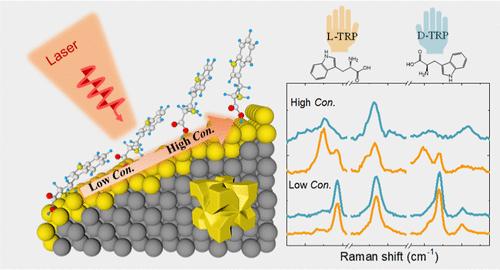
Sensitive recognition of enantiomer has aroused extensive interest due to its importance in diverse fields ranging from pharmaceuticals to catalysis and biomedicine. Chiral surface-enhanced Raman scattering (SERS) by chiral plasmonic substrates has emerged as a promising tool for the recognition of enantiomers with high sensitivity as well as molecular fingerprinting capability. However, the impact of the molecular states including surface packing density and configurations of surface-adsorbed chiral molecules on chiral SERS has been largely unexplored. Herein, we demonstrate that chiral SERS by chiral plasmonic nanoparticles (NPs) is sensitively dependent on the molecular coverage of enantiomers. Au helical nanocubes with tunable optical properties and intense near-field enhancements were chosen as the chiral plasmonic substrates for chiral SERS. By changing the concentration and structure of enantiomers, the impact of the molecular states including surface packing density and configurations of enantiomers on chiral SERS is revealed. Finally, we demonstrate the use of achiral molecules as internal molecular spacers for achieving the ultrasensitive detection of enantiomer. The insights gained from this work not only shed light on the underlying mechanisms dictating the chiral SERS by chiral plasmonic NPs but also strongly suggest a promising approach to the sensitive detection of molecular chirality using Raman spectroscopy.
期刊介绍:
Analytical Chemistry, a peer-reviewed research journal, focuses on disseminating new and original knowledge across all branches of analytical chemistry. Fundamental articles may explore general principles of chemical measurement science and need not directly address existing or potential analytical methodology. They can be entirely theoretical or report experimental results. Contributions may cover various phases of analytical operations, including sampling, bioanalysis, electrochemistry, mass spectrometry, microscale and nanoscale systems, environmental analysis, separations, spectroscopy, chemical reactions and selectivity, instrumentation, imaging, surface analysis, and data processing. Papers discussing known analytical methods should present a significant, original application of the method, a notable improvement, or results on an important analyte.



 京公网安备 11010802042870号
京ICP备2023020795号-1
京公网安备 11010802042870号
京ICP备2023020795号-1

 分享
分享
 求助内容:
求助内容: 应助结果提醒方式:
 扫码关注我们
