Yaqi Zhang, Panpan Chen, Haoyuan Geng, Min Li, Shiping Chen, Bangzhen Ma, Yan Ma, Jianjun Lai, Xiaoqing Cui, Wei Chong, Hao Chen, Xiao Wang, Chenglong Sun
{"title":"Development of a Single-Cell Spatial Metabolomics Method for the Characterization of Cell–Cell Metabolic Interactions","authors":"Yaqi Zhang, Panpan Chen, Haoyuan Geng, Min Li, Shiping Chen, Bangzhen Ma, Yan Ma, Jianjun Lai, Xiaoqing Cui, Wei Chong, Hao Chen, Xiao Wang, Chenglong Sun","doi":"10.1021/acs.analchem.5c00384","DOIUrl":null,"url":null,"abstract":"Tumor microenvironment (TME) is characterized by complex cellular composition and high molecular heterogeneity. Characterizing the metabolic interactions between different cells in the TME is important for understanding the molecular signatures of tumors and identifying potential metabolic vulnerabilities for tumor treatment. In this research, we develop a single-cell spatial metabolomics method to profile cell-specific metabolic signatures and cell–cell metabolic interactions using matrix-assisted laser desorption/ionization mass spectrometry imaging (MALDI-MSI). Different low-molecular-weight metabolites and lipids including glutamate, aspartate, glutamine, taurine, phenylalanine, glutathione, fatty acids, phospholipids, etc. were successfully detected and imaged after optimizing cell culture conductive slides, cell washing, and fixation procedures. Subsequently, we carried out single-cell spatial metabolomics on H460 large-cell lung cancer cells, HT-29 colorectal cancer cells, A549 lung cancer cells, HUH-7 liver cancer cells, and cancer-fibroblasts coculture system. We revealed that the metabolic profiles of both cancer cells and fibroblasts were altered after cell coculture. Glutamate and aspartate significantly increased in fibroblasts after coculture with cancer cells, corresponding to their indispensable roles in the creation of pro-cancer microenvironment. In addition, we discovered that the expressions of fatty acids and phospholipids in tumor cells and fibroblasts were also changed after cell coculture, which is closely related to the competition for energy and nutrient metabolites between different cells. We anticipate this single-cell analysis method to be broadly used in the investigations of diverse cellular models and cell–cell metabolic interactions.","PeriodicalId":27,"journal":{"name":"Analytical Chemistry","volume":"72 3 1","pages":""},"PeriodicalIF":6.7000,"publicationDate":"2025-04-04","publicationTypes":"Journal Article","fieldsOfStudy":null,"isOpenAccess":false,"openAccessPdf":"","citationCount":"0","resultStr":null,"platform":"Semanticscholar","paperid":null,"PeriodicalName":"Analytical Chemistry","FirstCategoryId":"92","ListUrlMain":"https://doi.org/10.1021/acs.analchem.5c00384","RegionNum":1,"RegionCategory":"化学","ArticlePicture":[],"TitleCN":null,"AbstractTextCN":null,"PMCID":null,"EPubDate":"","PubModel":"","JCR":"Q1","JCRName":"CHEMISTRY, ANALYTICAL","Score":null,"Total":0}
引用次数: 0
Abstract
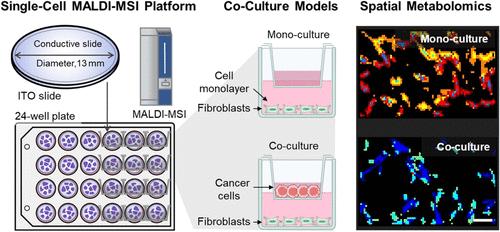
Tumor microenvironment (TME) is characterized by complex cellular composition and high molecular heterogeneity. Characterizing the metabolic interactions between different cells in the TME is important for understanding the molecular signatures of tumors and identifying potential metabolic vulnerabilities for tumor treatment. In this research, we develop a single-cell spatial metabolomics method to profile cell-specific metabolic signatures and cell–cell metabolic interactions using matrix-assisted laser desorption/ionization mass spectrometry imaging (MALDI-MSI). Different low-molecular-weight metabolites and lipids including glutamate, aspartate, glutamine, taurine, phenylalanine, glutathione, fatty acids, phospholipids, etc. were successfully detected and imaged after optimizing cell culture conductive slides, cell washing, and fixation procedures. Subsequently, we carried out single-cell spatial metabolomics on H460 large-cell lung cancer cells, HT-29 colorectal cancer cells, A549 lung cancer cells, HUH-7 liver cancer cells, and cancer-fibroblasts coculture system. We revealed that the metabolic profiles of both cancer cells and fibroblasts were altered after cell coculture. Glutamate and aspartate significantly increased in fibroblasts after coculture with cancer cells, corresponding to their indispensable roles in the creation of pro-cancer microenvironment. In addition, we discovered that the expressions of fatty acids and phospholipids in tumor cells and fibroblasts were also changed after cell coculture, which is closely related to the competition for energy and nutrient metabolites between different cells. We anticipate this single-cell analysis method to be broadly used in the investigations of diverse cellular models and cell–cell metabolic interactions.
期刊介绍:
Analytical Chemistry, a peer-reviewed research journal, focuses on disseminating new and original knowledge across all branches of analytical chemistry. Fundamental articles may explore general principles of chemical measurement science and need not directly address existing or potential analytical methodology. They can be entirely theoretical or report experimental results. Contributions may cover various phases of analytical operations, including sampling, bioanalysis, electrochemistry, mass spectrometry, microscale and nanoscale systems, environmental analysis, separations, spectroscopy, chemical reactions and selectivity, instrumentation, imaging, surface analysis, and data processing. Papers discussing known analytical methods should present a significant, original application of the method, a notable improvement, or results on an important analyte.



 京公网安备 11010802042870号
京ICP备2023020795号-1
京公网安备 11010802042870号
京ICP备2023020795号-1

 分享
分享
 求助内容:
求助内容: 应助结果提醒方式:
 扫码关注我们
