Jing Wang, Jianpu Tang, Aiqi Liang, Zhen Cui, Jiale Huo, Qian Li, Bin Ke, Dayong Yang, Chi Yao
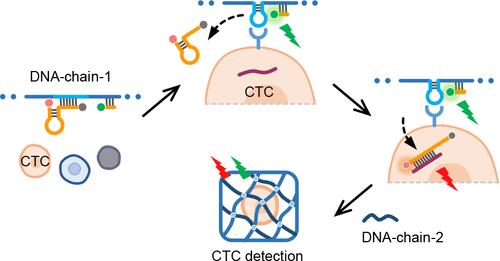
{"title":"A Smart DNA Network-Based Diagnostic System for Enrichment and Detection of Circulating Tumor Cells in Cancer Liquid Biopsy","authors":"Jing Wang, Jianpu Tang, Aiqi Liang, Zhen Cui, Jiale Huo, Qian Li, Bin Ke, Dayong Yang, Chi Yao","doi":"10.1021/acs.analchem.5c00648","DOIUrl":null,"url":null,"abstract":"Circulating tumor cells (CTCs) have emerged as critical biomarkers in liquid biopsy for noninvasive tumor diagnosis and real-time monitoring of cancer progression. However, the isolation of CTCs is often required before detection due to their ultralow abundance in peripheral blood. These isolation processes are typically time-consuming and prone to cell loss, which limits the utility of CTC-based liquid biopsy. Herein, we present a DNA network-based diagnostic system that enables specific recognition, selective enrichment, and accurate detection of CTCs directly from blood samples. The DNA network comprises ultralong DNA chains embedded with polyvalent aptamers and fluorescence detection modules. The polyvalent aptamers selectively bind to the epithelial cell adhesion molecule (EpCAM) on a CTC membrane, facilitating their enrichment through base pairing-driven DNA network formation. This system semiquantitatively detects the expression level of cancer-associated microRNA within CTCs using ratiometric fluorescence imaging based on the chemical assembly of two fluorescence modules. In clinical blood samples, this diagnostic system achieves 100% precision and 96% accuracy in distinguishing breast cancer patients from healthy donors, highlighting its promising potential for clinical breast cancer diagnosis.","PeriodicalId":27,"journal":{"name":"Analytical Chemistry","volume":"59 1","pages":""},"PeriodicalIF":6.7000,"publicationDate":"2025-04-04","publicationTypes":"Journal Article","fieldsOfStudy":null,"isOpenAccess":false,"openAccessPdf":"","citationCount":"0","resultStr":null,"platform":"Semanticscholar","paperid":null,"PeriodicalName":"Analytical Chemistry","FirstCategoryId":"92","ListUrlMain":"https://doi.org/10.1021/acs.analchem.5c00648","RegionNum":1,"RegionCategory":"化学","ArticlePicture":[],"TitleCN":null,"AbstractTextCN":null,"PMCID":null,"EPubDate":"","PubModel":"","JCR":"Q1","JCRName":"CHEMISTRY, ANALYTICAL","Score":null,"Total":0}
引用次数: 0
Abstract
Circulating tumor cells (CTCs) have emerged as critical biomarkers in liquid biopsy for noninvasive tumor diagnosis and real-time monitoring of cancer progression. However, the isolation of CTCs is often required before detection due to their ultralow abundance in peripheral blood. These isolation processes are typically time-consuming and prone to cell loss, which limits the utility of CTC-based liquid biopsy. Herein, we present a DNA network-based diagnostic system that enables specific recognition, selective enrichment, and accurate detection of CTCs directly from blood samples. The DNA network comprises ultralong DNA chains embedded with polyvalent aptamers and fluorescence detection modules. The polyvalent aptamers selectively bind to the epithelial cell adhesion molecule (EpCAM) on a CTC membrane, facilitating their enrichment through base pairing-driven DNA network formation. This system semiquantitatively detects the expression level of cancer-associated microRNA within CTCs using ratiometric fluorescence imaging based on the chemical assembly of two fluorescence modules. In clinical blood samples, this diagnostic system achieves 100% precision and 96% accuracy in distinguishing breast cancer patients from healthy donors, highlighting its promising potential for clinical breast cancer diagnosis.
期刊介绍:
Analytical Chemistry, a peer-reviewed research journal, focuses on disseminating new and original knowledge across all branches of analytical chemistry. Fundamental articles may explore general principles of chemical measurement science and need not directly address existing or potential analytical methodology. They can be entirely theoretical or report experimental results. Contributions may cover various phases of analytical operations, including sampling, bioanalysis, electrochemistry, mass spectrometry, microscale and nanoscale systems, environmental analysis, separations, spectroscopy, chemical reactions and selectivity, instrumentation, imaging, surface analysis, and data processing. Papers discussing known analytical methods should present a significant, original application of the method, a notable improvement, or results on an important analyte.



 京公网安备 11010802042870号
京ICP备2023020795号-1
京公网安备 11010802042870号
京ICP备2023020795号-1

 分享
分享
 求助内容:
求助内容: 应助结果提醒方式:
 扫码关注我们
