{"title":"Adsorption suppression and viscosity transition in semidilute PEO/silica nanoparticle mixtures under the protein limit","authors":"Saki Kusakabe , Xiang Li , Koichi Mayumi , Takuya Katashima , Ichiro Sakuma , Yuki Akagi","doi":"10.1016/j.jcis.2025.137377","DOIUrl":null,"url":null,"abstract":"<div><div>Understanding the interplay between polymer adsorption and colloidal interactions is essential for designing advanced materials with tailored properties. This study investigates the adsorption-driven aggregation and rheological transitions in semidilute mixtures of silica nanoparticles and high-molecular-weight poly(ethylene oxide) (PEO) in the protein limit, where the polymer’s size exceeds that of the particles. By systematically varying the ratio of the particle hydrodynamic size to the polymer’s hydrodynamic screening length (<em>R</em><sub>h,silica</sub>/<em>ξ</em><sub>h,PEO</sub>), distinct regimes of adsorption suppression, aggregation onset, and saturation were identified. Below <em>R</em><sub>h,silica</sub>/<em>ξ</em><sub>h,PEO</sub> = 1, adsorption was suppressed due to the entropic penalty of polymer distortion, resulting in negligible viscosity changes and stable particle dispersions. Near <em>R</em><sub>h,silica</sub>/<em>ξ</em><sub>h,PEO</sub> = 1, the adsorption energy overcame the entropy loss, triggering rapid aggregation and a sharp increase in viscosity, accompanied by the emergence of a slow relaxation mode in dynamic light scattering. At higher ratios (<em>R</em><sub>h,silica</sub>/<em>ξ</em><sub>h,PEO</sub> > 2), adsorption saturated, forming dense PEO-silica aggregates, as confirmed by small-angle neutron scattering. These findings challenge conventional theories of polymer adsorption and emphasize the critical role of polymer conformational entropy and adsorption energy balance. This study provides a framework for understanding polymer-mediated colloidal interactions in semidilute regimes, with implications for the rational design of polymer-colloid composites in materials science, biophysics, and industrial formulations.</div></div>","PeriodicalId":351,"journal":{"name":"Journal of Colloid and Interface Science","volume":"692 ","pages":"Article 137377"},"PeriodicalIF":9.7000,"publicationDate":"2025-08-15","publicationTypes":"Journal Article","fieldsOfStudy":null,"isOpenAccess":false,"openAccessPdf":"","citationCount":"0","resultStr":null,"platform":"Semanticscholar","paperid":null,"PeriodicalName":"Journal of Colloid and Interface Science","FirstCategoryId":"92","ListUrlMain":"https://www.sciencedirect.com/science/article/pii/S0021979725007684","RegionNum":1,"RegionCategory":"化学","ArticlePicture":[],"TitleCN":null,"AbstractTextCN":null,"PMCID":null,"EPubDate":"2025/3/31 0:00:00","PubModel":"Epub","JCR":"Q1","JCRName":"CHEMISTRY, PHYSICAL","Score":null,"Total":0}
引用次数: 0
Abstract
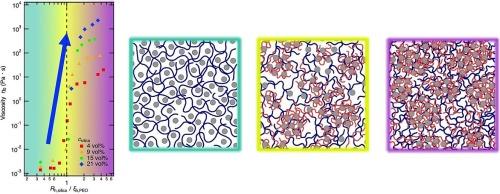
Understanding the interplay between polymer adsorption and colloidal interactions is essential for designing advanced materials with tailored properties. This study investigates the adsorption-driven aggregation and rheological transitions in semidilute mixtures of silica nanoparticles and high-molecular-weight poly(ethylene oxide) (PEO) in the protein limit, where the polymer’s size exceeds that of the particles. By systematically varying the ratio of the particle hydrodynamic size to the polymer’s hydrodynamic screening length (Rh,silica/ξh,PEO), distinct regimes of adsorption suppression, aggregation onset, and saturation were identified. Below Rh,silica/ξh,PEO = 1, adsorption was suppressed due to the entropic penalty of polymer distortion, resulting in negligible viscosity changes and stable particle dispersions. Near Rh,silica/ξh,PEO = 1, the adsorption energy overcame the entropy loss, triggering rapid aggregation and a sharp increase in viscosity, accompanied by the emergence of a slow relaxation mode in dynamic light scattering. At higher ratios (Rh,silica/ξh,PEO > 2), adsorption saturated, forming dense PEO-silica aggregates, as confirmed by small-angle neutron scattering. These findings challenge conventional theories of polymer adsorption and emphasize the critical role of polymer conformational entropy and adsorption energy balance. This study provides a framework for understanding polymer-mediated colloidal interactions in semidilute regimes, with implications for the rational design of polymer-colloid composites in materials science, biophysics, and industrial formulations.
期刊介绍:
The Journal of Colloid and Interface Science publishes original research findings on the fundamental principles of colloid and interface science, as well as innovative applications in various fields. The criteria for publication include impact, quality, novelty, and originality.
Emphasis:
The journal emphasizes fundamental scientific innovation within the following categories:
A.Colloidal Materials and Nanomaterials
B.Soft Colloidal and Self-Assembly Systems
C.Adsorption, Catalysis, and Electrochemistry
D.Interfacial Processes, Capillarity, and Wetting
E.Biomaterials and Nanomedicine
F.Energy Conversion and Storage, and Environmental Technologies



 京公网安备 11010802042870号
京ICP备2023020795号-1
京公网安备 11010802042870号
京ICP备2023020795号-1

 分享
分享
 求助内容:
求助内容: 应助结果提醒方式:
 扫码关注我们
